PaperarXiv:2510.02073
Inferring Optical Tissue Properties from Photoplethysmography using Hybrid Amortized Inference
arXiv preprint (cs.LG, physics.bio-ph, stat.ML)
 (opens in a new tab)
Behrmann, Jens et al., "Inferring Optical Tissue Properties from Photoplethysmography using Hybrid Amortized Inference", arXiv:2510.02073, CC BY 4.0
TL;DR
Smart wearables enable continuous tracking of established biomarkers such as heart rate, heart rate variability, and blood oxygen saturation via photoplethysmography (PPG). Beyond these metrics, PPG waveforms contain richer physiological information, as recent deep learning (DL) studies demonstrate. However, DL models often rely on features with unclear physiological meaning, creating a tension between predictive power, clinical interpretability, and sensor design.
- Form factor: other
Abstract
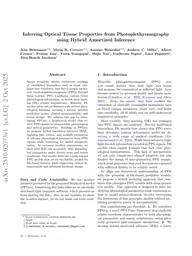
Smart wearables enable continuous tracking of established biomarkers such as heart rate, heart rate variability, and blood oxygen saturation via photoplethysmography (PPG). Beyond these metrics, PPG waveforms contain richer physiological information, as recent deep learning (DL) studies demonstrate. However, DL models often rely on features with unclear physiological meaning, creating a tension between predictive power, clinical interpretability, and sensor design. We address this gap by introducing PPGen, a biophysical model that relates PPG signals to interpretable physiological and optical parameters. Building on PPGen, we propose hybrid amortized inference (HAI), enabling fast, robust, and scalable estimation of relevant physiological parameters from PPG signals while correcting for model misspecification. In extensive in-silico experiments, we show that HAI can accurately infer physiological parameters under diverse noise and sensor conditions. Our results illustrate a path toward PPG models that retain the fidelity needed for DL-based features while supporting clinical interpretation and informed hardware design.
Verbatim from arXiv (opens in a new tab) · arXiv metadata (abstracts are released under CC0)
Results on ChatPPG leaderboards
All leaderboardsNo results from this paper on ChatPPG leaderboards yet. Browse the leaderboards.
Tasks & signals
Signals
Keywords
How it works
Cite this paper
APA
Behrmann, J., Cervera, M. R., Wehenkel, A., Miller, A. C., Cerussi, A., Jain, P., et al. (2025). Inferring Optical Tissue Properties from Photoplethysmography using Hybrid Amortized Inference. arXiv preprint. https://doi.org/10.48550/arXiv.2510.02073
BibTeX
@misc{behrmann2025inferring,
  title         = {{Inferring Optical Tissue Properties from Photoplethysmography using Hybrid Amortized Inference}},
  author        = {Behrmann, Jens and Cervera, Maria R. and Wehenkel, Antoine and Miller, Andrew C. and Cerussi, Albert and Jain, Pranay and others},
  year          = {2025},
  howpublished  = {arXiv preprint},
  doi           = {10.48550/arXiv.2510.02073},
  eprint        = {2510.02073},
  archivePrefix = {arXiv}
}
Built from the hub record. Check it against the publisher before submitting.
Added to the ChatPPG research hub