PaperarXiv:2609.33790
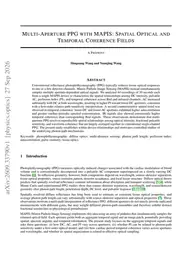
Multi-Aperture PPG with MAPIS: Spatial Optical and Temporal Coherence Fields
arXiv preprint
TL;DR
Matrix Pinhole Image Sensing (MAPIS): 4×9 multi-aperture reflectance PPG simultaneously sampling aperture-dependent optical fields. 44×30 s recordings on a single device; Red (655 nm) + IR (940 nm) @ 90 Hz, 36 apertures. Key within-device observations: AC grows sublinearly with DC (higher PI at lower-DC apertures); lower-DC/lower-AC apertures can show higher temporal coherence (ACF / cardiac-periodic power); IR more temporally coherent than Red on every matched aperture-record pair (median ACFIR−ACFR ≈ 0.087).
- Form factor: finger
Abstract
Conventional reflectance photoplethysmography (PPG) typically reduces tissue optical responses to one or a few detector channels. Matrix Pinhole Image Sensing (MAPIS) instead simultaneously samples multiple aperture-dependent optical signals. We analyzed 44 recordings of 30 seconds each from a single MAPIS device to characterize the spatial relationships among DC intensity, pulsatile AC, perfusion index (PI), and temporal coherence across Red and infrared channels. AC increased sublinearly with DC at both wavelengths, resulting in higher PI toward lower-DC apertures, consistent with a first-order relative path-sensitivity interpretation. A second counterintuitive spatial trend was observed in temporal coherence: lower-DC and lower-AC apertures exhibited higher autocorrelation and greater cardiac-periodic spectral concentration. IR signals also showed consistently higher temporal coherence than corresponding Red signals. These observations demonstrate that multi-aperture PPG resolves reproducible spatial relationships among optical intensity, fractional pulsatile sensitivity, and waveform coherence that are largely averaged together in conventional single-channel PPG. The present study establishes within-device relationships and motivates controlled studies of the underlying photon-path mechanisms.
Verbatim from arXiv (opens in a new tab) · arXiv metadata (abstracts are released under CC0)
Results on ChatPPG leaderboards
All leaderboardsNo results from this paper on ChatPPG leaderboards yet. Browse the leaderboards.
Tasks & signals
Tasks
Signals
Keywords
How it works
- Wavelengths
- red, IR
Cite this paper
APA
Wang, S., & Wang, Y. (2026). Multi-Aperture PPG with MAPIS: Spatial Optical and Temporal Coherence Fields. arXiv preprint. https://doi.org/10.48550/arXiv.2609.33790
BibTeX
@misc{wang2026multiaperture,
  title         = {{Multi-Aperture PPG with MAPIS: Spatial Optical and Temporal Coherence Fields}},
  author        = {Wang, Shuguang and Wang, Yuanjing},
  year          = {2026},
  howpublished  = {arXiv preprint},
  doi           = {10.48550/arXiv.2609.33790},
  eprint        = {2609.33790},
  archivePrefix = {arXiv}
}
Built from the hub record. Check it against the publisher before submitting.
Added to the ChatPPG research hub