PaperarXiv:2611.10739
Pulse waveform morphology encodes haemodynamic signatures of impending stroke
arXiv preprint (cs.AI)
TL;DR
Interpretable beat-level PPG morphology (timing, amplitude, contour, variability) separates the hours before in-hospital stroke recognition from stable windows: F1 0.941 (MIMIC-III, n=176) and 0.989 (MC-MED, n=154) at a nominal 360-min horizon, transferred unchanged. Dominated by systolic crest time vs each patient's own baseline.
- Form factor: clinical (ICU and emergency-department bedside PLETH)
Abstract
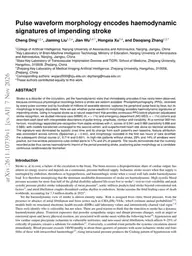
Stroke is a disorder of the circulation, yet the haemodynamic state that immediately precedes it has rarely been observed, because continuous physiological recordings before a stroke are seldom available. Photoplethysmography (PPG), recorded by every pulse oximeter and by hundreds of millions of wearable devices, captures the peripheral pulse beat by beat, but its morphology is largely discarded. Here we ask whether pulse waveform morphology encodes haemodynamic signatures of impending stroke. Using in-hospital stroke as a natural experiment that provides continuous PPG before physician-adjudicated stroke recognition, we studied intensive-care (MIMIC-III, n=176) and emergency-department (MC-MED, n=154) cohorts and described each beat with interpretable descriptors of pulse timing, amplitude, contour and variability. At a nominal 360-min horizon, morphology separated pre-recognition from stable windows with F_1 scores of 0.941 and 0.989 (sensitivity 0.998 and 0.980), with models transferred unchanged to the second cohort, and outperformed heart rate alone on identical windows. The signature was dominated by systolic crest time and its change from each patient's own baseline, feature attribution was concordant across cohorts (Spearman =0.865), and morphology recorded in the first two hours of care stratified the subsequent clinical course (F_1 0.714 and 0.691). In high-risk patients without stroke, 29% and 14% of windows were positive, but five-window persistence rules limited alerts to 17% and 2% of patients. The results demonstrate that the routinely recorded pulse thus carries haemodynamic imprint of the period preceding stroke, positioning pulse morphology as a candidate continuous cerebrovascular biomarker.
Verbatim from arXiv (opens in a new tab) · arXiv metadata (abstracts are released under CC0)
Results on ChatPPG leaderboards
All leaderboardsNo results from this paper on ChatPPG leaderboards yet. Browse the leaderboards.
Tasks & signals
Signals
Keywords
How it works
Cite this paper
Ding, C., Liu, J., Wu, J., Xu, H., & Zhang, D. (2026). Pulse waveform morphology encodes haemodynamic signatures of impending stroke. arXiv preprint. https://arxiv.org/abs/2611.10739
Ding, Cheng, Jiaming Liu, Jian Wu, Hongxia Xu, and Daoqiang Zhang. 2026. "Pulse waveform morphology encodes haemodynamic signatures of impending stroke." arXiv preprint. https://arxiv.org/abs/2611.10739.
Ding, C., Liu, J., Wu, J., Xu, H. and Zhang, D. (2026) 'Pulse waveform morphology encodes haemodynamic signatures of impending stroke', arXiv preprint. Available at: https://arxiv.org/abs/2611.10739
Ding, Cheng, et al. "Pulse waveform morphology encodes haemodynamic signatures of impending stroke." arXiv preprint, 2026. https://arxiv.org/abs/2611.10739.
C. Ding, J. Liu, J. Wu, H. Xu, and D. Zhang, "Pulse waveform morphology encodes haemodynamic signatures of impending stroke," arXiv preprint, 2026, [Online]. Available: https://arxiv.org/abs/2611.10739.
@misc{ding2026pulse,
  title         = {{Pulse waveform morphology encodes haemodynamic signatures of impending stroke}},
  author        = {Ding, Cheng and Liu, Jiaming and Wu, Jian and Xu, Hongxia and Zhang, Daoqiang},
  year          = {2026},
  howpublished  = {arXiv preprint},
  eprint        = {2611.10739},
  archivePrefix = {arXiv}
}Added to the ChatPPG research hub