Activity counts measure attention, not model quality. Missing counts are unknown. Publication status follows the linked source; a listed venue alone does not confirm peer review.
Held-out SeizeIT2 test (23 patients), frozen encoder + linear probe: AUPRC 0.3748 ± 0.0127, ROC-AUC 0.8025 ± 0.0071, balanced accuracy 0.7308 ± 0.0075. Random-init encoder AUPRC 0.3275; NeuroLM probe 0.2059 (medRxiv v2 Tables 3–4). Segment-level only.
- Signals
- ECG, IMU, EEG, EMG
- Form factor
- Head
- Year
- 2026
- Architecture
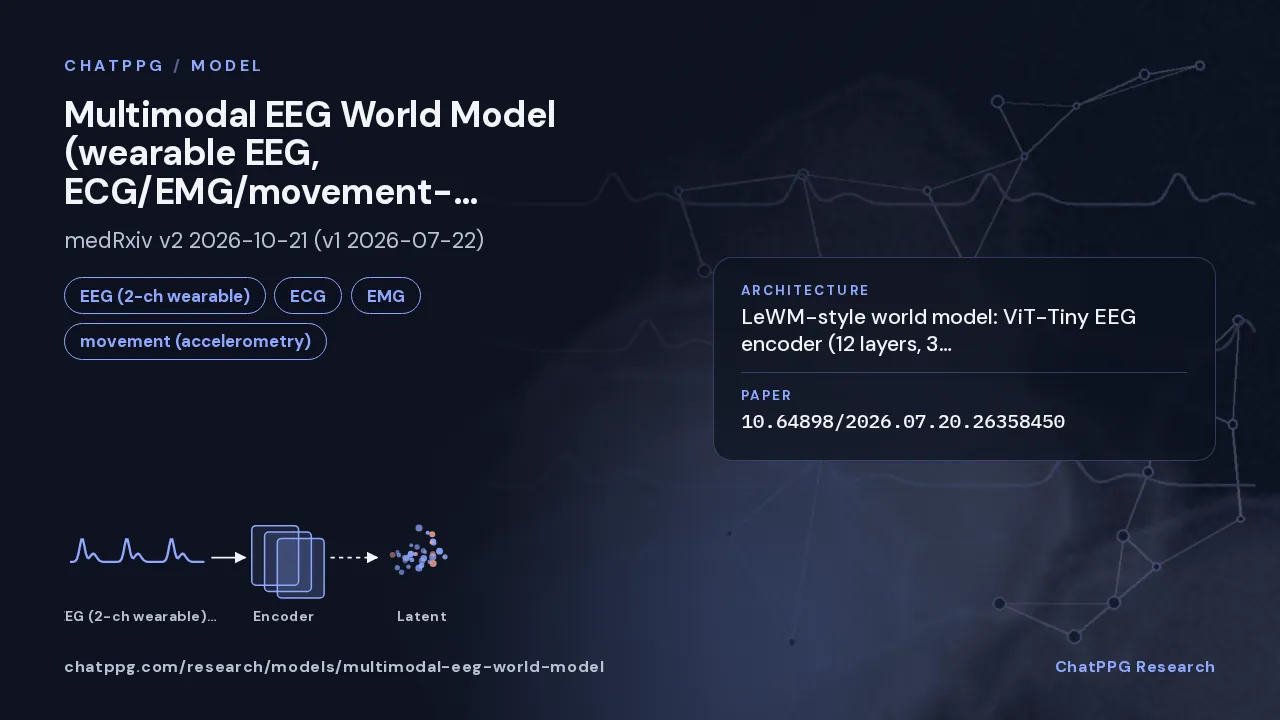
LeWM-style world model: ViT-Tiny EEG encoder (12 layers, 3 heads, d=192, patch 14) on 224x224 log-STFT of 5-s 2-ch EEG; separate ViT-Tiny ECG and EMG encoders (patch tokens) + 1-D conv movement tokenizer; 8-query cross-attention fusion to one condition vector; 6-layer/16-head transformer predictor with adaptive-LayerNorm conditioning predicts the next segment's EEG latent; loss = MSE + SIGReg
- Pretraining data
SeizeIT2 training subjects sub-001–096 (wearable behind-the-ear EEG + ECG + EMG + movement), no seizure labels
- License
No code or weights released or promised. Preprint all rights reserved.
- Type
- Task model
- Form factor
- Head
- Parameters
- Not reported
- Architecture
- LeWM-style world model: ViT-Tiny EEG encoder (12 layers, 3 heads, d=192, patch 14) on 224x224 log-STFT of 5-s 2-ch EEG; separate ViT-Tiny ECG and EMG encoders (patch tokens) + 1-D conv movement tokenizer; 8-query cross-attention fusion to one condition vector; 6-layer/16-head transformer predictor with adaptive-LayerNorm conditioning predicts the next segment's EEG latent; loss = MSE + SIGReg
- Venue
- medRxiv v2 2026-10-21 (v1 2026-07-22)
- Year
- 2026
- arXiv
- Not reported
- Code
- Not released
- Weights
- Not released
- Licence
- No code or weights released or promised. Preprint all rights reserved.
- Caveats
- Not reported
- Datasets
- Not reported
- Added
- Oct 21, 2026
- Updated
- Oct 26, 2026
Abstract
Existing supervised and self-supervised EEG models mainly learn discriminative or reconstructive representations within individual segments, while the transition information between adjacent EEG segments remains underexplored. In this study, we propose a Multimodal self-supervised EEG World Model for wearable seizure detection. Inspired by Le World Model, the proposed method encodes consecutive EEG segments into a shared latent space and predicts the next-segment latent representation from the current-segment representation conditioned on synchronized physiological information from ECG, EMG, and movement (MOV) signals. A learnable query-based fusion module aggregates the auxiliary multimodal representations into a compact physiological condition, while Sketched Isotropic Gaussian Regularization (SIGReg) is applied to stabilize the latent space and prevent representation collapse. After pretraining, only the pretrained EEG encoder is retained and frozen for linear binary probing, enabling EEG-only downstream seizure detection. We evaluated the proposed model on the SeizeIT2 wearable focal epilepsy dataset using a strict patient-wise training, validation, and test split. The proposed Multimodal EEG World Model achieved an AUPRC of 0.3748 ± 0.0127, ROC-AUC of 0.8025 ± 0.0071, and balanced accuracy of 0.7308 ± 0.0075, ranking first on these three metrics among the ablation studies. It also achieved the highest AUPRC, ROC-AUC, balanced accuracy, and F1-score among the evaluated external baselines. These findings demonstrate that synchronized multimodal physiological information can provide useful contextual information for latent EEG transition learning and improve wearable EEG representation learning.
Verbatim fromthe publisher's DOI record· Publisher licence: https://www.medrxiv.org/about/FAQ#license

Key results
How it works
- Pretraining data
- SeizeIT2 training subjects sub-001–096 (wearable behind-the-ear EEG + ECG + EMG + movement), no seizure labels
- Architecture
- LeWM-style world model: ViT-Tiny EEG encoder (12 layers, 3 heads, d=192, patch 14) on 224x224 log-STFT of 5-s 2-ch EEG; separate ViT-Tiny ECG and EMG encoders (patch tokens) + 1-D conv movement tokenizer; 8-query cross-attention fusion to one condition vector; 6-layer/16-head transformer predictor with adaptive-LayerNorm conditioning predicts the next segment's EEG latent; loss = MSE + SIGReg
- Inputs
- ECG, IMU, EEG, EMG
- Approach
- EEG · world model · JEPA · SIGReg · latent transition · multimodal conditioning
Datasets
Cite
APA
Yin, Z., Bai, Y., Zhou, L., Zhu, H., Moraros, J., Cheng, G., & Wang, S. (2026). Multimodal EEG World Model: Self-Supervised Latent Transition Learning for Wearable EEG Seizure Detection. medRxiv v2 2026-10-21. https://doi.org/10.64898/2026.07.20.26358450
BibTeX
@misc{yin2026multimodal,
  title         = {{Multimodal EEG World Model: Self-Supervised Latent Transition Learning for Wearable EEG Seizure Detection}},
  author        = {Yin, Ziyuan and Bai, Yifei and Zhou, Luqi and Zhu, Hongyi and Moraros, John and Cheng, Guangliang and Wang, Shuihua},
  year          = {2026},
  howpublished  = {medRxiv v2 2026-10-21},
  doi           = {10.64898/2026.07.20.26358450}
}
Built from the hub record. Check it against the publisher before submitting.
History
Record updated
Added to the ChatPPG research hub
Connections
Open in the graph explorerPapers
 A meta-learning method with reduced data requirements for training and updating deep learning models on wearable devicesShared topic: seizureCommunications Medicine · 2026
 A Multidimensional Data-Driven Hybrid Transformer Framework for Non-invasive Continuous Blood Pressure PredictionSame task: Pulse arrival timearXiv preprint · 2026
 Dynamic beat-to-beat blood pressure estimation using a multi-modal wearable deep learning approachSame task: Pulse arrival timePhysiological Measurement 47 · 2026