PaperarXiv:2610.28693
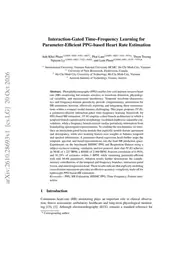
Interaction-Gated Time-Frequency Learning for Parameter-Efficient PPG-Based Heart Rate Estimation
arXiv 2610.28693v1 (cs.LG), submitted 2026-10-20; comment: accepted at SoICT 2026
Licence: arXiv preprint
 (opens in a new tab)
Pham, Anh Khoi et al., "Interaction-Gated Time-Frequency Learning for Parameter-Efficient PPG-Based Heart Rate Estimation", arXiv:2610.28693, CC BY 4.0
TL;DR
Temporal branch (dilated depthwise-separable convolutions on the pulse waveform) + frequency branch (bounded log-spectrogram). Interaction-gated fusion models agreement and discrepancy between the two branches and learns feature-wise weights; a parameter-shared head maps temporal, spectral and fused features to HR.
- Form factor: clinical
Abstract
Photoplethysmography (PPG) enables low-cost and non-invasive heart rate (HR) monitoring but remains sensitive to waveform distortion, physiological variability, and measurement interference. Temporal waveform characteristics and frequency-domain periodicity provide complementary information for HR estimation; however, effectively exploring and integrating these representations within a compact model remains challenging. This paper proposes TF-IG, a parameter-efficient interaction-gated time-frequency learning framework for PPG-based HR estimation. TF-IG employs a dual-branch architecture in which a temporal branch captures pulse morphology via dilated depthwise-separable convolutions, while a frequency branch extracts cardiac periodicity information from bounded log-spectrogram representations. To combine the two domains, we introduce an interaction-gated fusion module that explicitly models feature agreement and discrepancy, while also learning feature-wise weights to balance temporal and spectral information. A parameter-shared regression head further maps the temporal, spectral, and fused representations into the final HR prediction space. Experiments on the benchmark BIDMC PPG and Respiration Dataset using a subject-exclusive training, validation, and test protocol show that TF-IG achieves a mean absolute error (MAE) of 1.227 BPM, a root mean square error (RMSE) of 2.060 BPM, a Pearson correlation coefficient of 0.9934, and 92.28 percent of estimates within 3 BPM, while remaining parameter-efficient with only 84.6K parameters. Ablation results further demonstrate the complementary contributions of the temporal and frequency branches, interaction-gated fusion, and shared regression head. These results indicate that explicitly modeling cross-domain interactions provides an effective accuracy-complexity trade-off for lightweight PPG-based HR estimation.
Verbatim from arXiv (opens in a new tab) · arXiv metadata (abstracts are released under CC0)
Results on ChatPPG leaderboards · 1
All leaderboards| Leaderboard | Method | Result | Rank |
|---|---|---|---|
| BIDMC MAE (BPM)Heart rate estimation | TF-IG | 1.227MAE (BPM), lower is better | #1 of 1 |
1 row is credited to this paper. Ranks apply within each leaderboard only, as reported by the source.
Tasks & signals
Tasks
Signals
Keywords
Datasets

How it works
Cite this paper
APA
Pham, A. K., Lam, P., Ly, T. T. N., & Pham, L. (2026). Interaction-Gated Time-Frequency Learning for Parameter-Efficient PPG-Based Heart Rate Estimation. arXiv 2610.28693v1 , submitted 2026-10-20. https://arxiv.org/abs/2610.28693
BibTeX
@misc{pham2026interactiongated,
  title         = {{Interaction-Gated Time-Frequency Learning for Parameter-Efficient PPG-Based Heart Rate Estimation}},
  author        = {Pham, Anh Khoi and Lam, Phat and Ly, Thien Truong Nguyen and Pham, Lam},
  year          = {2026},
  howpublished  = {arXiv 2610.28693v1 , submitted 2026-10-20},
  eprint        = {2610.28693},
  archivePrefix = {arXiv}
}
Built from the hub record. Check it against the publisher before submitting.
Added to the ChatPPG research hub