PaperarXiv:2404.06869
SleepPPG-Net2: Deep learning generalization for sleep staging from photoplethysmography
arXiv preprint (cs.LG, cs.AI, eess.SP)
 (opens in a new tab)
Attia, Shirel et al., "SleepPPG-Net2: Deep learning generalization for sleep staging from photoplethysmography", arXiv:2404.06869, CC BY 4.0
TL;DR
Background: Sleep staging is a fundamental component in the diagnosis of sleep disorders and the management of sleep health. Traditionally, this analysis is conducted in clinical settings and involves a time-consuming scoring procedure. Recent data-driven algorithms for sleep staging, using the photoplethysmogram (PPG) time series, have shown high performance on local test sets but lower performance on external datasets due to data drift.
- Form factor: other
Abstract
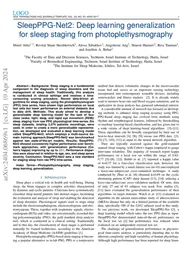
Background: Sleep staging is a fundamental component in the diagnosis of sleep disorders and the management of sleep health. Traditionally, this analysis is conducted in clinical settings and involves a time-consuming scoring procedure. Recent data-driven algorithms for sleep staging, using the photoplethysmogram (PPG) time series, have shown high performance on local test sets but lower performance on external datasets due to data drift. Methods: This study aimed to develop a generalizable deep learning model for the task of four class (wake, light, deep, and rapid eye movement (REM)) sleep staging from raw PPG physiological time-series. Six sleep datasets, totaling 2,574 patients recordings, were used. In order to create a more generalizable representation, we developed and evaluated a deep learning model called SleepPPG-Net2, which employs a multi-source domain training approach.SleepPPG-Net2 was benchmarked against two state-of-the-art models. Results: SleepPPG-Net2 showed consistently higher performance over benchmark approaches, with generalization performance (Cohen's kappa) improving by up to 19%. Performance disparities were observed in relation to age, sex, and sleep apnea severity. Conclusion: SleepPPG-Net2 sets a new standard for staging sleep from raw PPG time-series.
Verbatim from arXiv (opens in a new tab) · arXiv metadata (abstracts are released under CC0)
Results on ChatPPG leaderboards
All leaderboardsNo results from this paper on ChatPPG leaderboards yet. Browse the leaderboards.
Tasks & signals
Tasks
Signals
Keywords
How it works
Cite this paper
APA
Attia, S., Hershkovich, R. S., Tabakhov, A., Ang, A., Haimov, S., Tauman, R., et al. (2024). SleepPPG-Net2: Deep learning generalization for sleep staging from photoplethysmography. arXiv preprint. https://doi.org/10.48550/arXiv.2404.06869
BibTeX
@misc{attia2024sleepppgnet2,
  title         = {{SleepPPG-Net2: Deep learning generalization for sleep staging from photoplethysmography}},
  author        = {Attia, Shirel and Hershkovich, Revital Shani and Tabakhov, Alissa and Ang, Angeleene and Haimov, Sharon and Tauman, Riva and others},
  year          = {2024},
  howpublished  = {arXiv preprint},
  doi           = {10.48550/arXiv.2404.06869},
  eprint        = {2404.06869},
  archivePrefix = {arXiv}
}
Built from the hub record. Check it against the publisher before submitting.
Added to the ChatPPG research hub