PaperarXiv:2202.05735
SleepPPG-Net: a deep learning algorithm for robust sleep staging from continuous photoplethysmography
IEEE Journal of Biomedical and Health Informatics (also arXiv cs.LG / eess.SP)
 (opens in a new tab)
Kotzen, Kevin et al., "SleepPPG-Net: a deep learning algorithm for robust sleep staging from continuous photoplethysmography", arXiv:2202.05735, CC BY 4.0
TL;DR
Landmark raw-PPG 4-class (wake / light / deep / REM) sleep staging model. Trained end-to-end with a residual CNN feature extractor plus temporal CNN for long-range context on public sleep databases with raw PPG (MESA train/test; SHHS ECG used for related pretraining lineage; CFS for external generalization), totalling ~2,374 patients / ~23,055 hours across the reported PPG-containing sets. Held-out median Cohen’s κ 0.75 vs 0.69 for the best compared SOTA feature-based approach; external κ 0.74 after transfer learning.
- Form factor: other
Abstract
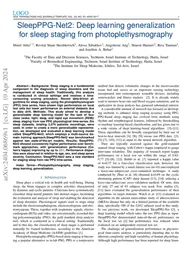
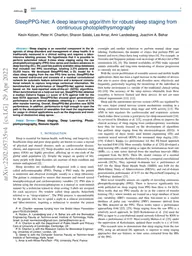
Introduction: Sleep staging is an essential component in the diagnosis of sleep disorders and management of sleep health. It is traditionally measured in a clinical setting and requires a labor-intensive labeling process. We hypothesize that it is possible to perform robust 4-class sleep staging using the raw photoplethysmography (PPG) time series and modern advances in deep learning (DL). Methods: We used two publicly available sleep databases that included raw PPG recordings, totalling 2,374 patients and 23,055 hours. We developed SleepPPG-Net, a DL model for 4-class sleep staging from the raw PPG time series. SleepPPG-Net was trained end-to-end and consists of a residual convolutional network for automatic feature extraction and a temporal convolutional network to capture long-range contextual information. We benchmarked the performance of SleepPPG-Net against models based on the best-reported state-of-the-art (SOTA) algorithms. Results: When benchmarked on a held-out test set, SleepPPG-Net obtained a median Cohen's Kappa () score of 0.75 against 0.69 for the best SOTA approach. SleepPPG-Net showed good generalization performance to an external database, obtaining a score of 0.74 after transfer learning. Perspective: Overall, SleepPPG-Net provides new SOTA performance. In addition, performance is high enough to open the path to the development of wearables that meet the requirements for usage in clinical applications such as the diagnosis and monitoring of obstructive sleep apnea.
Verbatim from arXiv (opens in a new tab) · arXiv metadata (abstracts are released under CC0)
Results on ChatPPG leaderboards
All leaderboardsNo results from this paper on ChatPPG leaderboards yet. Browse the leaderboards.
Tasks & signals
Tasks
Signals
Keywords
How it works
Cite this paper
APA
Kotzen, K., Charlton, P. H., Salabi, S., Amar, L., Landesberg, A., & Behar, J. A. (2023). SleepPPG-Net: a deep learning algorithm for robust sleep staging from continuous photoplethysmography. IEEE Journal of Biomedical and Health Informatics. https://doi.org/10.1109/JBHI.2022.3225363
BibTeX
@article{kotzen2023sleepppgnet,
  title         = {{SleepPPG-Net: a deep learning algorithm for robust sleep staging from continuous photoplethysmography}},
  author        = {Kotzen, Kevin and Charlton, Peter H. and Salabi, Sharon and Amar, Lea and Landesberg, Amir and Behar, Joachim A.},
  year          = {2023},
  journal       = {IEEE Journal of Biomedical and Health Informatics},
  doi           = {10.1109/JBHI.2022.3225363},
  eprint        = {2202.05735},
  archivePrefix = {arXiv}
}
Built from the hub record. Check it against the publisher before submitting.
Added to the ChatPPG research hub