Paperdoi:10.1038/s41586-026-10507-6
Passive Heart-Rate Monitoring During Smartphone Use in Everyday Life
 (opens in a new tab)
Shun Liao et al., "Passive heart-rate monitoring during smartphone use in everyday life", doi:10.1038/s41586-026-10507-6, CC BY-NC-ND 4.0
TL;DR
Demonstrates passive heart-rate estimation from smartphone camera video in everyday settings using rPPG, with large-scale real-world validation. Open-source code is available from the Google Health consumer-health-research repository.
- Form factor: camera_rppg
Abstract
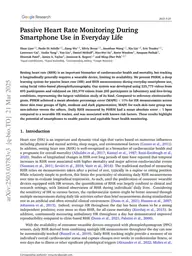
Resting heart rate (RHR) is a key biomarker of cardiovascular health and mortality1-3, but passively tracking it longitudinally generally requires a wearable device, limiting its availability. Here we present passive heart-rate monitoring (PHRM), a deep-learning system that uses facial video-based photoplethysmography for passive measurements of heart rate (HR) and RHR during everyday smartphone interactions. Our system was developed using 192,353 videos from 485 participants and validated on 162,546 videos from 211 participants in laboratory and free-living conditions, representing, to our knowledge, the largest validation study of its kind. PHRM outperformed state-of-the-art methods on our benchmarks. Compared with reference electrocardiograms, PHRM achieved a mean absolute percentage error (MAPE) lower than 10% for HR measurements across three skin-tone groups of light, medium and dark pigmentation, meeting industry accuracy standards; MAPE for each skin-tone group was non-inferior versus the others. Daily RHR measured by PHRM had a mean absolute error of less than five beats per minute, compared with a wearable HR tracker, and was associated with known risk factors for cardiovascular disease. These results highlight the potential of smartphones for enabling passive and equitable monitoring of heart health. To facilitate further research, we publicly release a large, annotated smartphone video dataset along with a pre-trained HR model.
Verbatim from Europe PMC (opens in a new tab) · Licence: cc by-nc-nd
Results on ChatPPG leaderboards
All leaderboardsNo results from this paper on ChatPPG leaderboards yet. Browse the leaderboards.
Tasks & signals
Tasks
Signals
Keywords
How it works
- Wavelengths
- RGB
Cite this paper
APA
Passive Heart-Rate Monitoring During Smartphone Use in Everyday Life. (2026). https://doi.org/10.1038/s41586-026-10507-6
BibTeX
@misc{passivehrsmartph2026passive,
  title         = {{Passive Heart-Rate Monitoring During Smartphone Use in Everyday Life}},
  year          = {2026},
  doi           = {10.1038/s41586-026-10507-6}
}
Built from the hub record. Check it against the publisher before submitting.
Record updated
Added to the ChatPPG research hub