PaperarXiv:2510.13068
NeuroRVQ: Multi-Scale Biosignal Tokenization for Generative Foundation Models
arXiv preprint
TL;DR
Content is limited to the arXiv record (2510.13068v4, read 2026-10-17); no numbers beyond the abstract.
Abstract
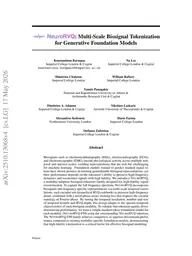
Biosignals such as electroencephalography (EEG), electrocardiography (ECG), and electromyography (EMG) encode physiological activity across multiple temporal and spectral scales, yielding representations that are rich but challenging for machine learning. Foundation models trained to predict masked signal tokens have shown promise in learning generalizable biosignal representations, yet their performance depends on the tokenizer's ability to preserve high-frequency dynamics and reconstruct signals with high fidelity. We introduce NeuroRVQ, a modality-adaptive biosignal tokenizer family designed for high-fidelity signal reconstruction. To capture the full frequency spectrum, NeuroRVQ decomposes biosignals into frequency-specific representations via multi-scale temporal convolutions, each encoded into hierarchical RVQ codebooks to preserve high-frequency detail, combined with a novel phase-aware training loss that respects the circular topology of Fourier phase. By tuning the temporal resolution, number and size of temporal kernels and RVQ depth, this design adapts to the spectro-temporal characteristics of each biosignal modality. To validate that tokenizer quality drives downstream performance, we train a simple masked-token foundation model for each modality (NeuroRVQ-FM) using the corresponding NeuroRVQ tokenizer. The NeuroRVQ-FM family achieves competitive or superior downstream performance compared to existing modality-specific foundation models, demonstrating that high-fidelity tokenization is a critical factor for effective biosignal modeling.
Verbatim from arXiv (opens in a new tab) · arXiv metadata (abstracts are released under CC0)
Results on ChatPPG leaderboards
All leaderboardsNo results from this paper on ChatPPG leaderboards yet. Browse the leaderboards.
Tasks & signals
Signals
Keywords
Datasets
Models
How it works
Cite this paper
APA
Barmpas, K., Lee, N., Chalatsis, D., Raftery, W., Panagakis, Y., Adamos, D. A., Laskaris, N., Koliousis, A., Farina, D., & Zafeiriou, S. (2025). NeuroRVQ: Multi-Scale Biosignal Tokenization for Generative Foundation Models. arXiv preprint. https://arxiv.org/abs/2510.13068
BibTeX
@misc{barmpas2025neurorvq,
  title         = {{NeuroRVQ: Multi-Scale Biosignal Tokenization for Generative Foundation Models}},
  author        = {Barmpas, Konstantinos and Lee, Na and Chalatsis, Dimitrios and Raftery, William and Panagakis, Yannis and Adamos, Dimitrios A. and Laskaris, Nikolaos and Koliousis, Alexandros and Farina, Dario and Zafeiriou, Stefanos},
  year          = {2025},
  howpublished  = {arXiv preprint},
  eprint        = {2510.13068},
  archivePrefix = {arXiv}
}
Built from the hub record. Check it against the publisher before submitting.
Added to the ChatPPG research hub