PaperarXiv:2607.08001
Low-Rate Wrist SpO2 Estimation under Micro-Perturbations Using Motion-Aware Beat Selection and Perfusion-Guided Calibration
arXiv preprint (eess.SP)
 (opens in a new tab)
Liang, Zequan et al., "Low-Rate Wrist SpO2 Estimation under Micro-Perturbations Using Motion-Aware Beat Selection and Perfusion-Guided Calibration", arXiv:2607.08001, CC BY 4.0
TL;DR
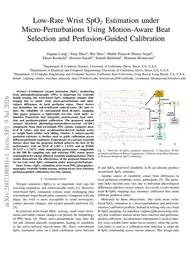
Continuous oxygen saturation (SPO2) monitoring from photoplethysmography (PPG) is important for wearable health sensing, but wrist-based SPO2 estimation remains challenging due to subtle wrist micro-perturbations and inter-subject differences in local perfusion status. These factors can destabilize the red-to-infrared ratio-of-ratios (R) and reduce the reliability of conventional fixed R-SPO2 mapping. This paper proposes a lightweight low-rate wrist SPO2 estimation framework that integrates motion-aware beat selection and perfusion-guided calibration.
- Form factor: wrist
Abstract
Continuous oxygen saturation (SPO2) monitoring from photoplethysmography (PPG) is important for wearable health sensing, but wrist-based SPO2 estimation remains challenging due to subtle wrist micro-perturbations and inter-subject differences in local perfusion status. These factors can destabilize the red-to-infrared ratio-of-ratios (R) and reduce the reliability of conventional fixed R-SPO2 mapping. This paper proposes a lightweight low-rate wrist SPO2 estimation framework that integrates motion-aware beat selection and perfusion-guided calibration. The proposed method extracts beat-level alternating-current/direct-current (AC/DC) components from dual-wavelength PPG signals, computes beat-level R values, and uses accelerometer-derived motion scores to weight beats within each sliding window. A subject-specific perfusion reference is further used to guide calibration across different perfusion conditions. Experiments on a private wearable dataset show that the proposed method achieves the best 25 Hz performance, with an MAE of 2.3051.113% and an RMSE of 3.1171.743%, while maintaining performance comparable to the 100 Hz sampling rate and reducing PPG sensor power consumption for energy-efficient wearable implementation. These results demonstrate the effectiveness of the proposed framework for low-rate wrist SPO2 estimation under micro-perturbations.
Verbatim from arXiv (opens in a new tab) · arXiv metadata (abstracts are released under CC0)
Results on ChatPPG leaderboards
All leaderboardsNo results from this paper on ChatPPG leaderboards yet. Browse the leaderboards.
Tasks & signals
Tasks
Signals
Keywords
How it works
- Wavelengths
- red, IR
Cite this paper
APA
Liang, Z., Miao, N., Shao, W., Nejad, M. P. S., Kourkchi, E., Sayadi, H., et al. (2026). Low-Rate Wrist SpO2 Estimation under Micro-Perturbations Using Motion-Aware Beat Selection and Perfusion-Guided Calibration. arXiv preprint. https://doi.org/10.48550/arXiv.2607.08001
BibTeX
@misc{liang2026lowrate,
  title         = {{Low-Rate Wrist SpO2 Estimation under Micro-Perturbations Using Motion-Aware Beat Selection and Perfusion-Guided Calibration}},
  author        = {Liang, Zequan and Miao, Ning and Shao, Wei and Nejad, Mahdi Pirayesh Shirazi and Kourkchi, Ehsan and Sayadi, Hossein and others},
  year          = {2026},
  howpublished  = {arXiv preprint},
  doi           = {10.48550/arXiv.2607.08001},
  eprint        = {2607.08001},
  archivePrefix = {arXiv}
}
Built from the hub record. Check it against the publisher before submitting.
Added to the ChatPPG research hub