PaperarXiv:2608.26000
CardioFusion-AI: Robust ECG--PPG Fusion for Multimodal Physiological Monitoring Under Signal Degradation
arXiv preprint (eess.SP, cs.LG, q-bio.QM) · 7 pages, 4 figures. Under review at IEEE Journal of Biomedical and Health Informatics. Code: https://github.com/ka-cyber/CardioFusion-AI
TL;DR
Wearable electrocardiogram (ECG) and photoplethysmogram (PPG) sensors are complementary but individually fragile: motion artifact, poor contact, and sensor dropout can degrade one or both signals. Fusion strategies that assume both modalities are equally trustworthy can become less reliable than a single clean modality under degradation.
- Form factor: other
Abstract
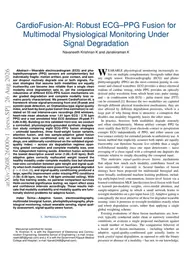
Wearable electrocardiogram (ECG) and photoplethysmogram (PPG) sensors are complementary but individually fragile: motion artifact, poor contact, and sensor dropout can degrade one or both signals. Fusion strategies that assume both modalities are equally trustworthy can become less reliable than a single clean modality under degradation. We present CardioFusion-AI, a framework whose signal-processing front end, including R-peak and systolic-peak detection, an Orphanidou-type signal-quality index, and beat-by-beat pulse transit time estimation, is validated on 53 real intensive-care recordings (848 windows; heart-rate mean absolute error 1.61 bpm for ECG and 2.78 bpm for PPG) and a real annotated fetal ECG database (R-peak F1 0.89-0.98). We then conduct a controlled synthetic degradation study comparing eight ECG-PPG fusion strategies across six degradation regimes spanning graded corruption and complete modality loss, using five independent training seeds. Attention fusion achieved the lowest descriptive overall error (1.66+/-0.43 bpm). Both adaptive gates reallocated weight toward the healthy modality under complete modality loss, but showed near-zero correlation between gate weight and signal quality under graded degradation (r = 0.10-0.24). Signal-quality conditioning produced a specific improvement under missing-PPG conditions (1.56+/-0.59 bpm), approaching the 1.48 bpm unimodal ceiling. With only five training seeds, no pairwise comparison survives Holm-corrected significance testing; effect sizes and confidence intervals are therefore reported. These results indicate that modality availability and modality quality are functionally distinct problems for adaptive fusion.
Verbatim from arXiv (opens in a new tab) · arXiv metadata (abstracts are released under CC0)
Results on ChatPPG leaderboards
All leaderboardsNo results from this paper on ChatPPG leaderboards yet. Browse the leaderboards.
Tasks & signals
Signals
Keywords
How it works
Cite this paper
APA
Kamalakannan, N. K., & Kamalakannan, J. (2026). CardioFusion-AI: Robust ECG--PPG Fusion for Multimodal Physiological Monitoring Under Signal Degradation. arXiv preprint · 7 pages, 4 figures. Under review at IEEE Journal of Biomedical and Health Informatics. Code: https://github.com/ka-cyber/CardioFusion-AI. https://doi.org/10.48550/arXiv.2608.26000
BibTeX
@misc{kamalakannan2026cardiofusionai,
  title         = {{CardioFusion-AI: Robust ECG--PPG Fusion for Multimodal Physiological Monitoring Under Signal Degradation}},
  author        = {Kamalakannan, Navaneetha Krishnan and Kamalakannan, Janakiraman},
  year          = {2026},
  howpublished  = {arXiv preprint · 7 pages, 4 figures. Under review at IEEE Journal of Biomedical and Health Informatics. Code: https://github.com/ka-cyber/CardioFusion-AI},
  doi           = {10.48550/arXiv.2608.26000},
  eprint        = {2608.26000},
  archivePrefix = {arXiv}
}
Built from the hub record. Check it against the publisher before submitting.
Record updated
Added to the ChatPPG research hub