Paperdoi:10.3389/fdgth.2026.1978726
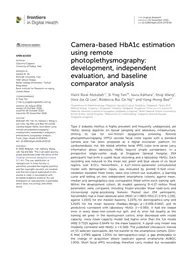
Camera-based HbA1c estimation using remote photoplethysmography: development, independent evaluation, and baseline comparator analysis
Frontiers in Digital Health
 (opens in a new tab)
Hairil Rizal Abdullah et al., "Camera-based HbA1c estimation using remote photoplethysmography: development, independent evaluation, and baseline comparator analysis", doi:10.3389/fdgth.2026.1978726, CC BY 4.0
TL;DR
NervoHbA1c (4.27M CNN + demographics) on facial rPPG RGB means (8.53 s, 6 ROIs); n=254 SGH. Pooled MAE 1.081% HbA1c vs median 1.230% / demographics 1.237% (p=0.008–0.042); r=0.505. Webcam checkpoint fails on smartphone cohorts (device shift).
- Form factor: camera
Abstract
Type 2 diabetes mellitus is highly prevalent and frequently undiagnosed, yet HbA1c testing depends on blood sampling and laboratory infrastructure, limiting its use for low-friction dysglycemia screening. Remote photoplethysmography (rPPG) records facial color signals with a standard camera and has been proposed as a digital biomarker platform for cardiometabolic risk. We tested whether facial rPPG color time series carry information about laboratory HbA1c beyond simple comparators. In a prospective single-center study at Singapore General Hospital, 254 participants had both a usable facial recording and a laboratory HbA1c. Each recording was reduced to the mean red, green and blue values of six facial regions over 8.53 s. NervoHbA1c, a 4.27-million-parameter convolutional model with demographic inputs, was evaluated by pooled 5-fold cross-validation repeated three times, leave-one-cohort-out evaluation, a learning curve and testing on two independent smartphone cohorts, against mean, median and demographics-only comparators fitted within each training split. Within the development cohort, 16 models spanning 0–4.27 million fitted parameters were compared, including frozen-encoder linear read-outs and conventional signal-processing features. Pooled over 254 participants, NervoHbA1c had a mean absolute error (MAE) of 1.081% (95% CI 0.973–1.193), against 1.230% for the median baseline, 1.237% for demographics-only and 1.254% for the mean baseline ( N adeau–Bengio p = 0.008–0.042), and its predictions correlated with laboratory HbA1c ( r = 0.505). It had the lowest error in every leave-one-cohort-out split, and its error fell steadily as the training set grew. In the development cohort, error decreased with model capacity: every lower-capacity model had higher error than the full model (MAE 0.732% against 0.844% for the mean baseline). A signal-only model was modestly correlated with HbA1c ( r = 0.368). The published checkpoint, trained on 53 webcam participants, did not transfer to the smartphone cohorts (SGH-6 MAE 1.478% against 1.205% for demographics-only), a gap attributable to the change of acquisition device (webcam against smartphone AUROC 1.000). Short facial rPPG recordings therefore carry modest but recoverable information about HbA1c beyond demographics when the training data match the acquisition device. Participant-level evaluation, cross-cohort testing and simple comparators are needed before camera-based digital biomarkers advance toward clinical use, and a larger full-precision cohort is planned.
Verbatim from the publisher's DOI record (opens in a new tab) · Publisher licence: https://creativecommons.org/licenses/by/4.0/
Results on ChatPPG leaderboards
All leaderboardsNo results from this paper on ChatPPG leaderboards yet. Browse the leaderboards.
Tasks & signals
Signals
Keywords
How it works
Cite this paper
Abdullah, H. R., Tan, S. Y., Kalhara, I., Wang, S., Lee, V. J. Q., Ng, R. R. G., & Bee, Y. M. (2026). Camera-based HbA1c estimation using remote photoplethysmography: development, independent evaluation, and baseline comparator analysis. Frontiers in Digital Health. https://doi.org/10.3389/fdgth.2026.1978726
Abdullah, Hairil Rizal, Si Ying Tan, Isuru Kalhara, Shiqi Wang, Vera Jia Qi Lee, Roderica Rui Ge Ng, and Yong Mong Bee. 2026. "Camera-based HbA1c estimation using remote photoplethysmography: development, independent evaluation, and baseline comparator analysis." Frontiers in Digital Health. https://doi.org/10.3389/fdgth.2026.1978726.
Abdullah, H. R., Tan, S. Y., Kalhara, I., Wang, S., Lee, V. J. Q., Ng, R. R. G. and Bee, Y. M. (2026) 'Camera-based HbA1c estimation using remote photoplethysmography: development, independent evaluation, and baseline comparator analysis', Frontiers in Digital Health. doi: 10.3389/fdgth.2026.1978726.
Abdullah, Hairil Rizal, et al. "Camera-based HbA1c estimation using remote photoplethysmography: development, independent evaluation, and baseline comparator analysis." Frontiers in Digital Health, 2026. https://doi.org/10.3389/fdgth.2026.1978726.
H. R. Abdullah et al., "Camera-based HbA1c estimation using remote photoplethysmography: development, independent evaluation, and baseline comparator analysis," Frontiers in Digital Health, 2026, doi: 10.3389/fdgth.2026.1978726.
@article{abdullah2026camerabased,
  title         = {{Camera-based HbA1c estimation using remote photoplethysmography: development, independent evaluation, and baseline comparator analysis}},
  author        = {Abdullah, Hairil Rizal and Tan, Si Ying and Kalhara, Isuru and Wang, Shiqi and Lee, Vera Jia Qi and Ng, Roderica Rui Ge and Bee, Yong Mong},
  year          = {2026},
  journal       = {Frontiers in Digital Health},
  doi           = {10.3389/fdgth.2026.1978726}
}Added to the ChatPPG research hub