Activity counts measure attention, not model quality. Missing counts are unknown. Publication status follows the linked source; a listed venue alone does not confirm peer review.
Average macro-F1 over a plain MAE baseline: +2.56 (broad multi-label), +4.85 (morphology), +12.80 (rhythm) across nine downstream tasks. No comparison with published ECG FMs in the abstract, so no board row.
- Signals
- ECG
- Form factor
- Any
- Year
- 2026
- Architecture
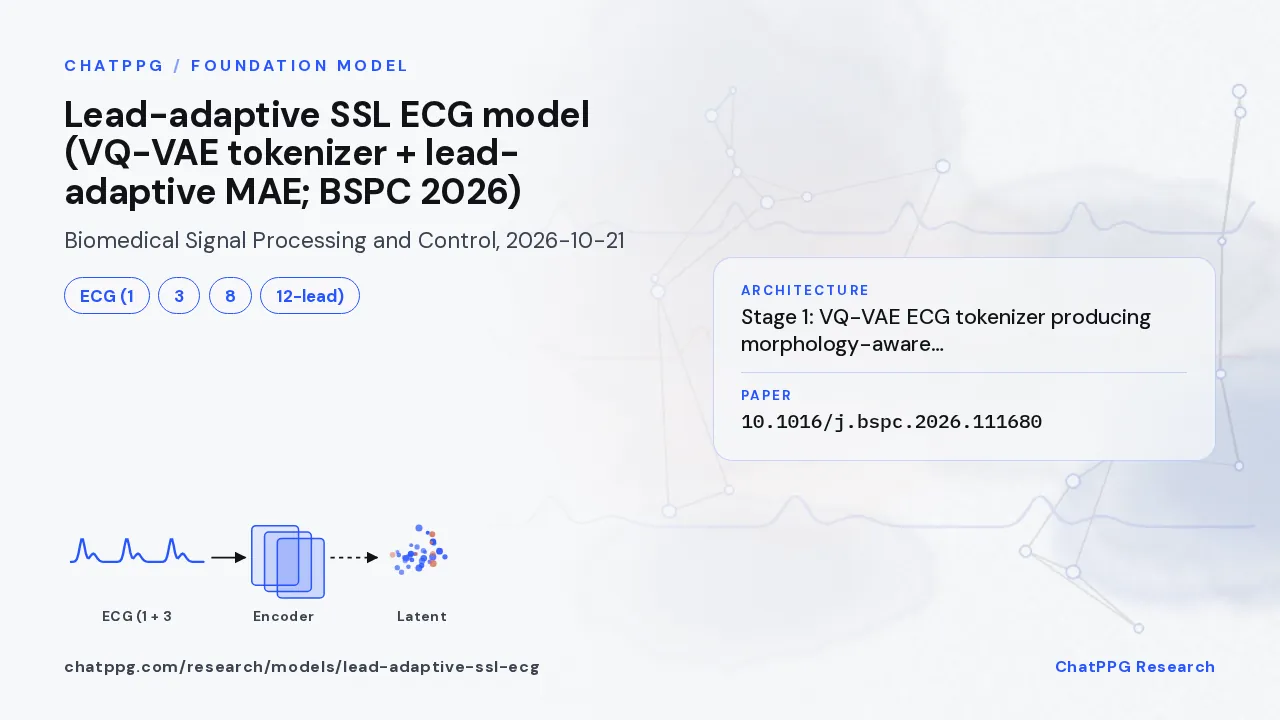
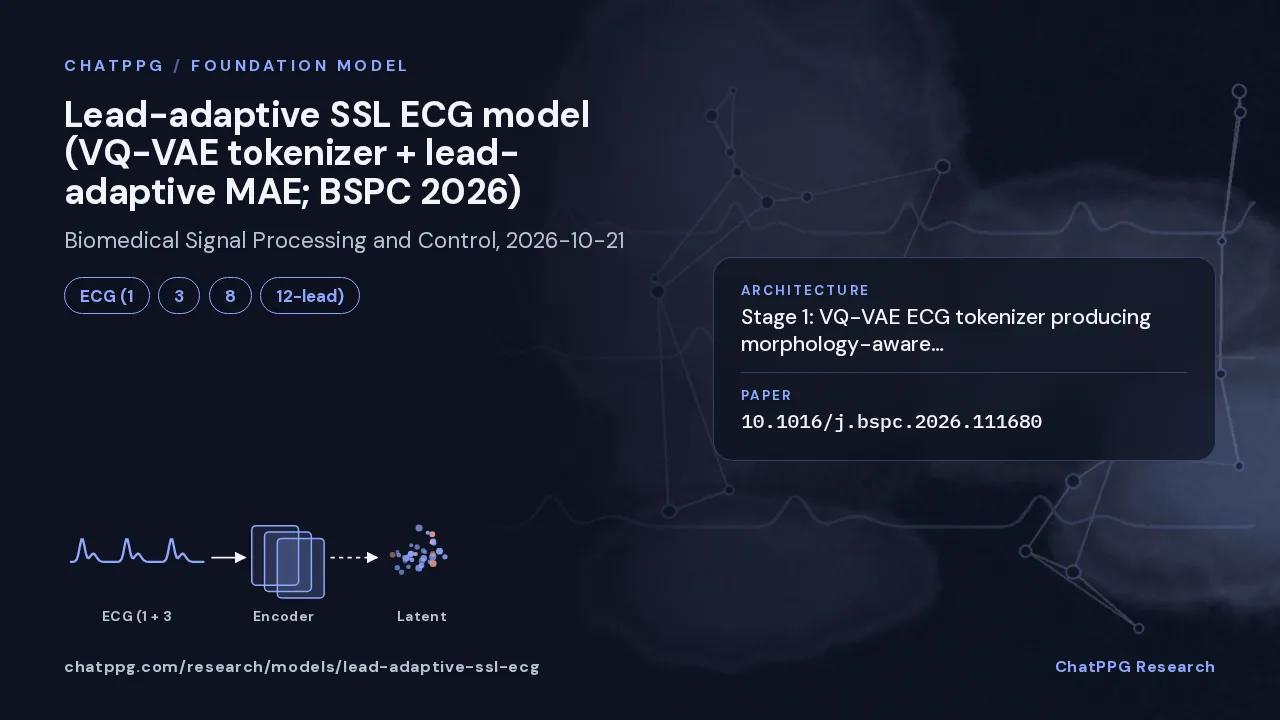
Stage 1: VQ-VAE ECG tokenizer producing morphology-aware waveform tokens with patch and lead-time positional encodings. Stage 2: masked autoencoder with an adaptive-lead training algorithm so one backbone accepts 1-, 3-, 8- and 12-lead input (paper-reported description)
- Pretraining data
178,602 multi-center ECG records (sources not named in the abstract)
- Type
- Foundation model
- Modalities
- ECG
- Form factor
- Any
- Parameters
- Not reported
- Architecture
- Stage 1: VQ-VAE ECG tokenizer producing morphology-aware waveform tokens with patch and lead-time positional encodings. Stage 2: masked autoencoder with an adaptive-lead training algorithm so one backbone accepts 1-, 3-, 8- and 12-lead input (paper-reported description)
- Venue
- Biomedical Signal Processing and Control, 2026-10-21
- Year
- 2026
- arXiv
- Not reported
- Code
- Not released
- Weights
- Not released
- Licence
- Not reported
- Caveats
- Not reported
- Datasets
- Not reported
- Added
- Oct 22, 2026
- Updated
- Oct 26, 2026
Abstract
Background Electrocardiogram (ECG) is a critical non-invasive tool for the early detection of cardiovascular diseases. However, ECG interpretation remains challenging because of signal complexity, limited medical resources, and heterogeneous monitoring settings. Most deep learning models are still designed for specific tasks and fixed lead configurations, limiting their transfer across clinical and wearable ECG scenarios. Objective This study aims to develop a lead-adaptive self-supervised ECG representation model that supports transferable analysis across representative tasks and lead configurations. Methods The proposed model follows a two-stage framework. First, a VQ-VAE-based ECG tokenizer converts raw ECG segments into morphology-aware waveform tokens and integrates patch and lead-time positional encodings to retain spatiotemporal context. Second, a Masked Autoencoder (MAE) extracts rich representations from unlabeled data, empowered by a novel adaptive-lead training algorithm to generalize across varying lead configurations. Results After pretraining on 178,602 multi-center ECG records, the model was evaluated on nine downstream ECG tasks under representative 1-, 3-, 8-, and 12-lead settings. Compared with a plain MAE baseline, it improved average macro-F1 by +2.56, +4.85, and +12.80 points on broad multi-label, morphology-related, and rhythm-related classification, respectively. Ablation analyses further supported the contributions of ECG tokenization and lead-adaptive pretraining. Conclusions The proposed model improves representation transfer across the evaluated ECG monitoring scenarios. By providing a robust representation backbone for intelligent ECG analysis, it offers a transferable technical solution for clinical ECG interpretation and wearable ECG monitoring, and may reduce the need to develop separate models for each task and lead configuration.
Verbatim fromOpenAlex· Abstract via OpenAlex (publisher-deposited); © the authors/publisher
Key results
How it works
- Pretraining data
- 178,602 multi-center ECG records (sources not named in the abstract)
- Architecture
- Stage 1: VQ-VAE ECG tokenizer producing morphology-aware waveform tokens with patch and lead-time positional encodings. Stage 2: masked autoencoder with an adaptive-lead training algorithm so one backbone accepts 1-, 3-, 8- and 12-lead input (paper-reported description)
- Inputs
- ECG
- Approach
- foundation model · ECG · VQ VAE · tokenizer · masked autoencoder · lead adaptive
Datasets
Papers· 1
Cite
APA
Li, Z., Tian, Y., Wei, X., Wang, M., Jin, Y., Shi, Z., Xiaohan, T., Liu, Y., Zhao, L., & Liu, C. (2026). Lead-adaptive self-supervised ECG representation model for multi-scenario ECG monitoring. Biomedical Signal Processing and Control, 2026-10-21. https://doi.org/10.1016/j.bspc.2026.111680
BibTeX
@article{li2026leadadaptive,
  title         = {{Lead-adaptive self-supervised ECG representation model for multi-scenario ECG monitoring}},
  author        = {Li, Zhiyuan and Tian, Yuanyuan and Wei, Xiaoyang and Wang, Mengxiao and Jin, Yanrui and Shi, Zehua and Xiaohan, Tang and Liu, Yushun and Zhao, Liqun and Liu, Chengliang},
  year          = {2026},
  journal       = {Biomedical Signal Processing and Control, 2026-10-21},
  doi           = {10.1016/j.bspc.2026.111680}
}
Built from the hub record. Check it against the publisher before submitting.
History
Record updated
Added to the ChatPPG research hub
Connections
Open in the graph explorerPapers
- Lead-adaptive self-supervised ECG representation model for multi-scenario ECG monitoringPaper on this modelBiomedical Signal Processing and Control · 2027
 QECGBERT: a scalable ECG foundation model based on self-supervised language learning via VQ-VAE waveform tokenizationShared topic: vq vaearXiv 2610.33964v1 · 2026
 NormWear: Toward Foundation Model for Multivariate Wearable Sensing of Physiological SignalsShared topic: masked autoencoderIMWUT/UbiComp 2025 · 2024
Models
 IECGShared topic: no codeweakly-supervised interpretability-enhancing ECG foundation modelFoundation modelECGText2026
- Multimodal EEG World Model (wearable EEG, ECG/EMG/movement-conditioned latent transition SSL)Shared topic: no codeECGIMUEEG2026
 QECGBERT (VQ-VAE beat-token BERT ECG FM; Afghah lab)Shared topic: vq vaeFoundation modelECG2026