Activity counts measure attention, not model quality. Missing counts are unknown. Publication status follows the linked source; a listed venue alone does not confirm peer review.
Channel-agnostic supervised sleep stager: any mix of EEG/EOG channels in one pass, hypnograms at 30 s down to 1/128 s. Hold-out weighted macro F1 0.777 vs 0.768 for retrained U-Sleep.
Parameters
3.16M
Signals
EEG, EOG
Form factor
Clinical
License
MIT (repo LICENSE); weights in the same repo
Year
2026
Architecture
U-Sleep U-Net backbone (12 encoder + 12 decoder blocks) with 13 mid-network channel-attention modules (MLP + softmax over channels) and a configurable average-pooling segment classifier (30 s down to 1/128 s)
U-Sleep U-Net backbone (12 encoder + 12 decoder blocks) with 13 mid-network channel-attention modules (MLP + softmax over channels) and a configurable average-pooling segment classifier (30 s down to 1/128 s)
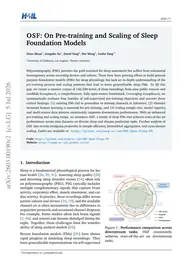
Sleep is essential for health, yet studying its dynamics requires manual sleep staging, a labor-intensive step in research and clinical care. Across centers, polysomnography (PSG) recordings are traditionally scored in 30-s epochs for pragmatic, not physiological, reasons and vary in electrode count, montage, and subject characteristics. These constraints challenge harmonized multi-center studies and the discovery of robust biomarkers on shorter timescales. We present AnySleep, a deep neural network that scores sleep from any electroencephalography (EEG) or electrooculography (EOG) data at adjustable temporal resolutions. We trained and validated the model on over 20,000 overnight recordings (>200,000 h of EEG and EOG) from 28 datasets across multiple clinics to promote robust generalization across sites. The model attains state-of-the-art performance and surpasses or equals established baselines at 30-s epochs. Performance improves with more channels, yet remains strong when EOG is absent, or only EOG or single EEG derivations (frontal, central, or occipital) are available. On sub-30-s timescales, the model captures short wake intrusions consistent with arousals and improves the prediction of pathophysiological conditions (obstructive sleep apnea, narcolepsy type 1, insomnia) over 30-s scoring. We make the model publicly available to facilitate large-scale studies with heterogeneous electrode setups and accelerate biomarker discovery in sleep.
U-Sleep U-Net backbone (12 encoder + 12 decoder blocks) with 13 mid-network channel-attention modules (MLP + softmax over channels) and a configurable average-pooling segment classifier (30 s down to 1/128 s)
Cite the publication recorded for this model. Check it against the publisher before submitting.
Grieger, N., Raskob, J., Mehrkanoon, S., & Bialonski, S. (2026). AnySleep: a channel-agnostic deep learning system for high-resolution sleep staging in multi-center cohorts. npj Digital Medicine. https://doi.org/10.1038/s41746-026-03406-7
Grieger, Niklas, Jannik Raskob, Siamak Mehrkanoon, and Stephan Bialonski. 2026. "AnySleep: a channel-agnostic deep learning system for high-resolution sleep staging in multi-center cohorts." npj Digital Medicine. https://doi.org/10.1038/s41746-026-03406-7.
Grieger, N., Raskob, J., Mehrkanoon, S. and Bialonski, S. (2026) 'AnySleep: a channel-agnostic deep learning system for high-resolution sleep staging in multi-center cohorts', npj Digital Medicine. doi: 10.1038/s41746-026-03406-7.
Grieger, Niklas, et al. "AnySleep: a channel-agnostic deep learning system for high-resolution sleep staging in multi-center cohorts." npj Digital Medicine, 2026. https://doi.org/10.1038/s41746-026-03406-7.
N. Grieger, J. Raskob, S. Mehrkanoon, and S. Bialonski, "AnySleep: a channel-agnostic deep learning system for high-resolution sleep staging in multi-center cohorts," npj Digital Medicine, 2026, doi: 10.1038/s41746-026-03406-7.
@article{grieger2026anysleep,
  title         = {{AnySleep: a channel-agnostic deep learning system for high-resolution sleep staging in multi-center cohorts}},
  author        = {Grieger, Niklas and Raskob, Jannik and Mehrkanoon, Siamak and Bialonski, Stephan},
  year          = {2026},
  journal       = {npj Digital Medicine},
  doi           = {10.1038/s41746-026-03406-7}
}