PaperarXiv:2610.19052
Why Do VLMs Fail at Remote Physiological Measurement? Rethinking with Physiological Grounding and Numerical Alignment (VITAL)
arXiv 2610.19052 (submitted 2026-10-13 18:50 UTC)
Open code
TL;DR
Finds two bottlenecks for VLMs on video rPPG: (1) generic visual-semantic features lose fine physiological cues; (2) autoregressive discrete tokens are misaligned with continuous numeric output. VITAL (Visual-physiological Token Alignment for Language Models) keeps the normal visual pathway for semantics and adds an independent physiological pathway. Structured numerical alignment makes generated HR values more reliable.
- Form factor: camera
Abstract
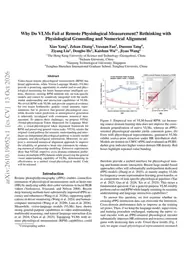
Video-based remote physiological measurement (RPM) has broad applications, while Vision-Language Models (VLMs) provide a promising opportunity to enable end-to-end physiological monitoring for future human-aware intelligent systems. However, existing RPM methods rely on task-specific models and cannot be seamlessly integrated with the multimodal understanding and interaction capabilities of VLMs. We revisit RPM with VLMs and provide empirical evidence for two major bottlenecks: generic visual semantic representations fail to preserve fine-grained physiological cues; while discrete token prediction in autoregressive generation is inherently misaligned with continuous numerical measurement. To address these challenges, we propose VITAL (Visual-physiological Token Alignment for Language Models), a visual-physiological token alignment framework for RPM and preserving general vision tasks. VITAL retains the original visual pathway for semantic understanding and introduces an independent physiological pathway to jointly model semantic and physiological information. Moreover, we propose a structured numerical alignment approach to improve the reliability of generative heart rate estimation by enhancing numerical relationship modeling. Extensive experiments show that VITAL improves cross-domain estimation performance on multiple rPPG datasets while preserving the general visual understanding capability of VLMs, demonstrating its effectiveness as a unified visual-physiological model. Code will be released.
Verbatim from arXiv (opens in a new tab) · arXiv metadata (abstracts are released under CC0)
Results on ChatPPG leaderboards
All leaderboardsNo results from this paper on ChatPPG leaderboards yet. Browse the leaderboards.
Tasks & signals
Tasks
Signals
Keywords
How it works
Cite this paper
APA
Yang, X., Zhang, Z., Fan, Y., Tang, D., Liu, Z., He, D., Wu, K., & Wang, J. (2026). Why Do VLMs Fail at Remote Physiological Measurement? Rethinking with Physiological Grounding and Numerical Alignment (VITAL). arXiv 2610.19052. https://arxiv.org/abs/2610.19052
BibTeX
@misc{yang2026vlms,
  title         = {{Why Do VLMs Fail at Remote Physiological Measurement? Rethinking with Physiological Grounding and Numerical Alignment (VITAL)}},
  author        = {Yang, Xiao and Zhang, Zekun and Fan, Yuxuan and Tang, Duoxun and Liu, Ziyang and He, Dengbo and Wu, Kaishun and Wang, Jiyao},
  year          = {2026},
  howpublished  = {arXiv 2610.19052},
  eprint        = {2610.19052},
  archivePrefix = {arXiv}
}
Built from the hub record. Check it against the publisher before submitting.
Added to the ChatPPG research hub