Paperdoi:10.1007/s44470-026-00195-4
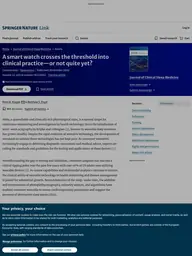
A smart watch crosses the threshold into clinical practice—or not quite yet?
Journal of Clinical Sleep Medicine
TL;DR
Commentary on the Samsung Galaxy Watch sleep apnea validation by Alavi and colleagues. It highlights r = 0.87 between watch eAHI and PSG AHI, specificity of 66.7% at the default cutoff, a cohort weighted towards moderate-to-severe OSA, and 38.8% of participants missing a valid watch estimate on at least one attended night.
- Form factor: wrist
Caveats
- eAHI vs OAHI 4%; the comparison is plotted in Alavi et al. Fig. 2c (scatter, both lab nights), but r = 0.87 is not printed on the figure or caption and the body text is paywalled, so the value is still sourced from the Khayat & Floyd commentary; First author Arash Alavi stated in an email to ChatPPG (2026-10-30) that r = 0.87 (225 night-level pairs, OAHI 4%) appears on p. 6 of Alavi et al. JCSM 2026 (Fig. 2c). Author-reported; the paywalled text wasn't independently checked.; Samsung-funded.
Results on ChatPPG leaderboards · 1
All leaderboards| Leaderboard | Method | Result | Rank |
|---|---|---|---|
| Stanford enriched cohort Pearson rSleep apnea (OSA) screening | Samsung Galaxy Watch OSA featureCaveat: eAHI vs OAHI 4%; the comparison is plotted in Alavi et al. Fig. 2c (scatter, both lab nights), but r = 0.87 is not printed on the figure or caption and the body text is paywalled, so the value is still sourced from the Khayat & Floyd commentary; First author Arash Alavi stated in an email to ChatPPG (2026-10-30) that r = 0.87 (225 night-level pairs, OAHI 4%) appears on p. 6 of Alavi et al. JCSM 2026 (Fig. 2c). Author-reported; the paywalled text wasn't independently checked.; Samsung-funded. | 0.87Pearson r, higher is better | Unranked |
1 row is credited to this paper. Ranks apply within each leaderboard only, as reported by the source.
Tasks & signals
Tasks
Signals
Keywords
How it works
Cite this paper
Khayat, R. N., & Floyd, M. S. (2026). A smart watch crosses the threshold into clinical practice—or not quite yet? Journal of Clinical Sleep Medicine. https://doi.org/10.1007/s44470-026-00195-4
Khayat, Rami N. and Matthew S. Floyd. 2026. "A smart watch crosses the threshold into clinical practice—or not quite yet?" Journal of Clinical Sleep Medicine. https://doi.org/10.1007/s44470-026-00195-4.
Khayat, R. N. and Floyd, M. S. (2026) 'A smart watch crosses the threshold into clinical practice—or not quite yet?', Journal of Clinical Sleep Medicine. doi: 10.1007/s44470-026-00195-4.
Khayat, Rami N., and Matthew S. Floyd "A smart watch crosses the threshold into clinical practice—or not quite yet?" Journal of Clinical Sleep Medicine, 2026. https://doi.org/10.1007/s44470-026-00195-4.
R. N. Khayat and M. S. Floyd, "A smart watch crosses the threshold into clinical practice—or not quite yet?" Journal of Clinical Sleep Medicine, 2026, doi: 10.1007/s44470-026-00195-4.
@article{khayat2026smart,
  title         = {{A smart watch crosses the threshold into clinical practice—or not quite yet?}},
  author        = {Khayat, Rami N. and Floyd, Matthew S.},
  year          = {2026},
  journal       = {Journal of Clinical Sleep Medicine},
  doi           = {10.1007/s44470-026-00195-4}
}Record updated
Added to the ChatPPG research hub