Paperdoi:10.1371/journal.pone.0267749
Posttraumatic stress disorder hyperarousal event detection using smartwatch physiological and activity data
PLoS One 17(5):e0267749
 (opens in a new tab)
Mahnoosh Sadeghi et al., "Posttraumatic stress disorder hyperarousal event detection using smartwatch physiological and activity data", doi:10.1371/journal.pone.0267749, CC BY 4.0
TL;DR
Ninety-nine US veterans with PTSD wore consumer smartwatches (Moto 360 or Apple Watch Series 3–4) that logged heart rate and accelerometry, and self-reported hyperarousal events were used as labels. An XGBoost model detected hyperarousal events with accuracy above 83% and an AUC of 0.70.
- Form factor: wrist
Abstract
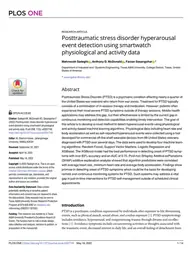
Posttraumatic Stress Disorder (PTSD) is a psychiatric condition affecting nearly a quarter of the United States war veterans who return from war zones. Treatment for PTSD typically consists of a combination of in-session therapy and medication. However; patients often experience their most severe PTSD symptoms outside of therapy sessions. Mobile health applications may address this gap, but their effectiveness is limited by the current gap in continuous monitoring and detection capabilities enabling timely intervention. The goal of this article is to develop a novel method to detect hyperarousal events using physiological and activity-based machine learning algorithms. Physiological data including heart rate and body acceleration as well as self-reported hyperarousal events were collected using a tool developed for commercial off-the-shelf wearable devices from 99 United States veterans diagnosed with PTSD over several days. The data were used to develop four machine learning algorithms: Random Forest, Support Vector Machine, Logistic Regression and XGBoost. The XGBoost model had the best performance in detecting onset of PTSD symptoms with over 83% accuracy and an AUC of 0.70. Post-hoc SHapley Additive exPlanations (SHAP) additive explanation analysis showed that algorithm predictions were correlated with average heart rate, minimum heart rate and average body acceleration. Findings show promise in detecting onset of PTSD symptoms which could be the basis for developing remote and continuous monitoring systems for PTSD. Such systems may address a vital gap in just-in-time interventions for PTSD self-management outside of scheduled clinical appointments.
Verbatim from the publisher's DOI record (opens in a new tab) · Publisher licence: http://creativecommons.org/licenses/by/4.0/
Results on ChatPPG leaderboards
All leaderboardsNo results from this paper on ChatPPG leaderboards yet. Browse the leaderboards.
Tasks & signals
Tasks
Signals
Keywords
How it works
Cite this paper
Sadeghi, M., McDonald, A. D., & Sasangohar, F. (2022). Posttraumatic stress disorder hyperarousal event detection using smartwatch physiological and activity data. PLoS One, 17(5), e0267749. https://doi.org/10.1371/journal.pone.0267749
Sadeghi, Mahnoosh, Anthony D. McDonald, and Farzan Sasangohar. 2022. "Posttraumatic stress disorder hyperarousal event detection using smartwatch physiological and activity data." PLoS One 17 (5): e0267749. https://doi.org/10.1371/journal.pone.0267749.
Sadeghi, M., McDonald, A. D. and Sasangohar, F. (2022) 'Posttraumatic stress disorder hyperarousal event detection using smartwatch physiological and activity data', PLoS One, 17(5), p. e0267749. doi: 10.1371/journal.pone.0267749.
Sadeghi, Mahnoosh, et al. "Posttraumatic stress disorder hyperarousal event detection using smartwatch physiological and activity data." PLoS One, vol. 17, no. 5, 2022, p. e0267749. https://doi.org/10.1371/journal.pone.0267749.
M. Sadeghi, A. D. McDonald, and F. Sasangohar, "Posttraumatic stress disorder hyperarousal event detection using smartwatch physiological and activity data," PLoS One, vol. 17, no. 5, p. e0267749, 2022, doi: 10.1371/journal.pone.0267749.
@article{sadeghi2022posttraumatic,
  title         = {{Posttraumatic stress disorder hyperarousal event detection using smartwatch physiological and activity data}},
  author        = {Sadeghi, Mahnoosh and McDonald, Anthony D. and Sasangohar, Farzan},
  year          = {2022},
  journal       = {PLoS One},
  volume        = {17},
  number        = {5},
  pages         = {e0267749},
  doi           = {10.1371/journal.pone.0267749}
}Added to the ChatPPG research hub