Paperdoi:10.1515/cdbme-2026-0132
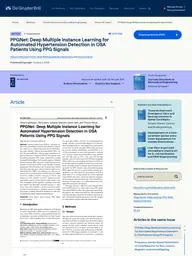
PPGNet: Deep Multiple Instance Learning for Automated Hypertension Detection in OSA Patients Using PPG Signals
Current Directions in Biomedical Engineering (CDBME)
TL;DR
Detects established systemic hypertension in OSA patients from PPG extracted from routine overnight PSG recordings — no extra sensors. Multiple Instance Learning: 30 s instances aggregated into 30 min bags with sleep-stage and apnea context. Leave-One-Patient-Out on n=33 clinically annotated OSA patients: AUROC 86.72%, AUPRC 88.01%, Acc 79.03%, Sens 83.33%, MCC 0.5842.
- Form factor: lab
Abstract
Systemic hypertension (HTN) is a prevalent cardiovascular comorbidity in patients with obstructive sleep apnea (OSA), yet no scalable framework exists for HTN detection using routinely collected polysomnography (PSG) signals. We present PPGNet, a deep learning framework for diagnostic detection of established HTN in OSA patients using photoplethysmography (PPG) signals extracted from standard overnight PSG recordings. The framework employs a Multiple Instance Learning (MIL) approach to model long-term hemodynamic and autonomic patterns across full-night recordings, aggregating 30-second instances into 30-minute bags enriched with sleep stage and apnea context. Evaluated under Leave- One-Patient-Out (LOPO) cross-validation on a clinically annotated cohort of 33 OSA patients, PPGNet achieved AUROC of 86.72%, AUPRC of 88.01%, Accuracy of 79.03%, Sensitivity of 83.33%, and MCC of 0.5842. Attention-based interpretability analysis confirms that the model captures clinically meaningful vascular signatures, including arterial stiffness markers and differential vasomotor responses to apnea events. This work establishes a proof-of-concept for cardiovascular risk stratification as a secondary outcome of routine sleep studies, enabling earlier HTN identification in this highrisk population without additional instrumentation.
Verbatim from the publisher's DOI record (opens in a new tab) · Publisher licence: http://creativecommons.org/licenses/by/4.0
Results on ChatPPG leaderboards
All leaderboardsNo results from this paper on ChatPPG leaderboards yet. Browse the leaderboards.
Tasks & signals
Tasks
Signals
Keywords
How it works
Cite this paper
APA
Moaqet, H. E., Janini, R., Salanitro, M., Glos, M., & Penzel, T. (2026). PPGNet: Deep Multiple Instance Learning for Automated Hypertension Detection in OSA Patients Using PPG Signals. Current Directions in Biomedical Engineering. https://doi.org/10.1515/cdbme-2026-0132
BibTeX
@article{moaqet2026ppgnet,
  title         = {{PPGNet: Deep Multiple Instance Learning for Automated Hypertension Detection in OSA Patients Using PPG Signals}},
  author        = {Moaqet, Hisham El and Janini, Rami and Salanitro, Matthew and Glos, Martin and Penzel, Thomas},
  year          = {2026},
  journal       = {Current Directions in Biomedical Engineering},
  doi           = {10.1515/cdbme-2026-0132}
}
Built from the hub record. Check it against the publisher before submitting.
Added to the ChatPPG research hub