Paperdoi:10.3390/s26196073
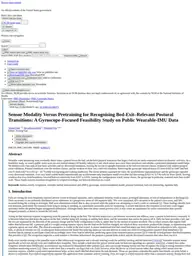
Sensor Modality Versus Pretraining for Recognising Bed-Exit–Relevant Postural Transitions: A Gyroscope-Focused Feasibility Study on Public Wearable-IMU Data
Sensors 2026, 26(19):6073 (MDPI; open access CC BY); received 2026-08-05, revised 2026-09-22
Open code
TL;DR
The six-axis model also needs far fewer labels than the fine-tuned FM. - The gyroscope carries the transitions. Removing it drops macro-F1 from 0.822 to 0.647 and bed-exit F1 from 0.657 to 0.351 (p < 10⁻⁴), while lying and walking are unaffected.
- Form factor: other
Abstract
Wearable ward monitoring must eventually detect when a patient leaves the bed, yet the brief postural transitions that begin a bed exit are under-examined relative to dynamic activities. As a feasibility study, we used a public waist-worn six-axis inertial dataset (30 healthy subjects) to ask which sensor axes carry these transitions and whether a pretrained foundation model helps. We defined a ten-class task of four basic activities and six directional transitions, treating the two lie-to-upright transitions as the bed-exit-relevant classes, evaluated with subject-grouped cross-validation. Postural transitions were the weakest classes, and the weakest of these was a bed-exit transition. Removing the gyroscope reduced macro-F1 from 0.822 to 0.647 and bed-exit F1 from 0.657 to 0.351 (p < 10−4) while leaving lying and walking unaffected. The mirror ablation separated the roles: the accelerometer captured posture and the gyroscope captured every directional transition. A six-axis hand-crafted model outperformed one accelerometer-only foundation model even after full fine-tuning (0.822 vs. 0.774) with far fewer labels. Scoring windows that cross bout boundaries lowered bed-exit sensitivity from 0.937 to 0.833. Among the configurations tested, sensor choice, the gyroscope in particular, mattered more than model scale. These results concern transition recognition in scripted recordings, not bed-exit detection on a ward.
Verbatim from the publisher's DOI record (opens in a new tab) · Publisher licence: https://creativecommons.org/licenses/by/4.0/
Results on ChatPPG leaderboards · 1
All leaderboards| Leaderboard | Method | Result | Rank |
|---|---|---|---|
| hapt macro-F1Human activity recognition | Hand-crafted 6-axis (Park 2026) | 0.822macro-F1, higher is better | #1 of 1 |
1 row is credited to this paper. Ranks apply within each leaderboard only, as reported by the source.
Tasks & signals
Tasks
Signals
Keywords
Datasets
Models
How it works
Cite this paper
APA
Park, Y., Bold, B., & Cha, W. (2026). Sensor Modality Versus Pretraining for Recognising Bed-Exit–Relevant Postural Transitions: A Gyroscope-Focused Feasibility Study on Public Wearable-IMU Data. Sensors 2026. https://doi.org/10.3390/s26196073
BibTeX
@article{park2026sensor,
  title         = {{Sensor Modality Versus Pretraining for Recognising Bed-Exit–Relevant Postural Transitions: A Gyroscope-Focused Feasibility Study on Public Wearable-IMU Data}},
  author        = {Park, Youmi and Bold, Bayarbaatar and Cha, Wonchul},
  year          = {2026},
  journal       = {Sensors 2026},
  doi           = {10.3390/s26196073}
}
Built from the hub record. Check it against the publisher before submitting.
Added to the ChatPPG research hub