Paperdoi:10.1136/bmj-2025-085535
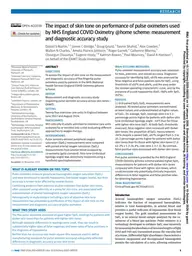
The impact of skin tone on performance of pulse oximeters used by NHS England COVID Oximetry @home scheme
BMJ 2026;392:e085535
 (opens in a new tab)
Daniel S Martin et al., "The impact of skin tone on performance of pulse oximeters used by NHS England COVID Oximetry @home scheme: measurement and diagnostic accuracy study", doi:10.1136/bmj-2025-085535, CC BY 4.0
TL;DR
Prospective measurement/diagnostic accuracy study of five fingertip pulse oximeters from the NHS England COVID Oximetry @home scheme vs arterial SaO2 (co-oximetry), with objective skin tone via spectrophotometer ITA. Analysed 11,018 paired SpO2–SaO2 measurements. All devices overestimated at lower SaO2 and underestimated at higher SaO2.
- Form factor: finger
Abstract
Objectives
To assess the impact of skin tone on the measurement and diagnostic accuracy of five fingertip pulse oximeters used by patients in the NHS (National Health Service) England COVID Oximetry @home scheme.
Design
Measurement and diagnostic accuracy study (exploring pulse oximeter accuracy across skin tones—EXAKT).
Setting
Twenty four intensive care units in England between June 2022 and August 2024.
Participants
903 critically ill adults admitted to intensive care units screened for or enrolled into a trial evaluating different approaches to oxygen therapy.
Interventions
Pulse oximetry derived peripheral oxygen saturation (SpO 2 ) measurements were compared with paired arterial oxygen saturation (SaO 2 ) measurements from arterial blood analysed by co-oximetry (gold standard). Skin tone (individual typology angle) was objectively measured using a handheld spectrophotometer.
Main outcome measures
Pulse oximeter measurement accuracy was assessed for bias, precision, and overall accuracy. Diagnostic accuracy for identifying SaO 2 ≤92% was assessed by false negative and false positive rates for SpO 2 using thresholds of ≤92% and ≤94%, and the area under the receiver operating characteristic curve, and by the presence of occult hypoxaemia (SaO 2 2 >92%).
Results
11 018 paired SpO 2 -SaO 2 measurements were analysed. All tested pulse oximeters overestimated at lower values and underestimated at higher values of SaO 2 . On average, SpO 2 readings were 0.6-1.5 percentage points higher for patients with darker skin tone (individual typology angle −44°) than for those with lighter skin tone (46°). At both SpO 2 thresholds assessed, false negative rates increased with darker skin tones; the proportion of SpO 2 measurements >94% despite a paired SaO 2 ≤92% ranged from 5.3 to 35.3 percentage points higher for patients with darker skin tones than for those with lighter skin tones (7.6-62.2% v 1.2-26.9%, rate ratio 2.3-7.1). By contrast, false positive rates decreased with darker skin tones.
Conclusions
Five pulse oximeters provided by the NHS England COVID Oximetry @home scheme yielded higher SpO 2 measurements for patients with darker skin tones compared with those with lighter skin tones, which could translate into potentially clinically important differences in false negative and false positive rates for detecting hypoxaemia.
Trial registration
ClinicalTrials.gov NCT05481515
Verbatim from the publisher's DOI record (opens in a new tab) · Publisher licence: http://creativecommons.org/licenses/by/4.0/
Results on ChatPPG leaderboards
All leaderboardsNo results from this paper on ChatPPG leaderboards yet. Browse the leaderboards.
Tasks & signals
Tasks
Signals
Keywords
How it works
- Wavelengths
- red, IR
Cite this paper
APA
Martin, D. S., Doidge, J. C., Gould, D., Shahid, T., Cowden, A., Charles, W. N., Johnson, A. F., Garrett, R., Mbema, C., Olusanya, O., Healy, E., Rowan, K., Mouncey, P., & Harrison, D. A. (2026). The impact of skin tone on performance of pulse oximeters used by NHS England COVID Oximetry @home scheme. BMJ 2026. https://doi.org/10.1136/bmj-2025-085535
BibTeX
@article{martin2026impact,
  title         = {{The impact of skin tone on performance of pulse oximeters used by NHS England COVID Oximetry @home scheme}},
  author        = {Martin, Daniel S. and Doidge, James C. and Gould, Doug and Shahid, Tasnin and Cowden, Alex and Charles, Walton N. and Johnson, Amelia Francis and Garrett, Roger and Mbema, Catherine and Olusanya, Olusegun and Healy, Eugene and Rowan, Kathryn and Mouncey, Paul and Harrison, David A.},
  year          = {2026},
  journal       = {BMJ 2026},
  doi           = {10.1136/bmj-2025-085535}
}
Built from the hub record. Check it against the publisher before submitting.
Added to the ChatPPG research hub