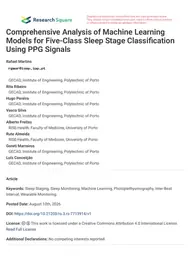
Paperdoi:10.21203/rs.3.rs-7713914/v1
Comprehensive Analysis of Machine Learning Models for Five-Class Sleep Stage Classification Using PPG Signals
Research Square preprint (2026-08-10; PubMed entry 2026-10-08)
 (opens in a new tab)
Rafael Martins et al., "Comprehensive Analysis of Machine Learning Models for Five-Class Sleep Stage Classification Using PPG Signals", doi:10.21203/rs.3.rs-7713914/v1, CC BY 4.0
Key results
All results- Random Forest (PPG features)Abstract (Results) (source, opens in a new tab)
0.65
Cohen's κ ↑
Sleep staging · MESA
5-class · classical machine learning on PPG features
Results as reported by the authors; not independently reproduced. A SOTA star marks the best value among results reported under the same evaluation protocol; ties go to the earlier publication.
TL;DR
Traditional ML (Random Forest, kNN, XGBoost) for five-class staging from MESA finger PPG. Subset of 48 participants, 3-min windows, PPG-morphology plus inter-beat-interval features. Combining PPG and IBI features helps most.
- Form factor: finger
Abstract
Accurate classification of sleep stages is essential for diagnosing sleep disorders and understanding sleep quality. While polysomnography (PSG) remains the gold standard, its invasiveness and cost hinder large-scale deployment. Photoplethysmography (PPG) offers a non-invasive and wearable alternative, yet most prior work either simplifies staging into fewer than five classes or relies on deep learning approaches with high computational demands. This study systematically evaluates traditional machine learning models for five-class sleep stage classification using PPG data from the MESA Sleep Dataset. A subset of 48 participants was analyzed, with signals segmented into 3-minute windows to enable robust extraction of both PPG-derived and inter-beat interval (IBI) features. Models including Random Forest, k-Nearest Neighbors, and XGBoost were benchmarked, demonstrating that combining PPG and IBI features substantially improves performance. Random Forest achieved the best results, with an accuracy of 72.2% and Cohen’s Kappa of 0.65, comparable to state-of-the-art deep learning methods while requiring fewer resources and offering greater interpretability. These findings highlight the potential of feature-based, computationally efficient models for five-stage sleep classification, supporting scalable and clinically relevant applications of wearable PPG monitoring.
Verbatim from the publisher's DOI record (opens in a new tab) · Publisher licence: https://creativecommons.org/licenses/by/4.0/
Results on ChatPPG leaderboards
All leaderboardsNo results from this paper on ChatPPG leaderboards yet. Browse the leaderboards.
Tasks & signals
Tasks
Signals
Keywords
Datasets
How it works
Cite this paper
APA
Martins, R., Ribeiro, R., Pereira, H., Silva, V., Freitas, A., Almeida, R., Marreiros, G., & Conceição, L. (2026). Comprehensive Analysis of Machine Learning Models for Five-Class Sleep Stage Classification Using PPG Signals. Research Square preprint. https://doi.org/10.21203/rs.3.rs-7713914/v1
BibTeX
@misc{martins2026comprehensive,
  title         = {{Comprehensive Analysis of Machine Learning Models for Five-Class Sleep Stage Classification Using PPG Signals}},
  author        = {Martins, R. and Ribeiro, R. and Pereira, H. and Silva, V. and Freitas, A. and Almeida, R. and Marreiros, G. and Conceição, L.},
  year          = {2026},
  howpublished  = {Research Square preprint},
  doi           = {10.21203/rs.3.rs-7713914/v1}
}
Built from the hub record. Check it against the publisher before submitting.
Added to the ChatPPG research hub