PaperarXiv:2512.01653
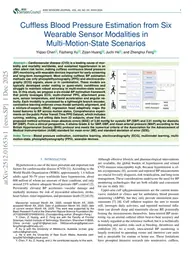
Cuffless Blood Pressure Estimation from Six Wearable Sensor Modalities in Multi-Motion-State Scenarios
arXiv preprint (eess.SP, cs.LG) · 13 pages, 7 figures
TL;DR
Cardiovascular disease (CVD) is a leading cause of morbidity and mortality worldwide, and sustained hypertension is an often silent risk factor, making cuffless continuous blood pressure (BP) monitoring with wearable devices important for early screening and long-term management. Most existing cuffless BP estimation methods use only photoplethysmography (PPG) and electrocardiography (ECG) signals, alone or in combination. These models are typically developed under resting or quasi-static conditions and struggle to maintain robust accuracy in multi-motion-state scenarios.
- Form factor: wrist
Abstract
Cardiovascular disease (CVD) is a leading cause of morbidity and mortality worldwide, and sustained hypertension is an often silent risk factor, making cuffless continuous blood pressure (BP) monitoring with wearable devices important for early screening and long-term management. Most existing cuffless BP estimation methods use only photoplethysmography (PPG) and electrocardiography (ECG) signals, alone or in combination. These models are typically developed under resting or quasi-static conditions and struggle to maintain robust accuracy in multi-motion-state scenarios. In this study, we propose a six-modal BP estimation framework that jointly leverages ECG, multi-channel PPG, attachment pressure, sensor temperature, and triaxial acceleration and angular velocity. Each modality is processed by a lightweight branch encoder, contrastive learning enforces cross-modal semantic alignment, and a mixture-of-experts (MoE) regression head adaptively maps the fused features to BP across motion states. Comprehensive experiments on the public Pulse Transit Time PPG Dataset, which includes running, walking, and sitting data from 22 subjects, show that the proposed method achieves mean absolute errors (MAE) of 3.60 mmHg for systolic BP (SBP) and 3.01 mmHg for diastolic BP (DBP). From a clinical perspective, it attains Grade A for SBP, DBP, and mean arterial pressure (MAP) according to the British Hypertension Society (BHS) protocol and meets the numerical criteria of the Association for the Advancement of Medical Instrumentation (AAMI) standard for mean error (ME) and standard deviation of error (SDE).
Verbatim from arXiv (opens in a new tab) · arXiv metadata (abstracts are released under CC0)
Results on ChatPPG leaderboards
All leaderboardsNo results from this paper on ChatPPG leaderboards yet. Browse the leaderboards.
Tasks & signals
Tasks
Signals
Keywords
How it works
Cite this paper
APA
Chen, Y., Xu, F., Huang, Z., He, J., & Feng, Z. (2025). Cuffless Blood Pressure Estimation from Six Wearable Sensor Modalities in Multi-Motion-State Scenarios. arXiv preprint · 13 pages, 7 figures. https://doi.org/10.48550/arXiv.2512.01653
BibTeX
@misc{chen2025cuffless,
  title         = {{Cuffless Blood Pressure Estimation from Six Wearable Sensor Modalities in Multi-Motion-State Scenarios}},
  author        = {Chen, Yiqiao and Xu, Fazheng and Huang, Zijian and He, Juchi and Feng, Zhenghui},
  year          = {2025},
  howpublished  = {arXiv preprint · 13 pages, 7 figures},
  doi           = {10.48550/arXiv.2512.01653},
  eprint        = {2512.01653},
  archivePrefix = {arXiv}
}
Built from the hub record. Check it against the publisher before submitting.
Added to the ChatPPG research hub