Paperdoi:10.48550/arXiv.2607.20027
Zero-shot heart rate variability forecasting from consumer wearables using time series foundation models
arXiv 2607.20027 (2026-07-22)
Licence: CC BY (OpenAlex)
 (opens in a new tab)
Peräkylä, Luukas et al., "Zero-Shot Heart Rate Variability Forecasting from Consumer Wearables Using Time Series Foundation Models", arXiv:2607.20027, CC BY 4.0
TL;DR
Evaluates TimesFM, Chronos and MOIRAI zero-shot for short-term HRV forecasting on real consumer-wearable data from 49 healthy people, against mean / exponential smoothing / EWMA. Introduces variability-preserving imputation (linear interpolation + locally adaptive stochastic noise). TSFMs beat all baselines without fine-tuning: MASE 0.81–0.87 across models and context lengths 32/64, Chronos and TimesFM best, MOIRAI limited; horizons up to 2 h.
- Form factor: consumer wearable
Abstract
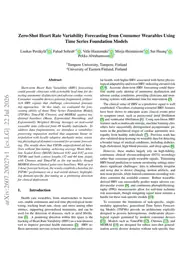
Short-term Heart Rate Variability (HRV) forecasting could provide clinicians with actionable lead time for detecting autonomic dysfunction and adverse cardiac events. Consumer wearable devices generate fragmented, artifact-rich HRV signals that challenge conventional forecasting approaches. In this study, we evaluated the forecasting ability of three Time Series Foundation Models (TSFMs), TimesFM, Chronos, and MOIRAI, against traditional baselines (Mean, Exponential Smoothing, and Exponentially Weighted Moving Average) on real-world wearable data collected from 49 healthy individuals. To address data fragmentation, we introduce a variability-preserving imputation method that augments linear interpolation with locally adaptive stochastic noise, retaining physiological dynamics essential for accurate forecasting. The results show that TSFMs outperformed all baselines without fine-tuning, achieving average Mean Absolute Scaled Error (MASE) between 0.81 and 0.87 across TSFMs and both context lengths (32 and 64 time steps), with Chronos and TimesFM as the top models, though MOIRAI showed limited gains over baselines. With up to a 2-hour forecast horizon, the results establish a baseline for TSFMs' performance on a real-world dataset, highlighting domain-specific fine-tuning as a promising direction for clinical deployment.
Verbatim from DataCite (opens in a new tab) · Licence: https://creativecommons.org/licenses/by/4.0/legalcode
Results on ChatPPG leaderboards
All leaderboardsNo results from this paper on ChatPPG leaderboards yet. Browse the leaderboards.
Tasks & signals
Signals
Keywords
How it works
Cite this paper
APA
Peräkylä, L., Sohrab, F., Hautamäki, V., Heinaniemi, M., Huang, S., & Abrahamsson, P. (2026). Zero-shot heart rate variability forecasting from consumer wearables using time series foundation models. arXiv 2607.20027. https://doi.org/10.48550/arXiv.2607.20027
BibTeX
@misc{perakyla2026zeroshot,
  title         = {{Zero-shot heart rate variability forecasting from consumer wearables using time series foundation models}},
  author        = {Peräkylä, Luukas and Sohrab, Fahad and Hautamäki, Ville and Heinaniemi, Merja and Huang, Sicong and Abrahamsson, Pekka},
  year          = {2026},
  howpublished  = {arXiv 2607.20027},
  doi           = {10.48550/arXiv.2607.20027}
}
Built from the hub record. Check it against the publisher before submitting.
Added to the ChatPPG research hub