Paperdoi:10.1109/OJEMB.2024.3354208
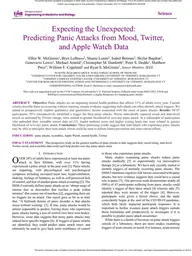
Expecting the Unexpected: predicting panic attacks from mood, Twitter and Apple Watch data (E. W. McGinnis … R. S. McGinnis; IEEE OJEMB 2024)
IEEE Open Journal of Engineering in Medicine and Biology 5 (2024)
 (opens in a new tab)
Ellen W. McGinnis et al., "Expecting the Unexpected: Predicting Panic Attacks From Mood, Twitter, and Apple Watch Data", doi:10.1109/OJEMB.2024.3354208, CC BY-NC-ND 4.0
TL;DR
Authors: Ellen W. McGinnis, Bryn Loftness, Shania Lunna, Isabel Berman, … Ryan S. McGinnis (12 authors; same group as LEMURS).
- Form factor: wrist (Apple Watch)
Abstract
ObjectivePanic attacks are an impairing mental health problem that affects 11% of adults every year. Current criteria describe them as occurring without warning, despite evidence suggesting individuals can often identify attack triggers. We aimed to prospectively explore qualitative and quantitative factors associated with the onset of panic attacks.ResultsOf 87 participants, 95% retrospectively identified a trigger for their panic attacks. Worse individually reported mood and state-level mood, as indicated by Twitter ratings, were related to greater likelihood of next-day panic attack. In a subsample of participants who uploaded their wearable sensor data (n = 32), louder ambient noise and higher resting heart rate were related to greater likelihood of next-day panic attack.ConclusionsThese promising results suggest that individuals who experience panic attacks may be able to anticipate their next attack which could be used to inform future prevention and intervention efforts.
Verbatim from Europe PMC (opens in a new tab) · Licence: cc by-nc-nd
Results on ChatPPG leaderboards
All leaderboardsNo results from this paper on ChatPPG leaderboards yet. Browse the leaderboards.
Tasks & signals
Signals
Keywords
How it works
Cite this paper
Expecting the Unexpected: predicting panic attacks from mood, Twitter and Apple Watch data (E. W. McGinnis … R. S. McGinnis; IEEE OJEMB 2024). (2024). IEEE Open Journal of Engineering in Medicine and Biology 5. https://doi.org/10.1109/OJEMB.2024.3354208
@article{mcginnisexpectin2024expecting,
  title         = {{Expecting the Unexpected: predicting panic attacks from mood, Twitter and Apple Watch data (E. W. McGinnis … R. S. McGinnis; IEEE OJEMB 2024)}},
  year          = {2024},
  journal       = {IEEE Open Journal of Engineering in Medicine and Biology 5},
  doi           = {10.1109/OJEMB.2024.3354208}
}Added to the ChatPPG research hub