Paperdoi:10.3390/s22166059
Camera-Derived Photoplethysmography (rPPG) and Speckle Plethysmography (rSPG): Comparing Reflective and Transmissive Mode at Various Integration Times Using LEDs and Lasers
Sensors 22(16):6059, 2022
TL;DR
This study compared camera-derived PPG and speckle plethysmography (SPG) on ten fingers using lasers and LEDs at 639 and 850 nm, in reflection and transmission. In reflection, laser-based SPG had far better signal quality (SQI above 0.965) than LED-based signals, which shows the advantage really comes from coherent light. In transmission the speckle washed out and SPG started to look like PPG.
- Form factor: camera
Abstract
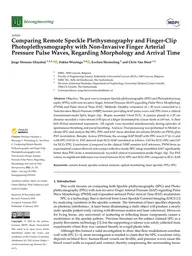
Background: Although both speckle plethysmography (SPG) and photoplethysmography (PPG) examine pulsatile changes in the vasculature using opto-electronics, PPG has a long history, whereas SPG is relatively new and less explored. The aim of this study was to compare the effects of integration time and light-source coherence on signal quality and waveform morphology for reflective and transmissive rSPG and rPPG. Methods: (A) Using time-domain multiplexing, we illuminated 10 human index fingers with pulsed lasers versus LEDs (both at 639 and 850 nm), in transmissive versus reflective mode. A synchronized camera (Basler acA2000-340 km, 25 cm distance, 200 fps) captured and demultiplexed four video channels (50 fps/channel) in four stages defined by illumination mode. From all video channels, we derived rPPG and rSPG, and applied a signal quality index (SQI, scale: Good > 0.95; Medium 0.95–0.85; Low 0.85–0.8; Negligible 0.965, LED-rSPG 0.951, reflective rPPG < 0.740, transmissive rSPG and rPPG 0.990–0.898. Incoherent mode: Reflective all <0.798 and transmissive all 0.92–0.987. Linear regressions revealed similar R2 values of rPPG with rSPG (R2 = 0.99) and ITA (R2 = 0.98); Discussion: Laser-rSPG and LED-rPPG produced different waveforms in reflection, but not in transmission. We created the concept of ITA to investigate this behavior. Conclusions: Reflective Laser-SPG truly originated from coherence. Transmissive Laser-rSPG showed a loss of speckles, accompanied by waveform changes towards rPPG. Diffuse spatial intensity modulation polluted spatial-mode SPG.
Verbatim from the publisher's DOI record (opens in a new tab) · Publisher licence: https://creativecommons.org/licenses/by/4.0/
Results on ChatPPG leaderboards
All leaderboardsNo results from this paper on ChatPPG leaderboards yet. Browse the leaderboards.
Tasks & signals
Tasks
Signals
Keywords
How it works
- Wavelengths
- 639 nm, 850 nm
Cite this paper
Olazábal, J. H., Wieringa, F. P., Hermeling, E., & Van Hoof, C. A. (2022). Camera-Derived Photoplethysmography (rPPG) and Speckle Plethysmography (rSPG): Comparing Reflective and Transmissive Mode at Various Integration Times Using LEDs and Lasers. Sensors , 2022, 22(16), 6059. https://doi.org/10.3390/s22166059
Olazábal, Jorge Herranz, Fokko Pieter Wieringa, Evelien Hermeling, and Chris A. Van Hoof. 2022. "Camera-Derived Photoplethysmography (rPPG) and Speckle Plethysmography (rSPG): Comparing Reflective and Transmissive Mode at Various Integration Times Using LEDs and Lasers." Sensors , 2022 22 (16): 6059. https://doi.org/10.3390/s22166059.
Olazábal, J. H., Wieringa, F. P., Hermeling, E. and Van Hoof, C. A. (2022) 'Camera-Derived Photoplethysmography (rPPG) and Speckle Plethysmography (rSPG): Comparing Reflective and Transmissive Mode at Various Integration Times Using LEDs and Lasers', Sensors , 2022, 22(16), p. 6059. doi: 10.3390/s22166059.
Olazábal, Jorge Herranz, et al. "Camera-Derived Photoplethysmography (rPPG) and Speckle Plethysmography (rSPG): Comparing Reflective and Transmissive Mode at Various Integration Times Using LEDs and Lasers." Sensors , 2022, vol. 22, no. 16, 2022, p. 6059. https://doi.org/10.3390/s22166059.
J. H. Olazábal, F. P. Wieringa, E. Hermeling, and C. A. Van Hoof, "Camera-Derived Photoplethysmography (rPPG) and Speckle Plethysmography (rSPG): Comparing Reflective and Transmissive Mode at Various Integration Times Using LEDs and Lasers," Sensors , 2022, vol. 22, no. 16, p. 6059, 2022, doi: 10.3390/s22166059.
@article{olazabal2022cameraderived,
  title         = {{Camera-Derived Photoplethysmography (rPPG) and Speckle Plethysmography (rSPG): Comparing Reflective and Transmissive Mode at Various Integration Times Using LEDs and Lasers}},
  author        = {Olazábal, Jorge Herranz and Wieringa, Fokko Pieter and Hermeling, Evelien and Van Hoof, Chris A.},
  year          = {2022},
  journal       = {Sensors , 2022},
  volume        = {22},
  number        = {16},
  pages         = {6059},
  doi           = {10.3390/s22166059}
}Added to the ChatPPG research hub