PaperarXiv:2610.08510
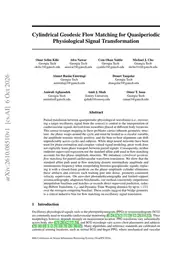
Cylindrical Geodesic Flow Matching for Quasiperiodic Physiological Signal Transformation
arXiv preprint (cs.AI)
 (opens in a new tab)
Kilic, Onur Selim et al., "Cylindrical Geodesic Flow Matching for Quasiperiodic Physiological Signal Transformation", arXiv:2610.08510, CC BY 4.0
TL;DR
Paired translation of quasiperiodic cardiovascular waveforms from a convenient wearable site to a clinically canonical one. Each sample is lifted to analytic-signal phase/amplitude, embedded on the cylinder (cos φ, sin φ, a) ∈ S¹ × ℝ>0, and conditional flow matching is trained along a closed-form geodesic on that cylinder instead of the usual affine path (which the authors prove shrinks amplitude and warps instantaneous frequency mid-bridge). The model predicts intrinsic phase/amplitude velocities with per-step re-projection; ~1.0 M-param 1D U-Net, ECG-conditioned.
- Form factor: other
Abstract
Paired translation between quasiperiodic physiological waveforms (i.e., recovering a target oscillatory signal from the source) is central to the interpretation of cardiovascular signals derived from wearables placed at different body locations. This source-to-target mapping in these problems carries inherent geometric structure: the phase wraps around the cycle and must be treated as a circular variable, the amplitude remains strictly positive, and the beat-to-beat alignment can drift unpredictably across cycles and subjects. While deep neural networks have been used for phase estimation and complex-valued signal modeling, prior work does not explicitly learn phase transport between paired signals. Consequently, neither endpoint-supervised regression nor the standard affine path used in flow matching accounts for this phase–amplitude structure. We introduce cylindrical geodesic flow matching for paired cardiovascular waveform translation. We show that the standard affine path used in flow matching distorts intermediate amplitude and instantaneous frequency when interpolating between quasiperiodic signals; replacing it with a closed-form geodesic on the phase–amplitude cylinder eliminates these artifacts and converts each training pair into dense, geometry-consistent velocity supervision. On zero-shot photoplethysmography and limited-support seismocardiography adaptation benchmarks, our method consistently outperforms interpolation baselines and matches or exceeds direct supervised prediction, reducing Hilbert Transform, L_2, and Dynamic Time Warping distance by up to ~15% over the strongest competing baseline. These results suggest that bridge geometry is a critical inductive bias for flow matching on oscillatory signal translation.
Verbatim from arXiv (opens in a new tab) · arXiv metadata (abstracts are released under CC0)
Results on ChatPPG leaderboards
All leaderboardsNo results from this paper on ChatPPG leaderboards yet. Browse the leaderboards.
Tasks & signals
Signals
Keywords
How it works
- Wavelengths
- green
Cite this paper
APA
Kilic, O. S., Nawar, A., Yaldiz, C. O., Cho, M. J., Emirdagi, A. R., Tangolar, D., Aghazadeh, A., Shah, A. J., & Inan, O. T. (2026). Cylindrical Geodesic Flow Matching for Quasiperiodic Physiological Signal Transformation. arXiv preprint. https://arxiv.org/abs/2610.08510
BibTeX
@misc{kilic2026cylindrical,
  title         = {{Cylindrical Geodesic Flow Matching for Quasiperiodic Physiological Signal Transformation}},
  author        = {Kilic, Onur Selim and Nawar, Afra and Yaldiz, Cem Okan and Cho, Michael J. and Emirdagi, Ahmet Rasim and Tangolar, Demet and Aghazadeh, Amirali and Shah, Amit J. and Inan, Omer T.},
  year          = {2026},
  howpublished  = {arXiv preprint},
  eprint        = {2610.08510},
  archivePrefix = {arXiv}
}
Built from the hub record. Check it against the publisher before submitting.
Added to the ChatPPG research hub