Paperdoi:10.1088/1361-6579/aeb105
Beat-to-beat BP, EDA and HR during road-traffic noise: time-course analysis (Dege, Hoog Antink et al., Physiol Meas 2026)
Physiological Measurement, 2026-10-16
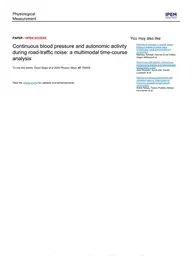 (opens in a new tab)
Tizian Dege et al., "Continuous blood pressure and autonomic activity during road-traffic noise: a multimodal time-course analysis", doi:10.1088/1361-6579/aeb105, CC BY 4.0
TL;DR
36 participants did a 2-back task under three noise conditions: road traffic at 58.12 and 52.12 dB(A), and ambient noise at 30.2 dB(A). Each run was 60 s rest, 120 s trial and 60 s recovery. Beat-to-beat SBP, DBP and HR came from cNIBP, and EDA from skin conductance, analysed in 24 ten-second intervals within subjects. HR and EDA mostly reflected transient changes around stressor onset; cNIBP captured sustained elevation through the trial and decline in recovery. HR showed a pronounced order effect.
- Form factor: finger
Abstract
Objective. Noise-induced stress is a prominent risk to well-being. Despite its relevance to cardiovascular load, blood pressure (BP) is rarely used in noise studies, because conventional cuff-based measurements have low temporal resolution. Continuous non-invasive BP (cNIBP) enables beat-to-beat monitoring, resolving short-lived, phase-dependent dynamics (latency, peak response, recovery) averaged out in intermittent protocols. This work records a detailed timeline of the stress response to realistic road-traffic noise during a cognitively demanding task, evaluating cNIBP alongside established autonomic markers (electrodermal activity (EDA) and heart rate (HR)). Approach. An experimental study with 36 participants
( n = 36 )
combined a 2-back mental task with three noise conditions: road traffic noise at 58.12 and 52.12 dB(A) and ambient noise at 30.2 dB(A). Each test comprised a 60 s Rest , 120 s Trial , and 60 s Recovery phase. Systolic (SBP) and diastolic BP (DBP) and HR were monitored via cNIBP; EDA via skin conductance. Signals were split into 24 non-overlapping ten-second intervals and analysed with within-subject comparisons. Main results. Both SBP and DBP provided detailed information about the cardiovascular response. Unlike HR and EDA, which mainly reflected transient changes around stressor onset, cNIBP captured sustained elevations during the Trial and their decline during recovery, adding complementary information missed by common autonomic markers. HR also showed a pronounced order effect, with increased responses during the first block independent of noise condition, whereas blood-pressure trajectories were more robust. Significance. These findings show that cNIBP resolves the onset, persistence, and recovery of the cardiovascular response to road-traffic noise, information that intermittent cuff measurements and common autonomic markers miss.
Verbatim from the publisher's DOI record (opens in a new tab) · Publisher licence: https://creativecommons.org/licenses/by/4.0/
Results on ChatPPG leaderboards
All leaderboardsNo results from this paper on ChatPPG leaderboards yet. Browse the leaderboards.
Tasks & signals
Tasks
Signals
Keywords
How it works
Cite this paper
Dege, T., Helders, J., Laufs, C., Herweg, A., & Antink, C. H. (2026). Beat-to-beat BP, EDA and HR during road-traffic noise: time-course analysis (Dege, Hoog Antink et al., Physiol Meas 2026). Physiological Measurement. https://doi.org/10.1088/1361-6579/aeb105
Dege, Tizian, Jan Helders, Christian Laufs, Andreas Herweg, and Christoph Hoog Antink. 2026. "Beat-to-beat BP, EDA and HR during road-traffic noise: time-course analysis (Dege, Hoog Antink et al., Physiol Meas 2026)." Physiological Measurement. https://doi.org/10.1088/1361-6579/aeb105.
Dege, T., Helders, J., Laufs, C., Herweg, A. and Antink, C. H. (2026) 'Beat-to-beat BP, EDA and HR during road-traffic noise: time-course analysis (Dege, Hoog Antink et al., Physiol Meas 2026)', Physiological Measurement. doi: 10.1088/1361-6579/aeb105.
Dege, Tizian, et al. "Beat-to-beat BP, EDA and HR during road-traffic noise: time-course analysis (Dege, Hoog Antink et al., Physiol Meas 2026)." Physiological Measurement, 2026. https://doi.org/10.1088/1361-6579/aeb105.
T. Dege, J. Helders, C. Laufs, A. Herweg, and C. H. Antink, "Beat-to-beat BP, EDA and HR during road-traffic noise: time-course analysis (Dege, Hoog Antink et al., Physiol Meas 2026)," Physiological Measurement, 2026, doi: 10.1088/1361-6579/aeb105.
@article{dege2026beattobeat,
  title         = {{Beat-to-beat BP, EDA and HR during road-traffic noise: time-course analysis (Dege, Hoog Antink et al., Physiol Meas 2026)}},
  author        = {Dege, Tizian and Helders, Jan and Laufs, Christian and Herweg, Andreas and Antink, Christoph Hoog},
  year          = {2026},
  journal       = {Physiological Measurement},
  doi           = {10.1088/1361-6579/aeb105}
}Added to the ChatPPG research hub