Activity counts measure attention, not model quality. Missing counts are unknown. Publication status follows the linked source; a listed venue alone does not confirm peer review.
End-to-end 3D-CNN for BVP from raw face video, plus FSAM (NMF-based joint multidimensional attention). Also shows FSAM plugged into EfficientPhys (2D-CNN / TSM).
- Form factor
- camera_rppg
- Openness
- Dual
- Code
- github.com/PhysiologicAILab/FactorizePhys
- Year
- 2024
arXiv: 2411.01542
- Type
- Task model
- Modalities
- Not reported
- Form factor
- Camera rPPG
- Parameters
- Not reported
- Architecture
- Not reported
- Venue
- Not reported
- Year
- 2024
- DOI
- Not reported
- Code
- Not reported
- Weights
- Not reported
- Licence
- Not reported
- Caveats
- Not reported
- Datasets
- Not reported
- Added
- Not reported
- Updated
- Oct 24, 2026
Abstract
Remote photoplethysmography (rPPG) enables non-invasive extraction of blood volume pulse signals through imaging, transforming spatial-temporal data into time series signals. Advances in end-to-end rPPG approaches have focused on this transformation where attention mechanisms are crucial for feature extraction. However, existing methods compute attention disjointly across spatial, temporal, and channel dimensions. Here, we propose the Factorized Self-Attention Module (FSAM), which jointly computes multidimensional attention from voxel embeddings using nonnegative matrix factorization. To demonstrate FSAM's effectiveness, we developed FactorizePhys, an end-to-end 3D-CNN architecture for estimating blood volume pulse signals from raw video frames. Our approach adeptly factorizes voxel embeddings to achieve comprehensive spatial, temporal, and channel attention, enhancing performance of generic signal extraction tasks. Furthermore, we deploy FSAM within an existing 2D-CNN-based rPPG architecture to illustrate its versatility. FSAM and FactorizePhys are thoroughly evaluated against state-of-the-art rPPG methods, each representing different types of architecture and attention mechanism. We perform ablation studies to investigate the architectural decisions and hyperparameters of FSAM. Experiments on four publicly available datasets and intuitive visualization of learned spatial-temporal features substantiate the effectiveness of FSAM and enhanced cross-dataset generalization in estimating rPPG signals, suggesting its broader potential as a multidimensional attention mechanism. The code is accessible at https://github.com/PhysiologicAILab/FactorizePhys.
Verbatim fromarXiv· arXiv metadata (abstracts are released under CC0)
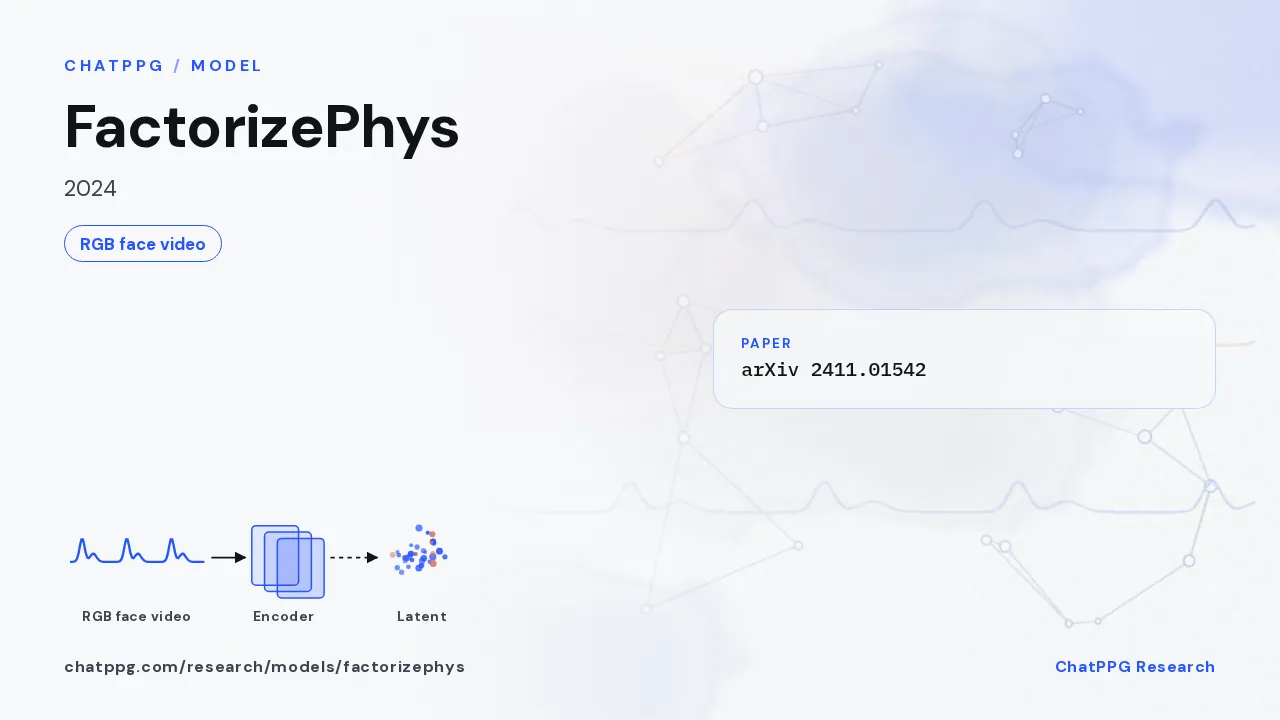
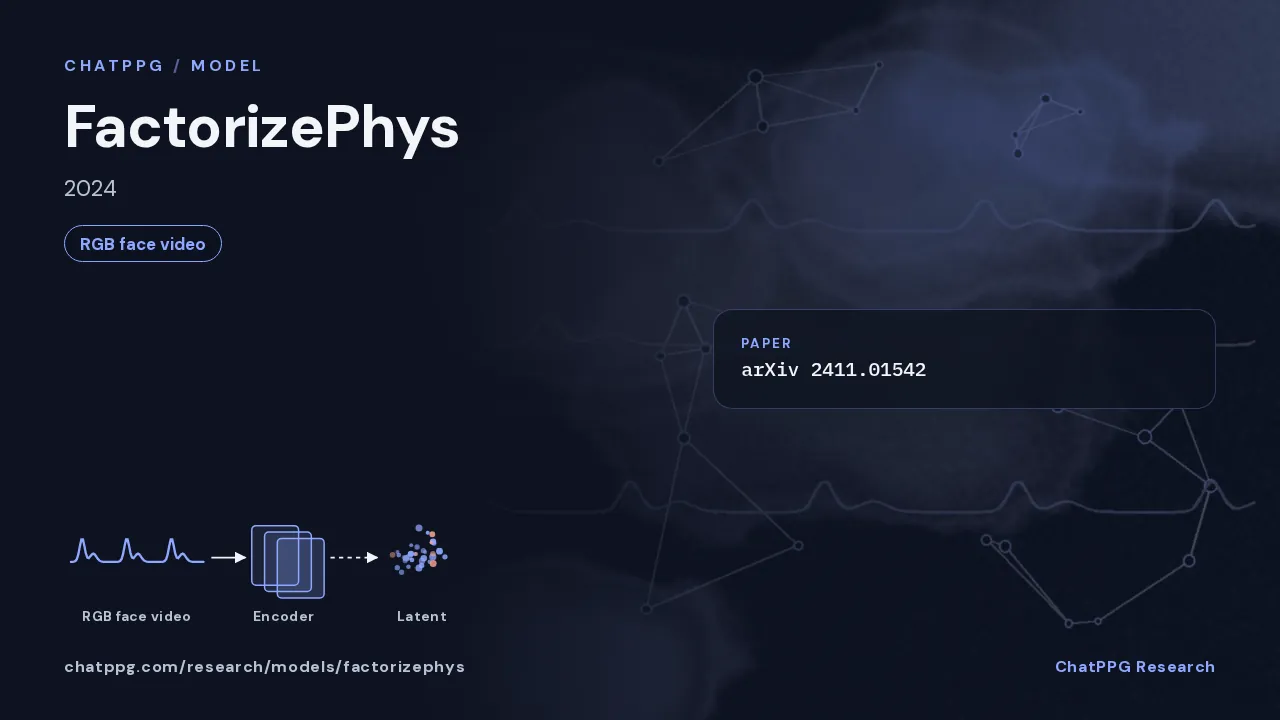
How it works
- Approach
- rppg · model · factorizephys · dual · neurips 2024 · fsam
Datasets
Cite
APA
FactorizePhys. (2024). arXiv. https://arxiv.org/abs/2411.01542
BibTeX
@misc{factorizephys2024factorizephys,
  title         = {{FactorizePhys}},
  year          = {2024},
  eprint        = {2411.01542},
  archivePrefix = {arXiv}
}
Built from the hub record. Check it against the publisher before submitting.
History
Record updated
- MS-rPPGShared topic: dualmulti-spectral (RGB + NIR) state space model for in-vehicle rPPG2026
- PhysMamba / RhythmMambaShared topic: dualMamba-based rPPG (open-rppg zoo)
- MSTransShared topic: modelmulti-scale spatio-temporal transformer for rPPGRGB2027
- FLOWShared topic: modelfeature-level optimal warping for domain-generalized rPPG2026