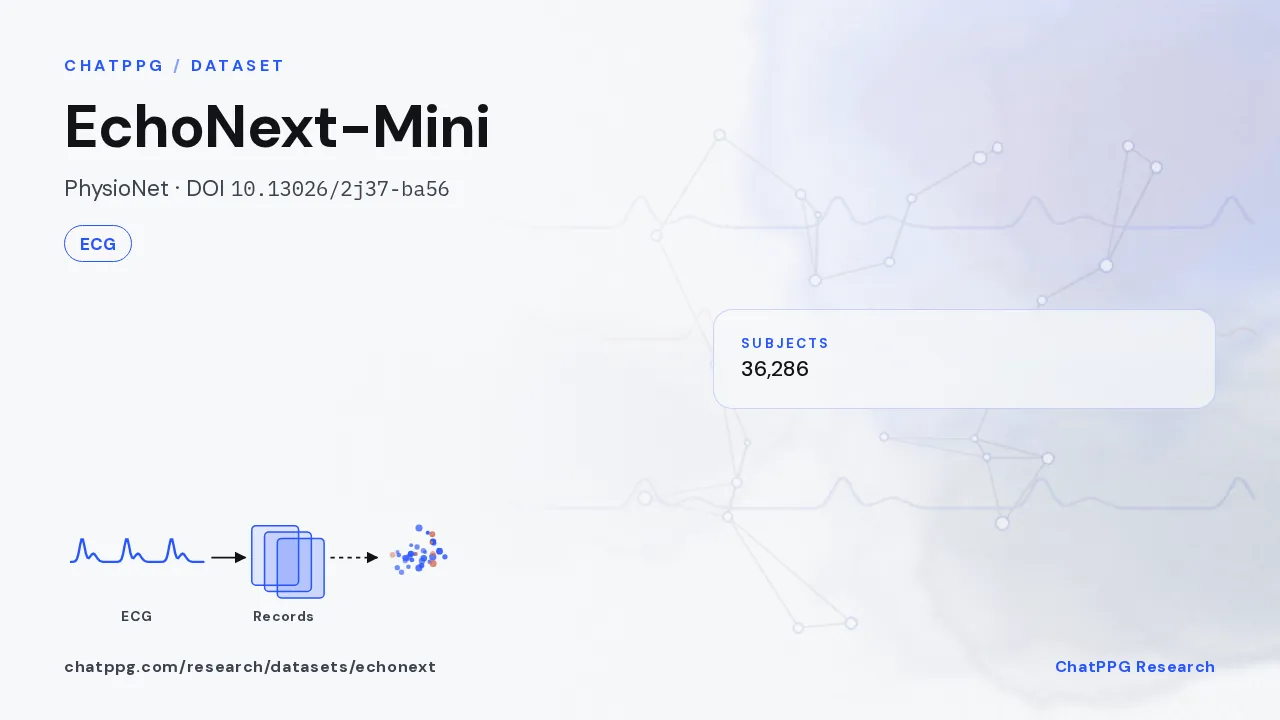
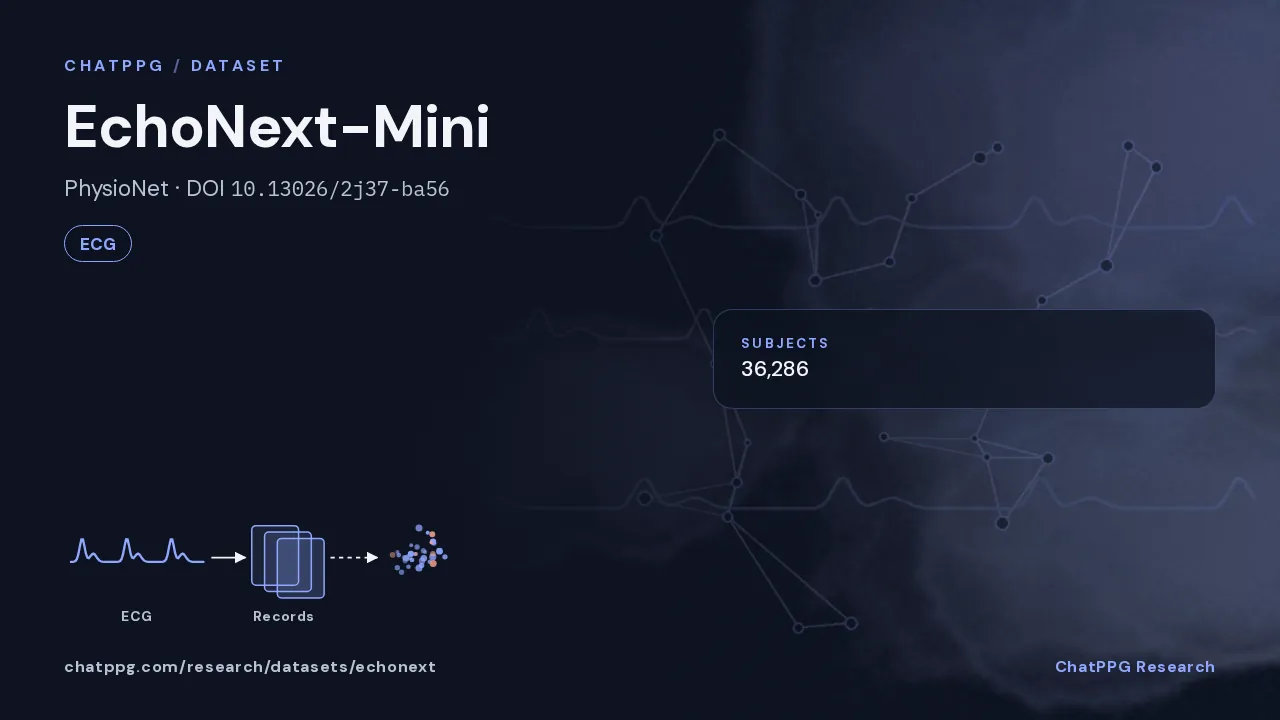
EchoNext-Mini is a PhysioNet restricted collection of 100,000 clinical 12-lead ECGs at 250 Hz from 36,286 adults, each paired with echocardiogram-confirmed structural heart disease labels from Columbia University Irving Medical Center. Waveforms are 10-second preprocessed segments with binary SHD thresholds and a composite moderate-or-greater SHD flag; access requires a PhysioNet account and the Restricted Health Data DUA.
- License
- PhysioNet Restricted Health Data License 1.5.0
- Type
- Dataset
- Access
- Not reported
- Subjects
- 36,286
- Signals
- ECG
- PPG sites
- None
- Setting
- Clinical
- Wrist
- No
- Raw waveforms
- No
- Tasks
- Not reported
- Updated
- Oct 27, 2026
Original description
This dataset contains a de-identified collection of 100,000 12-lead electrocardiograms (ECGs) with paired structural heart disease (SHD) labels derived from echocardiography, collected at Columbia University Irving Medical Center. Each ECG is provided with raw waveform data sampled at 250 Hz across all 12 leads, along with accompanying demographic and ECG-specific tabular metadata, including age, sex, heart rate, PR interval, QRS duration, and corrected QT interval. Each ECG is annotated with a binary label indicating the presence or absence of structural heart disease based on echocardiographic findings, including reduced left ventricular ejection fraction, increased ventricular wall thickness, significant valvular disease, right ventricular dysfunction, pulmonary hypertension, or pericardial effusion.
This dataset was developed as part of the creation of the Columbia Mini-Model, a lightweight deep learning model for SHD detection from ECGs. The dataset represents a simplified, focused subset of the larger EchoNext training population and was used to evaluate model performance in resource-constrained settings or smaller-scale deployment environments. It is being released to promote transparency and reproducibility, support further research in cardiovascular AI, and enable benchmarking of lightweight ECG-based screening models for structural heart disease.
Verbatim fromPhysioNet· Project abstract from PhysioNet
Key numbers
How it works
No model in the hub reports results on this dataset yet.
- Sampling
- 12-lead ECG 250 Hz, 10 s segments (preprocessed arrays N x 1 x 2500 x 12)
- Reference labels
- ecg
- Device roles
- Clinical reference (ECG)
Models trained or evaluated on it
Papers using it· 1
FAQ
How many subjects are in EchoNext-Mini?
EchoNext-Mini has data from 36,286 subjects, as listed in its research record.
What signals does EchoNext-Mini include?
EchoNext-Mini includes ECG data. Sampling rate as recorded: 12-lead ECG 250 Hz, 10 s segments (preprocessed arrays N x 1 x 2500 x 12).
How do I get EchoNext-Mini, and what is its licence?
It is hosted on PhysioNet at https://physionet.org/content/echonext/. Licence: PhysioNet Restricted Health Data License 1.5.0.
Which models and papers in the ChatPPG research hub use EchoNext-Mini?
The hub links it to 1 paper, including "Scaling ECG Foundation Models and Identifying a Threshold for Effective Representation Learning". They are listed under Related on this page.
Cite
APA
EchoNext-Mini [Data set]. (n.d.). physionet. https://doi.org/10.13026/2j37-ba56
BibTeX
@misc{echonextechonextmini,
  title         = {{EchoNext-Mini}},
  howpublished  = {physionet},
  doi           = {10.13026/2j37-ba56}
}
Built from the hub record. Check it against the publisher before submitting.
Cite the ChatPPG record
Cite the dated snapshot 2026-10 for a fixed, reproducible version. Please also cite the original publications listed above.
APA
ChatPPG. (2026). EchoNext-Mini: dataset record (Version 2026-10) [Data set]. ChatPPG Research Hub. https://chatppg.com/research/datasets/echonext
BibTeX
@misc{chatppg_dataset_echonext,
  author       = {{ChatPPG}},
  title        = {{EchoNext-Mini: dataset record}},
  year         = {2026},
  month        = oct,
  version      = {2026-10},
  howpublished = {\url{https://chatppg.com/research/datasets/echonext}},
  note         = {ChatPPG Research Hub, Snapshot 2026-10, https://chatppg.com/research/snapshots/2026-10}
}
CITATION.cff
cff-version: 1.2.0
message: "If you use this resource, please cite it as below."
type: dataset
title: "EchoNext-Mini: dataset record"
authors:
  - name: "ChatPPG"
url: "https://chatppg.com/research/datasets/echonext"
repository-artifact: "https://chatppg.com/research/snapshots/2026-10"
version: "2026-10"
date-released: "2026-10-27"
History
Record updated
Papers
- Scaling ECG Foundation Models and Identifying a Threshold for Effective Representation LearningUses EchoNext-MinimedRxiv preprint v1, posted 2026-07-17 · 2026
 ECG-JEPA: Learning General Representation of 12-Lead ECG with a Joint-Embedding Predictive ArchitectureShared topic: 12 leadNeural Networks · 2027
 AnyECG-Echo: Wearable Single-Lead ECG Detects Fine-Grained Structural Heart Disease Through Echo-Report SupervisionShared topic: structural heart diseaseResearch Square preprint · 2026