PPG for Cardiac Monitoring: From Heart Rate to Heart Failure Detection
PPG is becoming a first-line cardiac monitoring tool. This guide covers validated applications: heart rate, HRV, atrial fibrillation, heart failure, and emerging ECG-free arrhythmia detection.
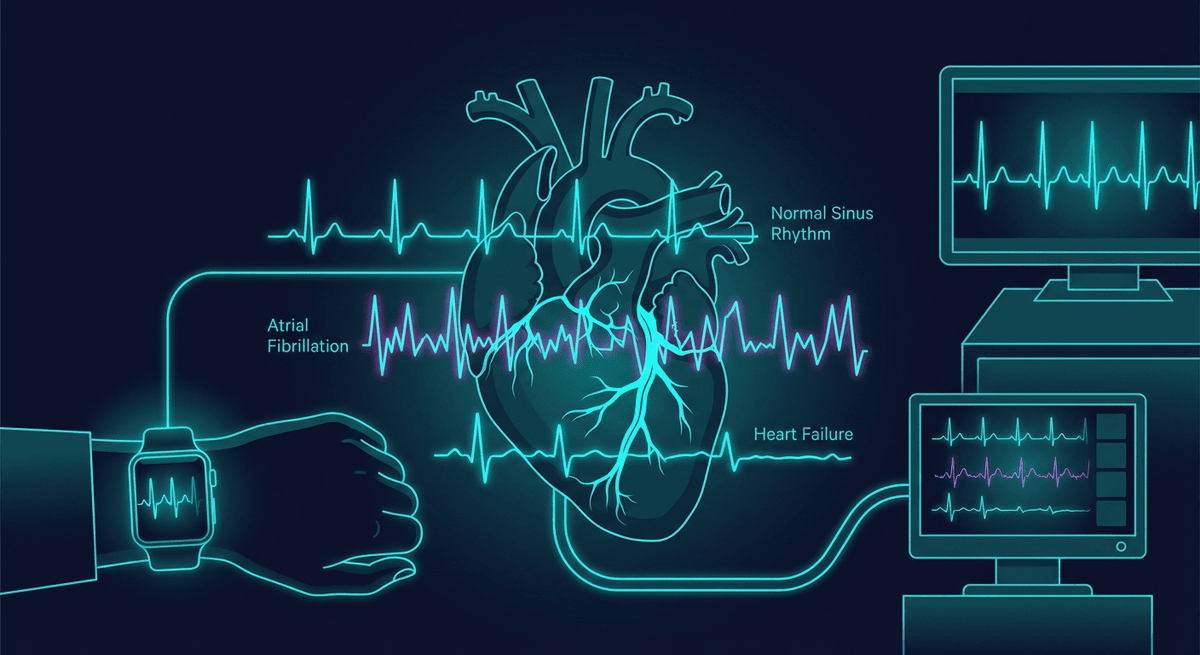
PPG has evolved from a pulse-oximetry component into a widely used source of pulse rate, rhythm-screening, and vascular-waveform data. Large wearable studies have shown the reach of PPG-based atrial-fibrillation notification, while sleep-apnea screening may use other sensors: Apple's cleared notification feature, for example, analyzes accelerometer-derived breathing disturbances rather than SpO2.
This guide maps out where PPG-based cardiac monitoring stands today: what is validated, what is emerging, and where the gaps remain.
1. Heart Rate and Rhythm Monitoring
The most mature application. PPG heart rate at rest is accurate to within ±3–5 bpm against ECG across virtually all modern consumer wearables. At the population scale, this has enabled genuinely new insights: Apple's Health eHeart Study used 60,000 participants' continuous resting heart rate data to characterize normal HR distributions across age, sex, and activity levels — impossible with episodic clinical measurements.
For continuous rhythm monitoring, PPG provides beat-to-beat IBI sequences that reveal regularity, irregularity, and rhythm pattern changes in real time. While it cannot replace ECG for arrhythmia characterization, it serves as a continuous screening layer — identifying individuals who warrant formal ECG evaluation.
2. Atrial Fibrillation Detection
AF detection is the most commercially and clinically significant PPG cardiac application. AF produces an irregularly irregular rhythm — chaotic inter-beat intervals without any predictable pattern. This is detectable in the PPG IBI sequence with high sensitivity and specificity.
FDA-cleared devices: Apple Watch (since Series 4), Withings ScanWatch, Samsung Galaxy Watch, and several others have FDA De Novo clearance or 510(k) clearance for AF notification. These features work by analyzing 30-second or 60-second IBI sequences and computing irregularity metrics.
Key validation study: The Apple Heart Study (Perez et al., 2019, NEJM) enrolled 419,297 participants. Among those who received AF notifications, 84% had AF on confirmatory ECG patch (positive predictive value 0.84). This was the largest cardiac arrhythmia study ever conducted, and it used only PPG data from a wrist wearable.
Current limitations: PPG cannot localize the origin of an arrhythmia, cannot detect all arrhythmia types, and produces false positives in patients with frequent ectopic beats. Confirmed AF diagnosis still requires ECG. But as a population screening tool, wrist PPG AF notification has unquestionable utility — the American Heart Association has incorporated wearable AF screening into its guidance.
For a full technical breakdown, see our PPG atrial fibrillation screening guide.
3. Heart Rate Variability (HRV)
HRV from PPG is the most widely used continuous cardiac metric in consumer wellness, sports performance, and recovery monitoring. RMSSD (root mean square of successive differences) computed from overnight PPG IBI sequences has been validated as a proxy for parasympathetic activity and recovery status.
Clinical applications of HRV have expanded significantly as continuous PPG data becomes available:
Post-cardiac event monitoring: HRV depression after myocardial infarction predicts adverse outcomes. Wearable PPG makes continuous post-discharge HRV monitoring practical for the first time.
Heart failure management: HRV in CHF patients correlates with NYHA functional class and prognosis. Continuous wearable monitoring may enable earlier detection of decompensation.
Long COVID autonomic dysfunction: Dysautonomia is a core feature of long COVID. PPG-derived HRV tracking in the home setting has emerged as a monitoring tool in long COVID research. See our PPG long COVID autonomic dysfunction guide.
4. Heart Failure Monitoring
PPG is increasingly used in heart failure management, both directly and as part of multi-parameter monitoring systems.
Hemodynamic monitoring: In compensated CHF, PPG waveform amplitude and pulse pressure variation are early hemodynamic markers. As congestion worsens, cardiac output falls, peripheral perfusion decreases, and waveform amplitude shrinks before clinical symptoms worsen.
Respiration and fluid status: PPG respiratory rate estimation becomes more irregular in decompensating CHF (Cheyne-Stokes breathing pattern). PPG amplitude variation with respiration — reflecting right heart preload sensitivity — increases with fluid overload.
Predictive monitoring: Samsung Research and Withings have published validation data for PPG-based daily cardiovascular metrics in CHF patients. CHARM study data suggests daily resting HR and HRV trends from wearables can identify decompensation windows 2–7 days before hospitalization.
Cardiac rehabilitation: Continuous PPG monitoring during structured exercise programs enables real-time HR zone tracking without chest electrodes, improving adherence to exercise prescriptions. See our PPG cardiac rehabilitation guide.
5. Arrhythmia Screening Beyond AF
While AF is the dominant arrhythmia application, research is expanding PPG monitoring to other rhythm disorders:
Supraventricular tachycardia (SVT): Episodes of rapid, regular tachycardia (150–250 bpm) are detectable in PPG as sudden-onset rapid regular rhythm. Algorithm sensitivity for SVT episode detection in ambulatory PPG studies ranges from 70–85%.
Bradyarrhythmias: Sinus bradycardia, sinus pauses, and AV block produce slow heart rates or sudden pauses detectable in PPG IBI sequences. Wearable-detected prolonged pauses (>2.5 seconds) prompted further evaluation in several case reports.
Premature atrial and ventricular contractions (PACs/PVCs): Frequent ectopics produce a characteristic IBI pattern (short-long coupling). PPG can detect frequent ectopy, though distinguishing PAC from PVC requires ECG morphology analysis.
Ventricular tachycardia: Sustained VT produces regular rapid PPG pulses. However, the hemodynamic instability in VT (and the urgency of detection) makes wearable PPG less relevant here — implanted devices and emergency monitoring are the appropriate tools.
6. Blood Pressure Monitoring
Cuffless blood pressure estimation using PPG is one of the most commercially anticipated applications in wearable health. Two main approaches:
Pulse transit time (PTT): The time between the ECG R-wave (or PPG pulse at a proximal site) and PPG pulse arrival at a distal site correlates inversely with arterial blood pressure. Stiffer arteries at higher pressure propagate pulses faster, reducing PTT. The challenge is that PTT requires either a two-site PPG measurement or ECG+PPG, and individual calibration is required.
Waveform morphology: PPG augmentation index, systolic upstroke time, and diastolic-to-systolic ratio correlate with blood pressure through their relationship to arterial stiffness. Models trained on population data can estimate BP from these features, but individual variability is high without calibration.
FDA regulatory status: No wearable device yet has FDA clearance as a Class II medical device for continuous cuffless BP monitoring without calibration. Samsung Galaxy Watch and Omron HeartGuide are regulated differently in different markets. The field is advancing rapidly — watch for approvals in the 2026–2027 window.
For the full technical picture, see our PPG blood pressure estimation guide.
PPG during sleep captures cardiac events that are otherwise invisible in people who do not have overnight cardiac monitoring.
Sleep apnea and respiratory events: Dual-wavelength PPG can identify oxygen-desaturation patterns that may accompany apnea, but desaturation is not present in every event and oximetry alone does not diagnose OSA. Wearable screening methods differ by product. Apple's FDA-cleared notification feature analyzes wrist movements with the accelerometer to derive breathing disturbances; it is not an SpO2 algorithm.
Nocturnal arrhythmias: AF, PACs, and bradyarrhythmias preferentially occur during sleep. Continuous overnight PPG has a significant advantage over daytime spot checks for capturing these events.
REM sleep cardiac surges: HR increases during REM sleep are a normal autonomic feature, but exaggerated surges are seen in REM sleep behavior disorder and some cardiac conditions. PPG-based sleep staging combined with HR analysis can flag atypical REM cardiac patterns.
Clinical Translation: Where Are We?
| Application | Status | FDA/CE Clearance | Accuracy |
|---|---|---|---|
| Resting heart rate | Mature, widespread | No (wellness) / Yes (medical) | ±3–5 bpm |
| AF detection (notification) | Commercialized | FDA De Novo (Apple, Withings) | ~84% PPV |
| HRV monitoring | Commercially mature | No | Good vs. ECG at rest |
| SpO₂ and sleep-apnea screening | Commercialized as distinct functions | Device- and claim-specific | Screening-level; method varies by device |
| Blood pressure estimation | Emerging | No US clearance | Requires calibration |
| Heart failure monitoring | Research / pilot | No | Promising, not validated |
Frequently Asked Questions
Can a PPG wearable replace an ECG for cardiac monitoring? No. ECG measures cardiac electrical activity directly and provides information PPG cannot — ST segment changes (ischemia), P-wave morphology, QRS width (bundle branch block), QT interval. PPG is an excellent screening and continuous monitoring tool but complements rather than replaces ECG for clinical diagnosis.
How does PPG detect atrial fibrillation? AF produces an irregularly irregular pulse rhythm. PPG devices collect 30–60 seconds of inter-beat intervals and apply algorithms (often based on RMSSD, coefficient of variation, or machine learning classifiers) to detect the lack of rhythm regularity characteristic of AF. See our full PPG AF detection guide.
Is PPG useful for monitoring heart failure at home? Increasingly, yes. Heart rate trends, HRV, respiratory rate derived from PPG amplitude modulation, and SpO₂ all provide clinically relevant hemodynamic information. Studies show that home wearable monitoring in CHF patients can reduce hospitalizations when integrated with remote monitoring programs.
What cardiac conditions can PPG NOT detect? PPG cannot detect: ischemia/angina (requires ECG ST analysis), structural heart disease (requires imaging), valvular pathology (requires echocardiography), left ventricular function (requires echo or cardiac MRI), or precise arrhythmia characterization beyond rhythm regularity.
Can PPG detect a heart attack? A PPG device would likely show a tachycardia and potential rhythm irregularity during an acute MI, but these are non-specific findings. STEMI detection requires ECG with ST-elevation recognition. Wearable PPG should not be relied upon for MI detection — emergency symptoms require emergency medical evaluation.
References
-
Perez, M. V., Mahaffey, K. W., Hedlin, H., et al. (2019). Large-scale assessment of a smartwatch to identify atrial fibrillation. New England Journal of Medicine, 381(20), 1909–1917. https://doi.org/10.1056/NEJMoa1901183
-
Bumgarner, J. M., Lambert, C. T., Hussein, A. A., et al. (2018). Smartwatch algorithm for automated detection of atrial fibrillation. Journal of the American College of Cardiology, 71(21), 2381–2388. https://doi.org/10.1016/j.jacc.2018.03.003
-
Avram, R., Tison, G. H., Aschbacher, K., et al. (2020). Real-world heart rate norms in the Health eHeart study. npj Digital Medicine, 2, 58. https://doi.org/10.1038/s41746-019-0134-9
-
Charlton, P. H., et al. (2022). Wearable photoplethysmography for cardiovascular monitoring. Proceedings of the IEEE, 110(3), 355–381. https://doi.org/10.1109/JPROC.2022.3149785