PPG Long Covid Autonomic Dysfunction
Long COVID (post-acute sequelae of SARS-CoV-2, or PASC) affects an estimated 10–30% of people who had COVID-19, and autonomic nervous system dysfuncti...
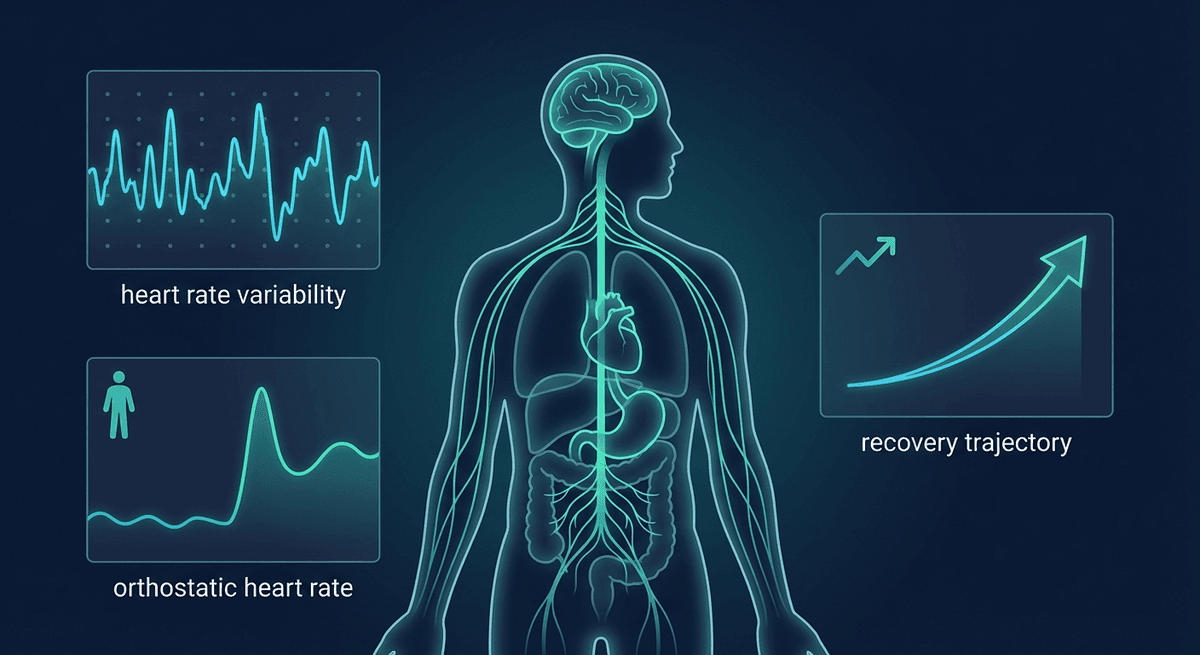
Long COVID (post-acute sequelae of SARS-CoV-2, or PASC) affects an estimated 10–30% of people who had COVID-19, and autonomic nervous system dysfunction is one of its most common and debilitating features. PPG wearables have emerged as a practical monitoring tool for long COVID patients, both for initial symptom characterization and for tracking recovery.
Autonomic dysfunction in long COVID manifests primarily as postural orthostatic tachycardia syndrome (POTS) or a POTS-like phenotype, dysregulated heart rate variability, and abnormal circulatory responses to ordinary activities. These are measurable with PPG.
What Autonomic Dysfunction Means in Long COVID
The autonomic nervous system controls heart rate, blood pressure, and vascular tone automatically, without conscious input. In long COVID, this system appears dysregulated in a significant proportion of patients, likely due to a combination of:
- Residual viral inflammatory effects on autonomic ganglia
- Autoantibodies against adrenergic and muscarinic receptors
- Mast cell activation affecting vascular tone
- Small fiber neuropathy impairing autonomic reflex arcs
- Persistent endothelial dysfunction
The result is an autonomic nervous system that overresponds to postural changes, underresponds to recovery cues, and maintains an inappropriately elevated sympathetic tone at rest.
PPG Biomarkers in Long COVID Autonomic Assessment
Heart Rate Variability (HRV)
HRV is the variation in time between consecutive heartbeats. Higher HRV generally reflects healthy autonomic flexibility: the heart accelerates during inhalation (sympathetic) and decelerates during exhalation (parasympathetic), producing respiratory sinus arrhythmia. This variation decreases when the autonomic system is stressed, ill, or dysregulated.
Multiple studies document reduced HRV in long COVID patients compared to recovered COVID and pre-COVID baselines:
A study by Barizien et al. (2021, doi:10.1038/s41598-021-93501-0) found significantly reduced SDNN (standard deviation of NN intervals) in long COVID patients compared to age-matched controls, with the reduction correlating with fatigue severity. RMSSD, reflecting parasympathetic tone, was also significantly reduced, consistent with autonomic imbalance favoring persistent sympathetic activation.
PPG-derived pulse rate variability (PRV) correlates well with ECG-derived HRV at rest (r > 0.95 for RMSSD and SDNN in most studies), making wrist-worn PPG devices practical tools for daily HRV monitoring in long COVID patients.
Resting Heart Rate Trends
Elevated resting heart rate is a reliable marker of autonomic dysfunction and sympathetic predominance. Many long COVID patients report persistently elevated resting heart rates (often 10–20 BPM above their pre-COVID baseline) that persist for weeks to months.
Daily resting heart rate monitoring with a PPG wearable provides objective data for this phenomenon. A 2022 analysis of Garmin wearable data from long COVID patients (Radin JM et al., 2022, doi:10.1186/s13054-022-03937-7) found that resting heart rate remained significantly elevated for 2–3 months after acute infection in symptomatic long COVID patients, normalizing more slowly than in patients who recovered fully.
Orthostatic Heart Rate Response
POTS is characterized by an increase in heart rate of 30 beats per minute or more within 10 minutes of moving from a lying to a standing position, without significant orthostatic hypotension. It is currently estimated to affect 10–30% of long COVID patients.
A simplified version of the orthostatic heart rate test can be performed with a PPG wearable:
- Lie down and allow heart rate to stabilize for 5 minutes (record lying HR)
- Stand up and record heart rate every minute for 10 minutes
- If HR increases by 30 BPM or more and this is sustained, POTS criteria are met
A 2022 paper by Larsen et al. (doi:10.1161/JAHA.121.024521) validated this wearable-based orthostatic protocol against tilt-table testing in long COVID patients, finding sensitivity of 82% and specificity of 89% for POTS diagnosis, making it a practical home screening tool.
Post-Exertional Malaise Detection
Post-exertional malaise (PEM) is the hallmark symptom of long COVID and myalgic encephalomyelitis/chronic fatigue syndrome (ME/CFS): symptom exacerbation following physical or mental effort that is disproportionate to the activity and delayed by 12–72 hours.
PPG-based monitoring can track the autonomic signature of PEM: heart rate elevation persisting long after activity has stopped, delayed HRV recovery, and abnormal overnight heart rate patterns.
Research from the Survivor Corps and various academic centers has documented that patients with long COVID show characteristic PPG waveform abnormalities during PEM episodes, including reduced HRV, elevated resting heart rate, and blunted nocturnal dipping of heart rate. These objective biomarkers are clinically valuable when patients are trying to establish that their functional limitations are physiological, not psychological.
SpO2 During Exertion
Some long COVID patients experience desaturation during mild exercise that does not occur at rest, consistent with ventilation-perfusion mismatch or pulmonary vascular dysfunction. Continuous SpO2 monitoring during a 6-minute walk test or during activities of daily living can document this phenomenon.
A 2021 study by Sonnweber et al. (doi:10.1183/13993003.02397-2020) found that 15% of post-COVID patients had exercise-induced SpO2 desaturation below 94% at 12 weeks post-infection, despite normal resting SpO2. Wrist-worn PPG SpO2 monitoring (with the caveats about accuracy noted elsewhere) can track this pattern over time.
Practical Monitoring Protocols for Long COVID Patients
Based on the literature and clinical experience, the following PPG monitoring practices are useful for long COVID patients:
Daily resting HRV measurement: First thing in the morning, before getting out of bed, take a 2–5 minute HRV measurement. This provides a daily autonomic status indicator. Declining HRV or elevated resting HR are early warning signs of impending symptom flares.
Orthostatic heart rate testing: Weekly 10-minute lying-to-standing protocol as described above, with results logged. Tracking over weeks provides objective evidence of improvement or worsening.
Activity-paced monitoring: Wearing a continuous HR monitor during activities helps establish personal heart rate thresholds beyond which PEM is likely. Many long COVID rehabilitation protocols recommend staying below a heart rate of (220 - age) × 0.6 to avoid PEM triggers.
Overnight monitoring: Sleep heart rate and SpO2 monitoring can reveal nocturnal autonomic dysfunction patterns not visible during daytime monitoring.
Limitations and Caveats
PPG monitoring provides objective data but cannot replace clinical evaluation. Long COVID autonomic dysfunction has multiple overlapping subtypes, and proper diagnosis requires:
- Formal tilt-table testing for confirmed POTS diagnosis (wearable screening supports but does not replace this)
- ECG for arrhythmia exclusion
- Blood work for autoantibodies, inflammatory markers, and thyroid function
- Cardiac imaging if significant symptoms suggest structural disease
Additionally, not all long COVID symptoms have autonomic origins. Cognitive symptoms (brain fog), joint pain, and other manifestations may have different pathophysiology that PPG monitoring will not capture.
The Research Landscape
Long COVID represents one of the most actively studied areas of PPG application. Several ongoing studies are using consumer wearable data at scale to characterize autonomic recovery trajectories:
- The Survivor Corps/Cornell collaborative study is using Apple Watch and Oura Ring data from thousands of long COVID patients to characterize HRV and HR recovery timelines
- The NIH-funded RECOVER initiative includes wearable biomarker collection
- Research groups at Stanford, UCSD, and several European centers have published on wearable-based POTS screening protocols
This research base is growing rapidly, and the role of PPG in long COVID monitoring is likely to become more clearly defined over the next few years.
Internal Links
- For HRV measurement methodology: PPG HRV Motion Artifacts and Accuracy
- For autonomic assessment via PPG: PPG Autonomic Function Testing
- For heart rate variability analysis: PPG Power Spectral Analysis
FAQ
Can a wearable diagnose long COVID? No wearable device can diagnose long COVID. However, PPG wearables can objectively document several cardinal features of long COVID: elevated resting heart rate, reduced HRV, abnormal orthostatic heart rate responses, and exercise-induced SpO2 changes. This objective data supports the clinical evaluation and treatment process.
What is POTS and how common is it in long COVID? Postural orthostatic tachycardia syndrome (POTS) is a form of dysautonomia where heart rate increases abnormally upon standing. An increase of 30 BPM within 10 minutes of standing, without significant hypotension, meets diagnostic criteria. Studies suggest 10–30% of long COVID patients develop a POTS or POTS-like phenotype.
How does HRV relate to long COVID symptoms? Heart rate variability reflects the balance between sympathetic and parasympathetic autonomic tone. Lower HRV indicates reduced autonomic flexibility and sympathetic predominance. Long COVID patients consistently show reduced HRV compared to controls, and HRV correlates with fatigue severity and functional capacity.
What PPG wearable is best for long COVID monitoring? No single device has been validated specifically for long COVID monitoring. Devices that provide continuous HRV tracking, resting heart rate, and SpO2 monitoring are most useful: Apple Watch, Garmin Fenix/Forerunner series, Oura Ring, Polar devices with continuous HR. The specific device matters less than consistent daily measurement with the same device.
What is post-exertional malaise and can PPG detect it? PEM is the signature symptom of long COVID and ME/CFS: disproportionate symptom worsening following physical or cognitive activity, typically delayed 12–72 hours. PPG can detect the autonomic signature of PEM (elevated HR, reduced HRV, delayed recovery) though it cannot predict onset. Heart rate monitoring during activity can help patients identify personal exertion thresholds that trigger PEM.
Is long COVID autonomic dysfunction permanent? Evidence suggests most patients show gradual improvement over 6–24 months, though recovery is highly variable. PPG-based longitudinal monitoring provides objective evidence of improvement trajectory. Formal rehabilitation programs (cardiac rehabilitation, graded exercise programs adapted for PEM) combined with symptom pacing show the best outcomes in current evidence.
Frequently Asked Questions
- What is POTS and how common is it in long COVID?
- Postural orthostatic tachycardia syndrome (POTS) involves heart rate increasing 30 BPM or more upon standing. Studies suggest 10–30% of long COVID patients develop a POTS or POTS-like phenotype.
- Can a wearable diagnose long COVID?
- No wearable device can diagnose long COVID. However, PPG wearables can objectively document elevated resting heart rate, reduced HRV, abnormal orthostatic responses, and exercise-induced SpO2 changes, supporting clinical evaluation.
- How does HRV relate to long COVID symptoms?
- HRV reflects autonomic balance. Long COVID patients consistently show reduced HRV, correlating with fatigue severity. Lower HRV indicates sympathetic predominance and reduced autonomic flexibility.