PPG Cardiac Rehabilitation Monitoring
Cardiac rehabilitation (CR) is one of the most evidence-based interventions in cardiovascular medicine. Systematic exercise training following myocard...
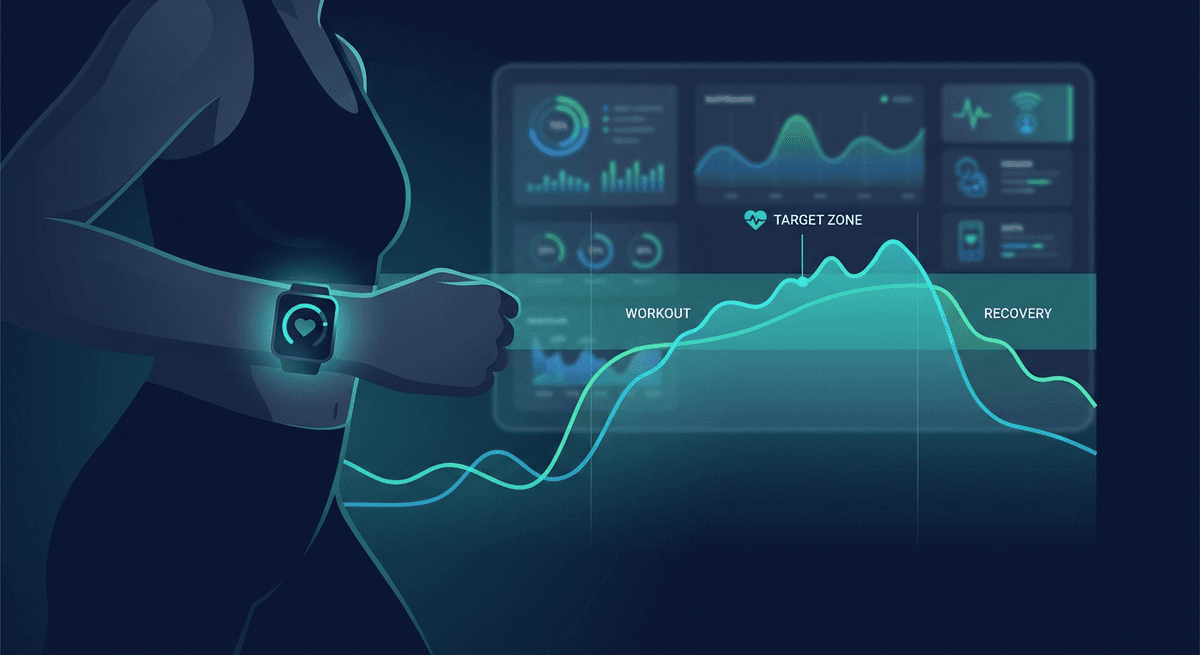
Cardiac rehabilitation (CR) is one of the most evidence-based interventions in cardiovascular medicine. Systematic exercise training following myocardial infarction, heart failure, or cardiac surgery reduces all-cause mortality by 15–28% and cardiovascular mortality by 26–31%. Despite this evidence, CR participation rates in most countries are below 30% of eligible patients.
PPG-based wearable monitoring has the potential to address two key barriers: adherence through home-based CR, and personalized exercise intensity guidance using heart rate targets derived from the patient's own PPG data.
Exercise Heart Rate Monitoring in Cardiac Rehabilitation
The foundation of CR exercise prescription is target heart rate: patients exercise at 50–85% of their heart rate reserve (Karvonen method) or 60–80% of their maximum heart rate. Staying within these zones provides sufficient stimulus for cardiovascular adaptation while avoiding excessive demands on a recovering heart.
The Karvonen formula: Target HR = HR_rest + (0.5–0.85) × (HR_max - HR_rest)
Where HR_max is typically estimated from a symptom-limited exercise test (METS), not from the 220 - age formula, which is unreliable in cardiac patients (particularly those on beta-blockers, where the formula overestimates chronotropic reserve).
PPG wearables enable continuous heart rate monitoring during home exercise, providing real-time feedback when patients exceed their target zones. This replaces the traditional method of manual pulse counting during exercise (impractical and inaccurate).
A randomized controlled trial by Rawstorn et al. (2016, doi:10.1161/JAHA.116.003723) demonstrated that remotely monitored wearable-guided home CR achieved equivalent improvements in cardiorespiratory fitness (peak VO2) compared to supervised gym-based CR, with significantly higher completion rates (91% vs 74%). The wearable component used continuous HR monitoring to guide session intensity.
Accuracy Considerations in Cardiac Patients
The accuracy limitations of PPG heart rate monitoring (described in detail in the smartwatch heart rate accuracy article) have particular implications in cardiac rehabilitation patients:
Beta-blockers: Most post-MI and heart failure patients are on beta-blocker therapy. Beta-blockers do not affect PPG sensor function or algorithm accuracy, but they change the physiological meaning of heart rate targets. Patients on beta-blockers have blunted heart rate responses to exercise, meaning the same workload intensity produces lower heart rate. This must be accounted for in CR exercise prescription, but it does not impair PPG accuracy per se.
Atrial fibrillation: A significant proportion of CR patients have AF, either permanent or paroxysmal. During AF, PPG-derived heart rate is an average rather than a beat-by-beat measure, and the displayed value may lag significantly behind actual ventricular rate changes. Exercise intensity monitoring in AF patients using PPG requires awareness that the reading represents a smoothed estimate.
Pacemakers: In pacemaker-dependent patients, the pacing rate is set by the device (or its rate-response algorithm). PPG accurately measures the paced heart rate, but the heart rate no longer reflects autonomic response to exercise in the same way. Target heart rate zones must be adjusted based on pacemaker settings.
Heart failure with reduced ejection fraction (HFrEF): In severe HFrEF, peripheral perfusion is compromised, potentially reducing PPG signal quality. Devices with higher LED power and improved algorithms generally perform better in these patients, but clinical judgment regarding signal quality is important.
Functional Capacity Tracking
Beyond session-by-session intensity monitoring, wearable PPG provides longitudinal data for tracking functional capacity improvement:
Resting heart rate trajectory: As cardiovascular fitness improves through CR, resting heart rate typically decreases. A consistent downward resting HR trend over weeks is objective evidence of cardiovascular adaptation. In heart failure, resting tachycardia (HR > 70 BPM) is an independent predictor of hospitalization and mortality; CR-induced resting HR reduction is clinically significant.
Heart rate recovery: Heart rate recovery (HRR) after exercise, specifically the drop in HR at 1 minute post-exercise, is a strong predictor of cardiovascular mortality. HRR < 12 BPM at 1 minute is abnormal and associated with 2-fold increased mortality risk. PPG wearables can track HRR automatically after each exercise session, providing a practical surrogate for formal functional testing.
Exercise-induced HR response: As fitness improves, the heart rate at a given absolute workload decreases (chronotropic efficiency improves). Tracking the heart rate response to a standardized exercise bout (fixed-pace walking or cycling) over weeks documents adaptation quantitatively.
Remote Cardiac Rehabilitation Models
The COVID-19 pandemic accelerated the shift to remote CR, and telerehabilitation evidence has strengthened since. PPG wearables are central to remote CR models:
Synchronous telemonitoring: During a home exercise session, real-time HR data is streamed to a clinician dashboard. Alerts are generated if HR exceeds programmed limits. This approximates the monitoring of a supervised CR session from a distance.
Asynchronous review: Daily exercise data including duration, HR zones, and heart rate recovery are uploaded to a patient management platform. The rehabilitation team reviews sessions weekly and adjusts prescriptions based on the data.
Machine learning-guided dose adjustment: Several research programs are developing algorithms that automatically adjust exercise prescriptions based on PPG-derived parameters, without requiring clinician review of individual sessions. This scales remote CR to large patient populations.
A systematic review of wearable-enabled home CR by Bachmann et al. (2022) found that wearable-supported home CR achieved similar improvements in peak VO2 and quality of life scores as traditional supervised CR across 14 randomized trials, supporting the model's clinical equivalence.
Heart Failure-Specific Applications
Heart failure patients are among the highest-risk and most challenging group for CR. PPG wearables provide several specific applications:
Fluid status monitoring: Heart rate and HRV changes often precede clinical decompensation (fluid overload, worsening dyspnea) by 24–72 hours. Daily resting HR monitoring can trigger early clinical review before patients require hospitalization. A study by Boehmer et al. (2017, doi:10.1161/CIRCHEARTFAILURE.116.003393) demonstrated that implantable hemodynamic monitoring reduced HF hospitalizations, and wearable-based approaches are attempting to provide similar early warning non-invasively.
Response to guideline-directed medical therapy: When HF medications are titrated (increasing beta-blocker dose, starting SGLT2 inhibitors), PPG-based HR monitoring documents the chronotropic effect and guides further titration.
Rehabilitation readiness assessment: On days when resting HR is elevated above baseline or HRV is suppressed, the patient may be decompensating or acutely ill. These objective signals can guide the decision to rest rather than exercise on those days.
Safety Monitoring
Wearable HR monitoring during CR home exercise serves a safety function: it can detect when patients significantly exceed their target zones, potentially flagging unsafe exercise intensity. Some programs send automated alerts to patients when HR exceeds the upper limit, prompting them to slow down.
More broadly, the presence of a continuous monitor provides a safety net. While no study has demonstrated that wearable monitoring prevents cardiac events during home exercise, it provides data that can reconstruct what happened in the event of an adverse outcome, and may provide early warning signals (premature rhythm detection, HR pattern changes) before frank events.
Evidence Summary and Clinical Recommendations
The evidence for wearable-supported CR is now sufficient to support its use in clinical practice. Current recommendations:
- PPG wearables are appropriate for heart rate monitoring during CR home exercise sessions in hemodynamically stable patients
- Exercise prescriptions should be based on formal exercise testing when possible, with PPG serving as the monitoring tool, not the prescription generator
- Clinicians reviewing wearable data should understand PPG accuracy limitations in their specific patient population (AF, beta-blocker use, HFrEF)
- Remote CR with wearable monitoring achieves equivalent clinical outcomes to supervised CR in appropriately selected patients
Internal Links
- For exercise heart rate monitoring accuracy: Smartwatch Heart Rate Accuracy
- For heart failure prediction applications: PPG Heart Failure Prediction
- For exercise recovery monitoring details: PPG Exercise Recovery Monitoring
FAQ
Can a smartwatch be used for cardiac rehabilitation monitoring? Yes. PPG-based smartwatches are appropriate for heart rate monitoring during home cardiac rehabilitation exercise in clinically stable patients. Several randomized trials have demonstrated that wearable-guided home CR achieves outcomes equivalent to supervised gym-based CR. However, exercise prescriptions should be based on formal exercise testing, and clinicians must understand device limitations in specific patient populations.
What heart rate zones should I target during cardiac rehab exercise? Target heart rate zones are individualized based on your symptom-limited exercise test results, not generic formulas. Most CR programs target 50–85% of heart rate reserve (Karvonen method). For patients on beta-blockers, the formula must use the actual maximum heart rate from the exercise test, not the age-based estimate.
How does beta-blocker use affect wearable heart rate monitoring during cardiac rehab? Beta-blockers blunt the heart rate response to exercise, meaning you reach your target heart rate at a higher actual workload than in a non-medicated patient. The PPG sensor itself still accurately measures heart rate; the clinical implication is that heart rate targets must be recalibrated based on the beta-blocked exercise test. Most standard CR protocols account for this.
What is heart rate recovery and why does it matter for cardiac patients? Heart rate recovery (HRR) is the drop in heart rate at 1 minute after stopping exercise. HRR > 12 BPM is normal; HRR < 12 BPM is associated with more than 2-fold increased cardiovascular mortality risk. Tracking HRR improvement over the course of CR provides an objective measure of cardiovascular adaptation and risk reduction.
Is home cardiac rehab as safe and effective as supervised rehab? A systematic review of 14 randomized trials found that wearable-supported home CR achieved similar improvements in peak VO2 and quality of life as traditional supervised CR. Safety profiles were comparable. Remote CR with appropriate monitoring and clinical oversight is a clinically validated alternative for patients who cannot attend supervised sessions.
Can wearables predict heart failure decompensation? Research suggests that HR and HRV changes often precede clinical heart failure decompensation by 24–72 hours. Daily resting HR monitoring and HRV tracking can potentially trigger early clinical review before patients require hospitalization. This is an active area of research with commercial implantable devices and consumer wearables both being investigated.
Frequently Asked Questions
- Can a smartwatch be used for cardiac rehabilitation monitoring?
- Yes. PPG-based smartwatches are appropriate for heart rate monitoring during home cardiac rehabilitation. Several randomized trials show wearable-guided home CR achieves outcomes equivalent to supervised gym-based CR in clinically stable patients.
- What is heart rate recovery and why does it matter for cardiac patients?
- Heart rate recovery (HRR) is the drop in heart rate at 1 minute after stopping exercise. HRR less than 12 BPM is abnormal and associated with more than 2-fold increased cardiovascular mortality risk. Improving HRR through cardiac rehab is a measurable outcome.
- How does beta-blocker use affect wearable heart rate monitoring during cardiac rehab?
- Beta-blockers blunt heart rate response to exercise. The PPG sensor accurately measures heart rate, but target zones must be recalibrated based on an exercise test performed while on the beta-blocker, not the age-based formula.