rPPG Driver Drowsiness Monitoring
The National Highway Traffic Safety Administration estimates that drowsy driving causes over 100,000 crashes annually in the United States, resulting ...
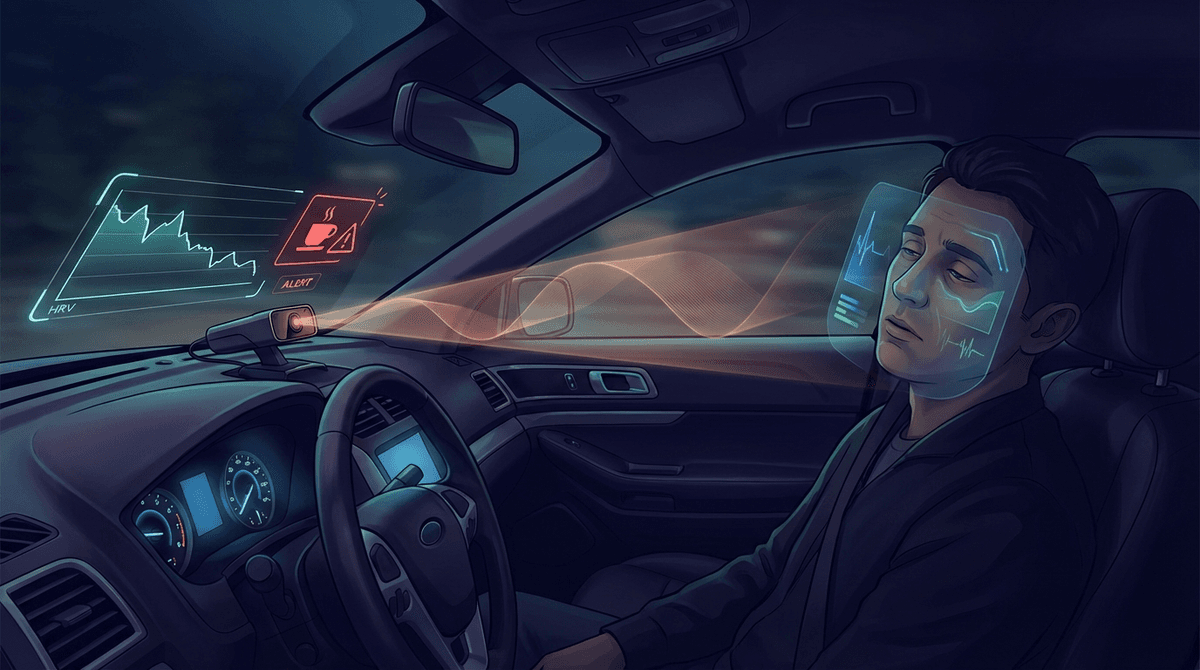
The National Highway Traffic Safety Administration estimates that drowsy driving causes over 100,000 crashes annually in the United States, resulting in roughly 1,550 deaths and 71,000 injuries. The challenge is that drowsiness is invisible to outside observers — unlike intoxication, there's no breath test. And by the time behavioral signs appear (lane drift, microsleeps), the driver is already severely impaired.
Camera-based rPPG is emerging as one component of a multi-modal driver monitoring system that can detect physiological precursors to critical drowsiness before behavioral symptoms appear. Heart rate changes, HRV collapse, blink dynamics, and subtle changes in facial vasomotor tone all shift as a driver fatigues — and an in-cabin camera can track all of them simultaneously.
Physiological Signatures of Driver Fatigue
Driver fatigue isn't a single physiological state. It progresses through stages with distinct physiological signatures:
Alert wakefulness: Heart rate 60-80 bpm, HRV in normal range, skin conductance variable, pupil diameter responsive to light.
Moderate drowsiness: HF component of HRV begins declining. Heart rate slows slightly. Blink rate decreases and blink duration increases. The face begins showing reduced vasomotor activity.
Severe drowsiness (pre-sleep): HRV low-frequency component dominates. Cardiac vagal activity shifts substantially. Microsleeps (brief involuntary sleep episodes 1-10 seconds) begin. These are essentially invisible in behavioral measures until the driver's eyes close — but the physiological shifts precede the behavioral signs by 5-15 minutes.
PERCLOS (percentage of time eyes are closed over a period) is the gold-standard behavioral marker. But by the time PERCLOS is elevated, the driver is already dangerously impaired. rPPG-based monitoring targets the earlier physiological shifts.
What the Camera Can See
An in-cabin Driver Monitoring System (DMS) camera, typically mounted behind the steering wheel or in the dashboard, captures the driver's face continuously at 20-30 fps. From this stream, rPPG can extract:
Heart Rate
Basic resting heart rate, while not strongly predictive of drowsiness alone, serves as a physiological baseline and can detect arousal responses to traffic events (sudden stops, near-misses causing heart rate spikes).
HRV Metrics
The most promising physiological marker. LF/HF ratio of HRV shifts reliably with drowsiness in controlled studies. A decline in RMSSD (root mean square of successive differences in inter-beat intervals) correlates with reduced parasympathetic tone that accompanies drowsiness. Liu et al. (2021, DOI: 10.1016/j.trc.2021.103109) demonstrated LF/HF-based drowsiness prediction with 78% accuracy against video-rated sleepiness scores.
Respiratory Rate
Respiratory rate decreases and becomes more irregular as drowsiness increases. Camera-based respiratory rate can be extracted simultaneously with cardiac rPPG from chest wall movement or nasal airflow-induced facial motion.
Vasomotor Response to Facial Stimulation
Some researchers have explored using in-cabin audio (radio, alerts) as deliberate stimuli and measuring the rPPG-detectable vascular response. Alert drivers show a consistent vasomotor orienting response; severely drowsy drivers show attenuated responses. This stimulus-response paradigm adds information beyond passive monitoring.
The In-Cabin Camera Challenge
Automotive environments are challenging for rPPG:
Highly variable lighting: Changing sunlight angles, shadows from trees and buildings, tunnels, and oncoming headlights at night all create rapid, unpredictable illumination changes. A driver entering a highway tunnel goes from bright daylight to near-total darkness in seconds.
Head motion and body movement: Driving involves substantial head movement — checking mirrors, turning toward passengers, reacting to events. The steering wheel blocks parts of the face intermittently. Road vibration introduces low-frequency motion artifacts.
Partial face occlusion: Glasses (clear and tinted), face masks, beards, and head coverings reduce the visible skin area for rPPG.
Long monitoring duration: Unlike a 30-second health check, driver monitoring must function continuously for hours. Signal quality assessment and automatic data quality gating are essential.
Several approaches have been developed specifically for automotive rPPG:
- NIR illumination: Automotive DMS cameras almost universally use NIR illumination (typically 850 or 940 nm) for consistent, lighting-condition-independent measurement. The IR illuminator provides a controlled light source regardless of ambient light levels.
- Multiple ROI with occlusion handling: Robust automotive systems use forehead, left cheek, right cheek, and nose as candidate ROIs, dynamically selecting the highest-quality subset based on landmark detection and occlusion assessment.
- Motion compensation via optical flow: Vehicle vibration and head movement are partially compensated using optical flow-based motion estimation before rPPG extraction.
Commercial Systems and Standards
Several Tier 1 automotive suppliers have DMS products incorporating physiological monitoring:
Seeing Machines (Fleet Monitor, FOVIO) uses eye-tracking as the primary metric, but recent versions incorporate rPPG-based heart rate as a secondary signal for drowsiness confirmation.
Smart Eye and Visteon have announced DMS systems with rPPG integration for fleet and passenger vehicle applications.
The Euro NCAP 2023 Safety Rating now includes Driver Monitoring System as a rated category, with detection of inattention and drowsiness as primary test scenarios. This regulatory pressure is driving rapid OEM adoption.
ISO 22736 standardizes in-vehicle driver monitoring systems, covering detection requirements and system interface standards. The EU General Safety Regulation mandated driver drowsiness and attention warning (DDAW) systems for new vehicle type approvals starting in 2022.
Combining rPPG with Behavioral Monitoring
The strongest commercial DMS systems combine physiological (rPPG) with behavioral (gaze, PERCLOS, head pose) and contextual (lane keeping, steering input patterns) signals. The fusion model achieves substantially higher drowsiness detection accuracy than any single channel.
Tavakoli et al. (2021, DOI: 10.1109/TITS.2020.3014910) demonstrated that combining facial rPPG-derived HRV with PERCLOS and lane deviation in a random forest classifier achieved 89% accuracy for severe drowsiness detection with 5-minute prediction horizon — compared to 71% for PERCLOS alone and 62% for rPPG-HRV alone.
The practical implication: rPPG doesn't replace behavioral monitoring, but it fills the gap before behavioral signs appear, providing an earlier warning that behavioral monitoring misses.
Ethical and Privacy Dimensions
Continuous physiological monitoring of drivers raises questions that go beyond technical accuracy:
Data ownership and retention: Insurance telematics companies are already interested in driver physiological data. Heart rate patterns during driving reveal information about health conditions, stress responses, and behavior that drivers may not wish to share.
False alarm consequences: An incorrect drowsiness alert in a commercial trucking context could trigger a mandatory rest stop, affecting delivery schedules and driver earnings. The cost of false positives is concrete and economically significant.
Worker monitoring regulations: In several European countries, continuous biometric monitoring of employees is restricted by labor law. Commercial vehicle operators deploying rPPG-based DMS must navigate these regulatory frameworks carefully.
- PPG Driver Fatigue Monitoring — contact PPG-based approach
- PPG Cognitive Load Detection — attention and cognitive state from PPG
- PPG Stress Detection Methods — physiological stress markers
- rPPG Privacy Data Ethics — ethical considerations in contactless monitoring
- rPPG Lighting Conditions Accuracy — handling variable light environments
Frequently Asked Questions
Can a car camera detect drowsy driving? Yes. Modern Driver Monitoring Systems use in-cabin cameras to detect behavioral signs (eye closure, head nodding) and, increasingly, physiological signals via rPPG (heart rate, HRV). The combination can detect dangerous drowsiness with prediction horizons of 5-10 minutes before behavioral symptoms become critical.
What physiological signs indicate driver drowsiness? Key markers include: declining HRV (reduced RMSSD and LF/HF shift), slowing heart rate, reduced vasomotor response to stimuli, decreasing respiratory rate, and increasing blink duration. These precede the PERCLOS (eye closure) metric by 5-15 minutes.
Does rPPG work in cars at night? Automotive DMS cameras use NIR illumination, allowing heart rate and physiological monitoring regardless of ambient light. NIR-based rPPG is specifically designed for this use case, providing consistent measurement in tunnels, at night, and under any weather condition.
Is driver physiological monitoring legal? It depends on jurisdiction and employment context. In the EU, the General Safety Regulation mandates driver drowsiness warning systems. However, continuous biometric data collection from commercial vehicle operators may face labor law restrictions in some countries. Personal vehicle monitoring is generally less regulated.
How accurate is rPPG-based drowsiness detection? When combined with behavioral monitoring (PERCLOS, lane deviation), rPPG-HRV contributes to drowsiness detection accuracy of 85-90% in published studies. Standalone rPPG drowsiness prediction achieves 60-70% accuracy — useful as a component but not sufficient alone.
Frequently Asked Questions
- Can a car camera detect drowsy driving?
- Yes. Modern Driver Monitoring Systems use in-cabin cameras to detect behavioral signs and physiological signals via rPPG (heart rate, HRV). The combination can detect dangerous drowsiness with prediction horizons of 5-10 minutes before behavioral symptoms become critical.
- What physiological signs indicate driver drowsiness?
- Key markers include declining HRV (reduced RMSSD and LF/HF shift), slowing heart rate, reduced vasomotor response to stimuli, decreasing respiratory rate, and increasing blink duration. These precede PERCLOS (eye closure) metrics by 5-15 minutes.
- Does rPPG work in cars at night?
- Automotive DMS cameras use NIR illumination, allowing heart rate and physiological monitoring regardless of ambient light. NIR-based rPPG is specifically designed for this use case, providing consistent measurement in tunnels, at night, and under any weather condition.
- How accurate is rPPG-based drowsiness detection?
- When combined with behavioral monitoring (PERCLOS, lane deviation), rPPG-HRV contributes to drowsiness detection accuracy of 85-90% in published studies. Standalone rPPG drowsiness prediction achieves 60-70% accuracy — useful as a component but not sufficient alone.