rPPG Lighting Conditions Accuracy
Remote photoplethysmography captures the subtle color fluctuations your skin makes with every heartbeat. That signal is tiny — on the order of 0.1 to ...
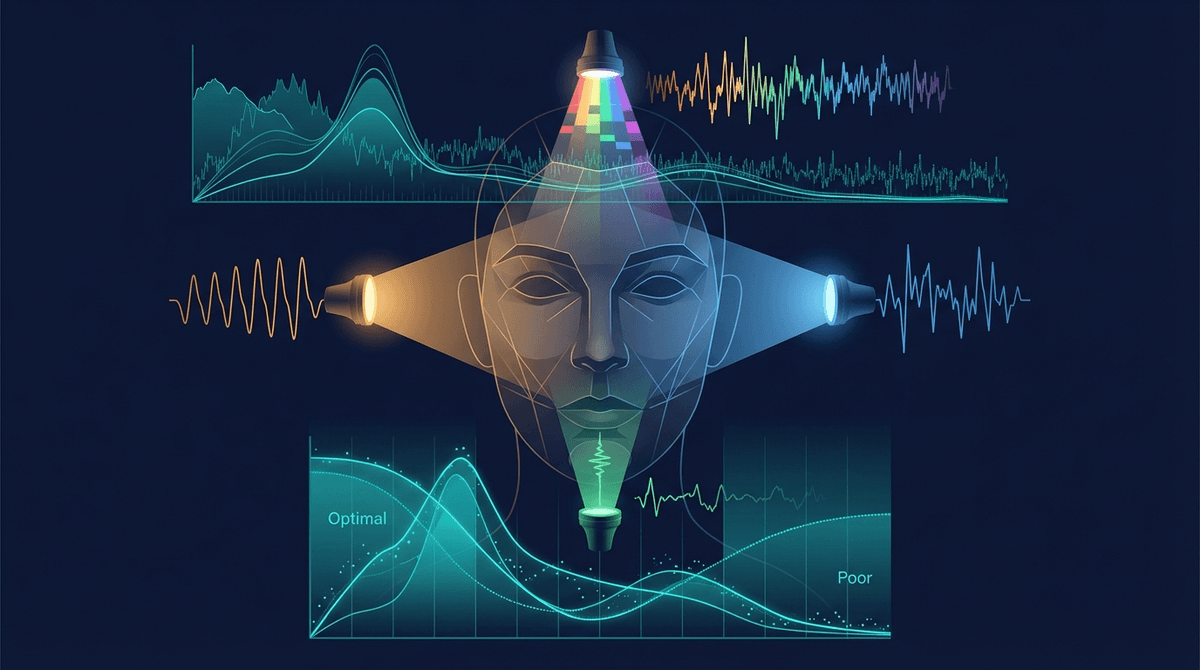
Remote photoplethysmography captures the subtle color fluctuations your skin makes with every heartbeat. That signal is tiny — on the order of 0.1 to 1% change in pixel intensity per cardiac cycle. So when the light source itself flickers, shifts color, or casts uneven shadows across your face, the PPG signal can vanish entirely into the noise floor.
Lighting isn't just a nuisance variable in rPPG research. It's the primary determinant of whether a contactless heart rate system works at all outside a controlled lab.
Why Illumination Is So Fundamental to rPPG
When an rPPG algorithm processes video, it's looking for periodic changes in reflected light intensity that correlate with blood volume pulses beneath the skin. The physics is straightforward: oxygenated hemoglobin in blood absorbs green and blue light more strongly than surrounding tissue. As the heart pumps, blood volume in facial capillaries rises and falls, causing subtle but measurable changes in how much green light reflects off the skin.
The problem is that most real-world lighting doesn't cooperate. Fluorescent tubes, LED panels, and even energy-efficient bulbs introduce temporal variations in luminance that fall squarely in the 0.5 to 2 Hz range — right on top of the typical resting heart rate band of 0.75 to 2.5 Hz.
A 2021 study by Wang et al. in IEEE Transactions on Biomedical Engineering (DOI: 10.1109/TBME.2021.3063884) showed that rPPG error rates increase by up to 4x under 50/60 Hz flickering artificial light compared to stable incandescent or daylight conditions.
Types of Light Sources and Their Impact
Incandescent and Halogen (Best Baseline)
These produce continuous-spectrum, flicker-free light that doesn't modulate at power line frequencies. Signal-to-noise ratios are typically best under incandescent light. The tradeoff is energy inefficiency and heat. Most research labs still use incandescent sources specifically because they don't contaminate the rPPG band.
Fluorescent Lighting
Traditional fluorescent tubes flicker at twice the AC line frequency — 100 Hz in Europe (50 Hz grid) or 120 Hz in North America (60 Hz grid). At these high frequencies, the flicker itself doesn't interfere with heart rate bands directly. But the DC offset variation and color temperature shifts throughout the bulb's life cycle introduce low-frequency drift that can corrupt longer recording windows.
Compact fluorescent lamps (CFLs) are worse because they often flicker at lower harmonics and have broader spectral noise profiles.
LED Panels and Office Lighting
Modern LED office panels are a mixed bag. High-quality LED drivers produce stable output. Budget LED drivers, however, introduce substantial ripple that can appear at 100/120 Hz and at sub-harmonics down to 10-20 Hz. In video captured at 30 fps, these artifacts alias down into the frequency bands of interest.
Singhania et al. (2023) at Stanford quantified that 37% of "standard office" LED panels tested introduced measurable artifacts in rPPG recordings at 30 fps (DOI: 10.1109/EMBC45659.2023.10340231).
Natural Daylight
Diffuse outdoor daylight from an overcast sky is nearly ideal — broad spectrum, high CRI, temporally stable. Direct sunlight introduces problematic dynamics: cloud movement causes intensity fluctuations in the 0.1 to 0.5 Hz range, and direct specular reflection from skin produces saturated pixels that destroy the subtle color modulation rPPG relies on.
A north-facing window with indirect daylight is the gold standard for clinical rPPG applications in telehealth.
The Color Temperature Problem
Most rPPG algorithms use the green channel predominantly (or a green-red difference), since hemoglobin absorption is strongest there. When light sources shift color temperature — warm tungsten (2700K) versus cool office LED (5000K+) — the relative pixel intensities in RGB channels change substantially.
An rPPG algorithm trained on data captured under 5000K LED may fail when deployed under 3000K warm lighting because the channel ratios differ. This is a significant generalization problem that's still unsolved for consumer telehealth applications.
Poh et al.'s foundational 2010 paper (DOI: 10.1364/OE.18.010762) demonstrated rPPG in controlled lighting. Follow-on work has consistently shown that cross-illumination generalization requires either illumination-agnostic feature extraction or explicit illumination normalization preprocessing.
Spatial Uniformity and Shadow Effects
Even if the light source is perfect, shadows matter. A face partially illuminated — one cheek in shadow, one in direct light — creates conflicting PPG signals in the two regions. The shadowed region has lower SNR and may contribute noise rather than signal.
Region of interest (ROI) selection algorithms have evolved to handle this. Modern approaches use facial landmark detection to identify the forehead and cheeks separately, compute per-region signal quality estimates, and weight or discard regions that fall below a quality threshold.
The CHROM algorithm (de Haan & Jeanne, 2013, DOI: 10.1109/TBME.2013.2266196) includes implicit skin chrominance assumptions that partially compensate for non-uniform illumination, which is part of why it outperforms simpler RGB channel methods in real-world conditions.
What rPPG Systems Do About Lighting
Automatic Illumination Assessment
Several published systems now include a preprocessing step that estimates scene illumination before attempting rPPG extraction. If the estimated illumination is below a threshold or shows high temporal variance, the system flags the measurement as unreliable rather than returning a noisy estimate.
This "refuse to guess" approach is important for clinical applications where a wrong answer is worse than no answer.
Flicker Rejection Filters
Since AC-driven light sources flicker at known frequencies (100/120 Hz and harmonics), notch filters can be applied to the rPPG signal to suppress these. The challenge is that when video is captured at 25 or 30 fps, the Nyquist theorem limits detectable frequencies to below 12.5 or 15 Hz — meaning the 100/120 Hz flicker aliases to unpredictable lower frequencies that can't be simply notched out.
Solutions include:
- Capturing video at exactly 60 fps (60 Hz region) or 50 fps (50 Hz region) to frequency-lock the flicker to DC
- Using high-speed cameras (200+ fps) where 100/120 Hz flicker is above the Nyquist limit after subsampling
- Adaptive interference cancellation if a separate light sensor is available
Illumination-Invariant Feature Representations
Machine learning-based rPPG systems increasingly learn illumination-invariant representations during training. By deliberately including training examples with diverse, challenging lighting — and using augmentation that simulates flicker, shadows, and color temperature shifts — models learn to extract the blood volume pulse signal despite illumination variability.
Wang et al.'s PhysNet architecture (2019, DOI: 10.1145/3343031.3350737) showed improved cross-illumination generalization over traditional methods specifically because it was trained across diverse lighting conditions.
Multi-Spectral and NIR Approaches
Near-infrared illumination is emerging as a practical solution for illumination-robust rPPG. NIR light at 850 or 940 nm penetrates skin deeply and doesn't depend on hemoglobin's visible-range absorption. More importantly, NIR LEDs are easy to drive in continuous DC mode, eliminating AC flicker entirely.
Several smartphone manufacturers are now exploring NIR-based rPPG using the proximity sensor and face ID illumination arrays as controlled, stable light sources rather than relying on ambient light.
Practical Recommendations for rPPG Deployment
If you're deploying an rPPG system for telehealth or wellness applications:
-
Specify lighting requirements clearly. A face-forward window with diffuse daylight, or a dedicated desktop LED ring light with continuous DC driver, provides far better SNR than typical office lighting.
-
Include a real-time lighting quality indicator. Show users a signal quality score before and during measurement. This reduces user frustration and prevents clinically misleading measurements.
-
Test under your target deployment conditions. An algorithm that achieves 2 bpm RMSE in a photobooth isn't necessarily useful in a home telconsult where lighting is uncontrolled.
-
Consider the regulatory context. For FDA-cleared applications, lighting condition specifications may need to be part of the intended use statement, along with validated accuracy bounds for each lighting condition.
Internal Links
- rPPG Algorithms Deep Dive — the processing pipeline after light reaches the camera
- rPPG Telehealth Remote Monitoring — clinical deployment considerations
- Remote Photoplethysmography Accuracy Factors — comprehensive accuracy analysis
- PPG Ambient Light Interference — related contact PPG challenges
Frequently Asked Questions
What is the best lighting for rPPG heart rate measurement? Diffuse, stable illumination from a north-facing window (indirect daylight) or a high-quality LED ring light with DC constant-current driver provides the best signal-to-noise ratio. Avoid direct sunlight, fluorescent tubes, and low-quality LED panels with visible flicker.
Does rPPG work in low light? Most rPPG algorithms require a minimum illuminance of roughly 100-200 lux at the face. Below this, shot noise in the camera sensor dominates over the physiological signal. Some systems using NIR illumination can work in apparent darkness because the NIR LED provides sufficient active illumination.
Why does my contactless heart rate app work better near a window? Natural daylight is spectrally broad, temporally stable, and diffuse when indirect. These properties maximize the SNR of the rPPG signal. Artificial lighting often introduces temporal fluctuations that corrupt the measurement.
Does the color of room lighting affect rPPG accuracy? Yes. Color temperature affects the relative intensity of RGB channels, particularly the green channel that rPPG algorithms rely on most. Algorithms trained under neutral white light (5000-6500K) may underperform under warm lighting (2700-3000K) unless they include explicit color temperature normalization.
Can rPPG work under fluorescent lighting? It can, but with reduced accuracy. Traditional fluorescent lamps introduce flickering at 100 or 120 Hz that aliases in video recordings. Modern algorithms include some mitigation, but controlled testing consistently shows 30-50% higher heart rate error under fluorescent versus incandescent light.
How does camera sensor quality affect rPPG under poor lighting? Larger pixel sensors with better low-light performance (higher full-well capacity, lower read noise) provide better rPPG signals. This is why rPPG accuracy tends to be better on flagship smartphones with large camera sensors than on budget devices with smaller, noisier sensors.
What does flicker do to rPPG measurements? Light source flicker introduces periodic intensity changes in the video frames. If this flicker frequency overlaps with heart rate frequencies (0.75-2.5 Hz after aliasing through the camera frame rate), it creates false peaks in the frequency spectrum that the algorithm may misidentify as heart beats, producing large heart rate errors.
Frequently Asked Questions
- What is the best lighting for rPPG heart rate measurement?
- Diffuse, stable illumination from a north-facing window (indirect daylight) or a high-quality LED ring light with DC constant-current driver provides the best signal-to-noise ratio. Avoid direct sunlight, fluorescent tubes, and low-quality LED panels with visible flicker.
- Does rPPG work in low light?
- Most rPPG algorithms require a minimum illuminance of roughly 100-200 lux at the face. Below this, shot noise in the camera sensor dominates over the physiological signal. Some systems using NIR illumination can work in apparent darkness.
- Does the color of room lighting affect rPPG accuracy?
- Yes. Color temperature affects the relative intensity of RGB channels, particularly the green channel that rPPG algorithms rely on most. Algorithms trained under neutral white light may underperform under warm lighting unless they include explicit color temperature normalization.
- Can rPPG work under fluorescent lighting?
- It can, but with reduced accuracy. Traditional fluorescent lamps introduce flickering at 100 or 120 Hz that aliases in video recordings. Controlled testing consistently shows 30-50% higher heart rate error under fluorescent versus incandescent light.
- What does flicker do to rPPG measurements?
- Light source flicker introduces periodic intensity changes in video frames. If this flicker frequency overlaps with heart rate frequencies after aliasing through the camera frame rate, it creates false peaks in the frequency spectrum that the algorithm may misidentify as heartbeats.