Driver Stress Detection with PPG: A Practical Guide for Automotive Monitoring
Learn how driver stress detection with PPG works in vehicles, from sensor placement and signal features to filtering noise, motion, and fatigue overlap.
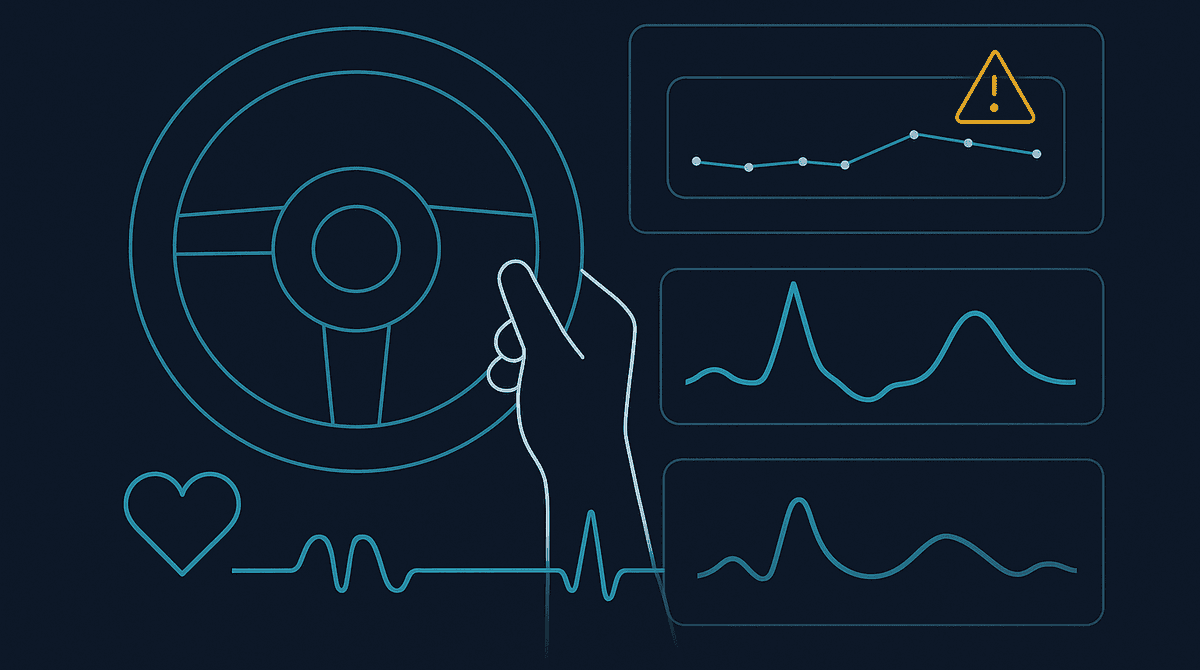
PPG can detect driver stress by tracking short term changes in pulse timing, pulse amplitude, and recovery patterns while a person is driving. In a vehicle, the best systems treat PPG as a continuous trend signal, not a single yes or no alarm, because road vibration, grip changes, and cabin events can all perturb the waveform. The real value comes from separating brief sympathetic activation from fatigue or pure distraction, so the car reacts in a measured way.
Why PPG fits automotive monitoring
Photoplethysmography is attractive for in car monitoring because it is compact, low power, and already familiar in wearables. A steering wheel sensor, finger clip in a test rig, watch style device, or seat integrated optical unit can all produce a usable pulse waveform under the right conditions. That makes PPG easier to scale than larger physiological systems that depend on chest straps or multi lead setups.
For driver monitoring, the goal is usually not a medical diagnosis. The goal is to estimate whether workload and autonomic arousal are rising in a way that could affect performance, comfort, or safety. Research on stress detection with physiological signals shows that PPG can support this task when signal quality, feature engineering, and context handling are treated seriously [1][2].
What stress looks like in a PPG signal
A PPG waveform reflects blood volume changes in the microvascular bed. Under mental stress, people often show faster heart rate, altered pulse rate variability, reduced peripheral pulse amplitude from vasoconstriction, and slower return to baseline after a demanding event. Those patterns are useful because they tie directly to autonomic response rather than only visible behavior.
In driving, those changes may appear after heavy traffic merges, near collisions, harsh braking, complex navigation decisions, or sustained time pressure. The waveform may become smaller, inter beat intervals may shorten, and short window variability measures may shift.
This is where many projects fail. They reduce the problem to average heart rate, then discover that caffeine, cabin heat, road vibration, and ordinary conversation can move heart rate too. A stronger approach uses heart rate, pulse rate variability proxies, amplitude features, signal quality indices, and event anchored recovery features together.
Separating acute stress from distraction and fatigue
This distinction matters more in a car than in many other environments. Acute sympathetic activation means the driver is physiologically activated now. That can happen during a real safety event, but it can also happen during a harmless lane change, a loud sound, or even excitement. If the system labels every arousal spike as dangerous stress, the vehicle will over prompt and lose credibility.
Distraction is different. A distracted driver may be looking away from the road, interacting with a screen, or mentally preoccupied, yet their PPG may show only a modest response. Fatigue is different again. Drowsy drivers often shift toward lower arousal, slower reactions, and degraded vigilance, which can overlap poorly with a classic stress signature. Some people even move from stress into fatigue during long drives, which means the model has to track state transitions rather than a single score.
The practical answer is to estimate three things separately:
- Arousal load, derived from recent PPG changes and recovery behavior.
- Signal trust, derived from motion noise, contact pressure, and waveform quality.
- Context, derived from vehicle events or other monitoring streams when available.
With that structure, a sharp PPG change during a cut in by another vehicle can be treated as acute sympathetic activation, while a low arousal, poor vigilance pattern can be handled more like fatigue. If the car also has camera, steering, lane, or pedal data, the fusion layer can decide whether the issue is overload, distraction, drowsiness, or simply a short lived normal response. This is also why teams working on adjacent problems should compare pipelines with PPG stress detection methods and driver drowsiness detection with PPG.
Sensor placement and hardware choices
Sensor placement defines the ceiling of the whole system. In controlled studies, finger and ear sites often produce strong waveforms, but they are not always practical for daily driving. A steering wheel contact sensor is appealing because it asks little of the driver, yet contact is intermittent and grip force changes can distort the waveform. A wrist wearable is easier to deploy, but motion artifact can rise during steering and road vibration. Seat or armrest concepts are comfortable, though they may suffer from weaker peripheral perfusion and clothing effects.
In practice, teams usually choose between two viable paths. The first is a dedicated vehicle touchpoint, such as a steering wheel module, optimized for short windows when contact is good. The second is a wearable companion device that continues monitoring before, during, and after the trip. The wearable path can be very powerful for baseline calibration because it captures pre drive state and post event recovery. That broader longitudinal view is also relevant to remote patient stress monitoring, where trend quality often matters more than a single instant reading.
A signal pipeline that survives the road
The signal pipeline should assume imperfect data from the start. A solid implementation usually includes:
- band pass filtering tuned for expected pulse frequencies
- beat detection with outlier rejection
- motion and contact quality checks
- short windows for reactive features, plus longer windows for baseline drift
- artifact flags that stop bad segments from driving alerts
Signal quality indexing is especially important. If the waveform is clipped, flat, saturated, or inconsistent from beat to beat, the system should say "low confidence" rather than force a stress estimate. False certainty is worse than temporary silence.
Baseline handling is the next piece. Drivers vary widely in resting heart rate, peripheral perfusion, and stress reactivity. A useful automotive model often compares the current window to that person's recent baseline from the same trip and, if available, to a longer personal baseline from prior trips. That reduces the chance that naturally high heart rate or low pulse amplitude is misread as acute stress.
Recovery modeling adds another practical layer. A driver who spikes during a merge but returns to baseline within thirty to sixty seconds is different from a driver who remains elevated for several minutes. That post event recovery curve often carries more operational meaning than the peak itself, because it reflects how long the system stays in a high load state.
Feature design and model strategy
For real vehicle use, feature sets should stay interpretable. Useful candidates include mean inter beat interval, short term pulse rate variability measures, pulse amplitude statistics, slope or width descriptors, signal entropy, and recovery features anchored to detected events. Windowed trend features can be more robust than single window values, especially when motion artifact is intermittent.
PPG derived pulse rate variability should be used carefully. It can approximate HRV related patterns, but it is not identical to ECG based HRV, especially when beat detection is unstable or peripheral timing shifts. That is still acceptable for driver monitoring, because the objective is operational state estimation, not cardiology grade measurement. The model just has to be honest about what the signal can support [4].
A good production model often looks more like a staged classifier or calibrated score than an opaque end to end network. One stage checks signal quality. One stage estimates acute physiological activation. Another stage fuses context, such as steering instability, braking, traffic complexity, or camera based cues. This staged design makes debugging easier, reduces false alarms, and helps engineers explain why the system acted.
Thresholding should also be state aware. A novice driver in dense traffic may show high activation often. A professional driver on a familiar route may show smaller swings. Adaptive thresholds, bounded by conservative safety rules, usually outperform fixed one size fits all cutoffs.
When and how the vehicle should respond
The response layer should be restrained. Stress detection is best used to modulate support, not punish the driver. Examples include soft cabin interventions, route simplification, reduced notification load, or a suggestion to take a break after sustained activation. These are useful because they match the uncertainty of the signal.
Avoid hard warnings for every short spike. Short sympathetic surges are part of normal driving. A better pattern is to trigger action only when elevated activation is sustained, confidence is high, and either recovery is poor or other risk signals agree. That is how you separate a momentary response from a state that may degrade performance.
In semi automated systems, PPG can also inform handoff strategy. If the driver has been physiologically loaded for several minutes, the car may choose calmer timing for a takeover request or present instructions more simply. This is one of the strongest practical cases for PPG in automotive monitoring: it helps tune the vehicle's behavior to the driver's current capacity.
Validation that reflects the real world
Bench accuracy is not enough. Validation needs simulator sessions, controlled driving tasks, and on road data with realistic motion, lighting, and cabin variation. Labels should combine self report, task markers, and behavioral context rather than rely on a single source. Engineers should inspect false positives by category, including contact loss, road vibration, thermal changes, emotional but safe events, and overlap with fatigue.
The most useful success metric is not only stress classification accuracy. It is whether the system improves downstream decisions, such as when to suppress distractions, when to recommend a rest break, or when to escalate monitoring because elevated activation is lasting too long. That is the practical automotive frame.
FAQ
Can PPG alone detect driver stress reliably?
PPG alone can estimate physiological stress trends, but reliability improves when it is paired with signal quality checks and driving context. It is best used for graded risk estimation, not a stand alone safety verdict.
How is driver stress different from driver fatigue in PPG data?
Stress often appears as higher arousal, faster pulse timing, amplitude reduction, and delayed recovery after demanding events. Fatigue usually reflects lower alertness and different temporal patterns, so the system should model them as separate states.
Is a steering wheel PPG sensor enough?
It can be enough for short, high quality windows when hand contact is stable. For continuous monitoring, a wearable or multi site design usually gives better coverage and more reliable baselines.
What features matter most for automotive PPG stress detection?
The strongest practical sets usually combine pulse timing, pulse rate variability proxies, amplitude and morphology features, signal quality indices, and recovery features after driving events. Context aware trends are often more useful than a single average heart rate value.
Why should the model track recovery after a stressful event?
Recovery shows whether the response was brief and normal or whether the driver stayed physiologically loaded. Sustained elevation is often more actionable than the initial spike.
Can PPG tell whether a driver is distracted?
Not by itself. PPG can show arousal, but distraction often needs camera, vehicle control, or interface data to confirm that attention has shifted away from driving.
References
- PMC9695300, open access research relevant to wearable and physiological stress detection: https://pmc.ncbi.nlm.nih.gov/articles/PMC9695300/
- PMC11970940, open access research relevant to PPG based stress feature analysis: https://pmc.ncbi.nlm.nih.gov/articles/PMC11970940/
- Electronics 12(13):2923, research relevant to automotive or wearable monitoring methods: https://www.mdpi.com/2079-9292/12/13/2923
- EHJ Digital Health ztab050, research relevant to pulse rate variability and PPG interpretation: https://doi.org/10.1093/ehjdh/ztab050
Frequently Asked Questions
- Can PPG alone detect driver stress reliably?
- PPG alone can estimate physiological stress trends, but reliability improves when it is paired with signal quality checks and driving context. It is best used for graded risk estimation, not a stand alone safety verdict.
- How is driver stress different from driver fatigue in PPG data?
- Stress often appears as higher arousal, faster pulse timing, amplitude reduction, and delayed recovery after demanding events. Fatigue usually reflects lower alertness and different temporal patterns, so the system should model them as separate states.
- Is a steering wheel PPG sensor enough?
- It can be enough for short, high quality windows when hand contact is stable. For continuous monitoring, a wearable or multi site design usually gives better coverage and more reliable baselines.
- What features matter most for automotive PPG stress detection?
- The strongest practical sets usually combine pulse timing, pulse rate variability proxies, amplitude and morphology features, signal quality indices, and recovery features after driving events. Context aware trends are often more useful than a single average heart rate value.
- Why should the model track recovery after a stressful event?
- Recovery shows whether the response was brief and normal or whether the driver stayed physiologically loaded. Sustained elevation is often more actionable than the initial spike.
- Can PPG tell whether a driver is distracted?
- Not by itself. PPG can show arousal, but distraction often needs camera, vehicle control, or interface data to confirm that attention has shifted away from driving.