Oura Ring Sleep Tracking Accuracy: What the Research Actually Shows
How accurate is the Oura Ring for sleep tracking? We review polysomnography validation studies, sleep stage accuracy, and how Oura compares to Fitbit and Apple Watch.
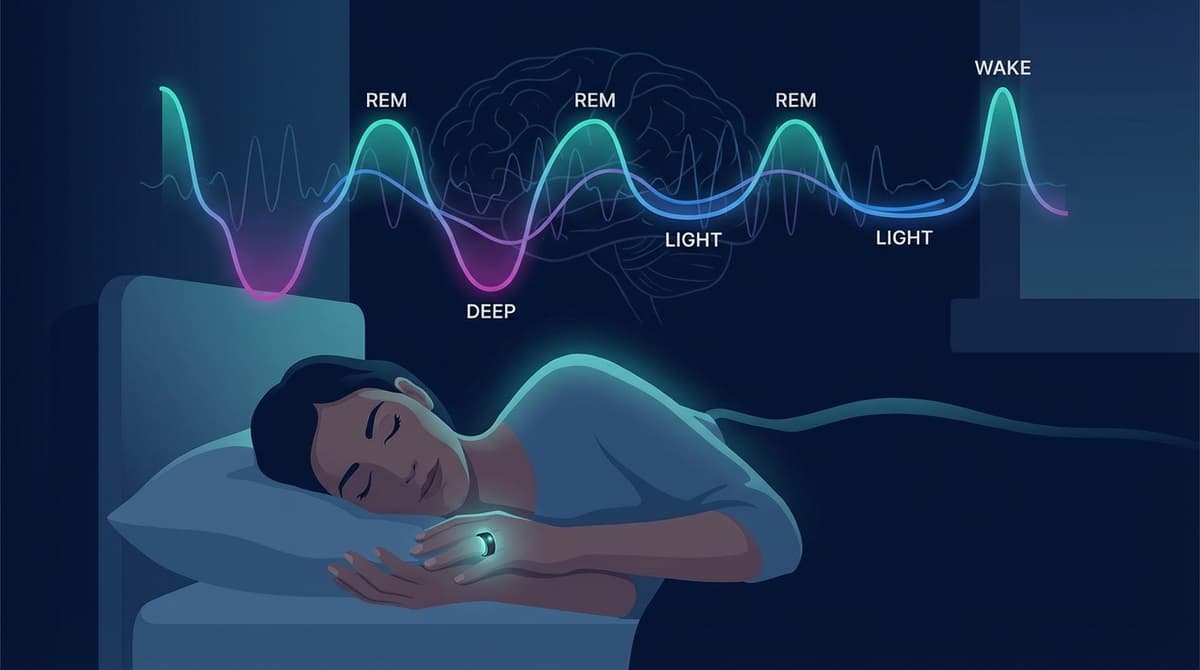
The Oura Ring is one of the most accurate consumer wearables for tracking total sleep time, typically falling within 15 to 30 minutes of polysomnography (PSG) measurements in validation studies. Its sleep staging accuracy is more mixed: the ring performs well for detecting light sleep and REM sleep but tends to overestimate deep sleep duration and struggles to reliably detect brief awakenings. These findings come from multiple independent studies comparing Oura directly against laboratory PSG, the clinical gold standard for sleep measurement.
If you have been considering the Oura Ring for sleep monitoring, or if you already own one and want to understand what those nightly sleep reports actually mean, this article breaks down the peer-reviewed evidence. We will cover how the ring detects sleep stages, where it performs best, where it falls short, and how it stacks up against competing devices like Fitbit and Apple Watch.
How Does the Oura Ring Detect Sleep Stages?
The Oura Ring uses a combination of three sensor modalities to classify sleep stages: photoplethysmography (PPG), a 3-axis accelerometer, and a skin temperature sensor. Each contributes different information to the sleep staging algorithm.
PPG and heart rate variability. The ring's infrared PPG sensor, positioned on the palmar side of the finger, captures pulse waveforms from which heart rate and heart rate variability (HRV) metrics are derived. Sleep stages have distinct autonomic signatures. Deep sleep (N3) is characterized by slow, regular heart rate with high parasympathetic tone, while REM sleep shows irregular heart rate patterns with phasic sympathetic surges. The finger is an excellent measurement site for PPG because it has high vascular density and minimal motion artifact during sleep compared to the wrist. For a deeper look at how PPG signals map to sleep stages, see our article on PPG sleep staging algorithms.
Accelerometry and movement. The built-in accelerometer detects body movement and restlessness. Periods of sustained stillness correlate with sleep, while frequent movements suggest wakefulness or light sleep. This actigraphy-based approach has been used in sleep research for decades, though it tends to overclassify still wakefulness as sleep.
Skin temperature. The Oura Ring measures finger skin temperature, which follows a circadian pattern. Core body temperature drops during sleep onset, and peripheral skin temperature rises as vasodilation occurs. Temperature changes also differ modestly across sleep stages, providing an additional input signal. This multi-sensor fusion approach is a significant advantage over devices that rely on PPG and accelerometry alone.
For more on how form factor affects PPG signal quality, see our guide to PPG wearable form factors.
What Do Polysomnography Comparison Studies Show?
Several independent research groups have tested Oura Ring accuracy against overnight laboratory polysomnography. The two most frequently cited studies are from de Zambotti and colleagues and from Altini and Kinnunen.
de Zambotti et al. (2019): Oura Ring Generation 2
de Zambotti et al. published one of the first rigorous PSG validation studies for the Oura Ring in the journal Sleep (DOI: 10.1093/sleep/zsz034). The study tested the second-generation Oura Ring in 41 adolescents and young adults during in-laboratory overnight PSG recordings.
Key findings:
- Total sleep time (TST): The Oura Ring overestimated TST by an average of 8 minutes, with a sensitivity of 96% for detecting sleep epochs. This is strong performance for a consumer device.
- Sleep onset latency: Oura detected sleep onset within approximately 10 minutes of PSG-determined onset, though it tended to classify quiet wakefulness before sleep as light sleep.
- Wake after sleep onset (WASO): Oura underestimated WASO by roughly 25 minutes, meaning it missed a substantial portion of nighttime awakenings. This is a common weakness across all consumer wearables.
- Sleep staging accuracy: Epoch-by-epoch agreement with PSG was approximately 65% for four-stage classification (wake, light, deep, REM). Light sleep showed the highest sensitivity (85%), followed by REM (73%), deep sleep (58%), and wake (48%).
The authors concluded that Oura Ring performed comparably to or better than most wrist-worn devices for TST estimation, though sleep staging accuracy had meaningful room for improvement, particularly for deep sleep and wake detection.
Altini and Kinnunen (2021): Oura Ring Generation 3
Altini and Kinnunen, researchers affiliated with Oura Health, published a large-scale validation study in Sensors (DOI: 10.3390/s21134302). This study evaluated an updated sleep staging algorithm using data from 48 participants across multiple nights, totaling over 100 PSG recording nights.
Key findings:
- Four-stage accuracy: Overall epoch-by-epoch agreement improved to approximately 79%, a substantial jump over the generation 2 results.
- TST estimation: Mean absolute error of about 17 minutes compared to PSG. Bias was small, with Oura slightly overestimating TST on average.
- REM detection: Cohen's kappa for REM sleep was 0.72, indicating substantial agreement with PSG. This represents strong REM detection for a consumer device.
- Deep sleep detection: Kappa for deep sleep (N3) was 0.55, which is moderate agreement. Deep sleep remained the most difficult stage to classify accurately.
- Light sleep: Kappa for combined N1/N2 was 0.62.
The improved accuracy in this study likely reflects both algorithmic improvements and the generation 3 hardware, which includes updated PPG sensors and improved temperature sensing. However, it is worth noting that this study was conducted by Oura-affiliated researchers, so independent replication is important for unbiased assessment.
Where Is Oura Most and Least Accurate?
Based on the available evidence, here is where the Oura Ring performs best and worst for sleep tracking.
Strengths
Total sleep time. This is consistently Oura's strongest metric. Across studies, TST estimates fall within 10 to 30 minutes of PSG values, which is clinically acceptable for longitudinal tracking. If your primary goal is knowing how long you slept each night and tracking trends over weeks and months, the Oura Ring delivers reliable data.
REM sleep detection. REM sleep has a distinctive autonomic profile: irregular heart rate, increased HRV variability, and phasic sympathetic bursts. The Oura Ring's PPG sensor captures these signatures effectively, and REM detection is among the ring's best-performing sleep stage classifications. Understanding HRV patterns is central to this capability. For more on how wearables measure HRV, see our PPG HRV wearable guide.
Night-to-night trend tracking. Even where absolute accuracy for a single night is imperfect, the Oura Ring shows good consistency. This means that relative comparisons (you slept more deeply last night than the night before) are more reliable than the specific minute counts displayed in the app.
Weaknesses
Brief awakenings. Like virtually all consumer wearables, the Oura Ring struggles to detect short awakenings during the night. If you wake up for 2 to 3 minutes, roll over, and fall back asleep, the ring often classifies that period as light sleep rather than wake. This leads to systematic underestimation of wake after sleep onset.
Deep sleep overestimation. Multiple studies have noted that Oura tends to overestimate time spent in deep sleep (N3). The likely explanation is that periods of very quiet, still light sleep (N2) with relatively low heart rate get misclassified as N3. The autonomic signatures of late-cycle N2 and N3 overlap considerably when measured from PPG and accelerometry alone, without the EEG slow-wave information that PSG uses.
Sleep onset in quiet wakefulness. If you lie quietly in bed reading or relaxing before falling asleep, the ring may log that time as sleep. This is an inherent limitation of any device that relies on motion and cardiac signals rather than brain wave monitoring.
How Does Oura Compare to Fitbit and Apple Watch for Sleep?
Comparing sleep tracking accuracy across devices is complicated because few studies test multiple devices simultaneously against PSG. However, separate validation studies allow for rough comparisons.
Oura Ring vs. Fitbit
Fitbit devices (now part of Google) use wrist-based PPG combined with accelerometry for sleep staging. A study by de Zambotti et al. (2019) in Sleep tested the Fitbit Charge 3 and found four-stage sleep staging accuracy of approximately 64% epoch-by-epoch agreement with PSG. TST estimation had a mean bias of about 9 minutes.
The Oura Ring generation 3 shows higher overall staging accuracy (~79% in the Altini and Kinnunen study) compared to Fitbit's ~64%. However, direct comparison is limited because these numbers come from different study populations, different PSG laboratories, and different algorithm versions. Fitbit's algorithms have also been updated since these studies.
One consistent advantage of the Oura Ring is its measurement site. The finger provides a stronger and more stable PPG signal during sleep than the wrist, resulting in more reliable heart rate and HRV extraction. Wrist-worn devices are more susceptible to motion artifacts even during sleep, particularly for side sleepers who compress the sensor against the mattress. For more on how PPG accuracy varies by body location, see our article on PPG heart rate accuracy.
Oura Ring vs. Apple Watch
Apple Watch includes sleep tracking in watchOS, using its PPG sensor array and accelerometer. Independent validation data for Apple Watch sleep staging is more limited than for Oura or Fitbit. Early studies of Apple Watch sleep tracking suggest TST accuracy comparable to Fitbit, with epoch-by-epoch staging accuracy in the 60-70% range for four-stage classification.
The Apple Watch has a hardware advantage in terms of raw sensor capability, with its 18-LED optical array providing excellent signal quality. However, the ring form factor gives Oura an edge during sleep specifically, because finger-based measurement is less prone to positional artifacts and the ring is far more comfortable to wear overnight. Many Apple Watch users remove the device for charging at night, which limits its practical sleep tracking utility.
Summary Comparison
| Metric | Oura Ring Gen 3 | Fitbit (wrist) | Apple Watch (wrist) |
|---|---|---|---|
| TST accuracy (mean error) | 10-20 min | 9-15 min | 10-20 min |
| 4-stage epoch agreement | ~79% | ~64% | ~60-70% |
| REM detection (kappa) | 0.72 | 0.52-0.60 | Limited data |
| Deep sleep detection (kappa) | 0.55 | 0.40-0.50 | Limited data |
| Wake detection (sensitivity) | 48-60% | 40-55% | Limited data |
| Overnight comfort | Excellent | Good | Moderate |
These numbers should be interpreted cautiously, as they come from different studies with different populations and methodologies.
What Role Does LED Wavelength Play?
The Oura Ring primarily uses infrared LEDs for its PPG measurements, which is an important design choice. Infrared light penetrates deeper into tissue than green light and is less affected by skin pigmentation, making it well-suited for the finger's vascular bed. Most wrist-worn devices rely on green LEDs for heart rate during active use and switch to infrared or red LEDs during sleep.
The finger also benefits from having arteries and arterioles closer to the skin surface compared to the dorsal wrist, producing a higher signal-to-noise ratio. This anatomical advantage, combined with infrared wavelength selection, contributes to the Oura Ring's relatively strong PPG signal quality during overnight recording. For a technical explanation of how LED wavelength choice affects PPG signal quality, see our article on PPG LED wavelength selection.
Can You Trust Oura's Sleep Score?
Oura generates a composite "Sleep Score" that combines TST, sleep efficiency, sleep stage proportions, restfulness, and other metrics into a single 0-100 number. This score is a proprietary calculation, and Oura has not published the exact weighting formula.
From a practical standpoint, the Sleep Score is best treated as a relative indicator rather than an absolute measure of sleep quality. A score of 85 one night versus 72 the next night likely reflects a genuine difference in sleep quality, even if the precise staging data has the limitations described above. The score is less useful as a comparison between individuals, since baseline sleep architecture varies substantially with age, fitness level, and genetics.
One important caveat: the Sleep Score incorporates resting heart rate and HRV trends, which are objectively well-measured by the ring. This means the score captures genuine physiological information beyond just sleep staging, which adds value even when stage classification is imperfect.
Frequently Asked Questions
How accurate is the Oura Ring for tracking total sleep time?
The Oura Ring typically estimates total sleep time within 10 to 30 minutes of polysomnography measurements. It has a slight tendency to overestimate sleep duration because it sometimes classifies quiet wakefulness as light sleep. For most users, this level of accuracy is sufficient for tracking sleep trends over time.
Is the Oura Ring accurate for deep sleep tracking?
Deep sleep is the Oura Ring's weakest sleep stage classification. Studies show moderate agreement (Cohen's kappa around 0.55) between Oura's deep sleep detection and PSG. The ring tends to overestimate deep sleep by misclassifying some periods of quiet light sleep as N3 deep sleep. Users should treat deep sleep numbers as approximate rather than precise.
How does the Oura Ring compare to polysomnography for sleep staging?
Polysomnography uses EEG, EMG, and EOG to classify sleep stages based on brain activity, muscle tone, and eye movements. The Oura Ring uses PPG, accelerometry, and temperature, which are indirect measures of sleep state. Overall four-stage agreement between Oura Gen 3 and PSG is approximately 79%, which is strong for a consumer wearable but well below the 85-90% inter-scorer agreement typical between human PSG technicians.
Does the Oura Ring detect sleep apnea?
The Oura Ring does not diagnose sleep apnea. While the ring measures blood oxygen saturation (SpO2) and can flag low overnight SpO2 readings, it is not FDA-cleared for sleep apnea detection. Significant overnight oxygen desaturation patterns visible in Oura data may warrant a conversation with a physician, but a clinical sleep study is required for formal diagnosis.
Is the Oura Ring more accurate than Fitbit for sleep tracking?
Based on available validation studies, the Oura Ring Gen 3 shows higher sleep staging accuracy (~79% epoch agreement) compared to Fitbit wrist devices (~64%). The ring's finger-based PPG measurement provides a more stable signal during sleep than wrist-based devices. However, these comparisons are based on separate studies and should be interpreted with caution.
Why does the Oura Ring sometimes show different sleep data than how I feel?
Subjective sleep quality and objective sleep metrics do not always align. You might feel poorly rested despite the ring showing adequate TST and sleep stages, or you might feel great after a night the ring scored lower. Factors like sleep inertia (grogginess upon waking), dream content, psychological stress, and caffeine timing influence perceived sleep quality in ways that PPG and accelerometry cannot capture.
Does skin tone affect the Oura Ring's sleep tracking accuracy?
The Oura Ring uses infrared LEDs, which are less affected by melanin absorption than green LEDs commonly used in wrist-worn devices. This means skin pigmentation has a smaller impact on signal quality for the Oura Ring compared to many wrist-worn wearables. However, ring fit and finger size can affect signal quality, so proper sizing is important for accurate readings regardless of skin tone.
The Bottom Line
The Oura Ring is among the most accurate consumer wearables for sleep tracking, with particular strengths in total sleep time estimation and REM detection. Its finger-based PPG measurement provides a cleaner signal than wrist-worn alternatives during overnight recording, and its multi-sensor approach (PPG, accelerometry, temperature) gives it more data inputs than devices relying on PPG and motion alone.
That said, no consumer wearable replaces polysomnography. The Oura Ring's deep sleep measurements should be interpreted as approximate, its wake detection will miss brief nighttime arousals, and its Sleep Score is a proprietary composite rather than a clinical measure. For longitudinal self-tracking and general sleep health awareness, the Oura Ring delivers meaningful and relatively accurate data. For clinical sleep assessment or suspected sleep disorders, a formal sleep study remains the standard of care.