Oura Ring Accuracy: What Validation Studies Show About Heart Rate, HRV, Sleep, and SpO2
How accurate is the Oura Ring? We review published validation studies covering heart rate, HRV, SpO2, temperature, and sleep staging accuracy for Gen 3.
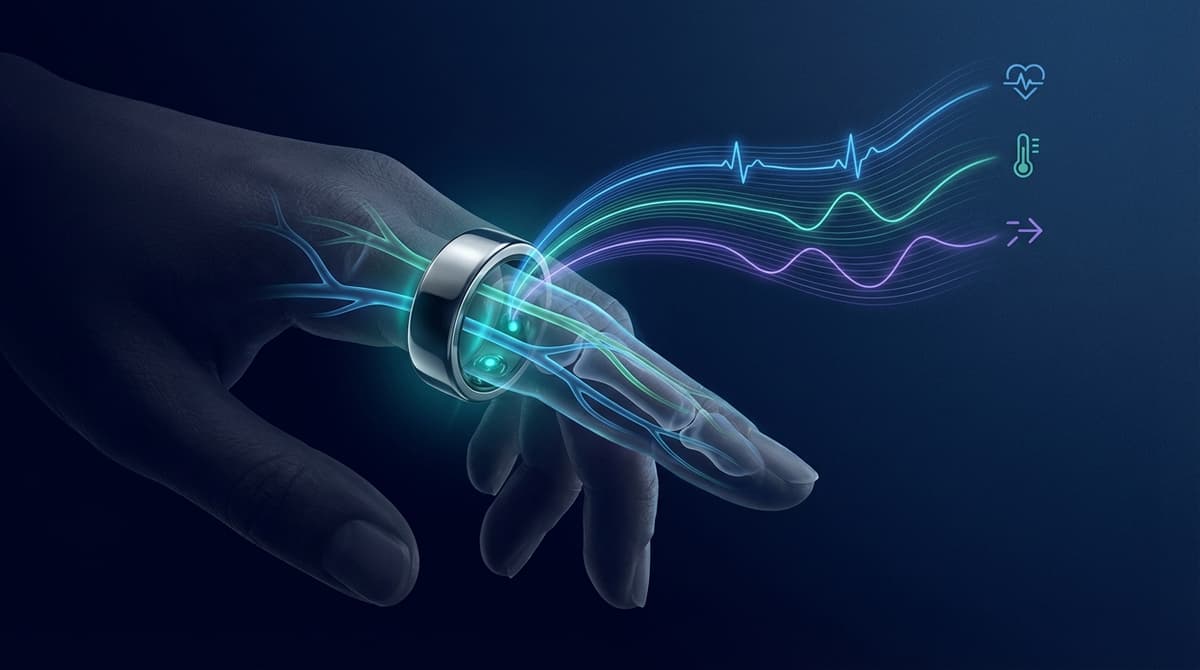
The Oura Ring is one of the most accurate consumer wearables for resting heart rate, HRV, and sleep tracking, largely because it measures PPG from the finger rather than the wrist. Validation studies show resting heart rate accuracy within 1 to 3 bpm of ECG reference, overnight HRV (RMSSD) correlations of r = 0.85 or higher, and sleep staging agreement rates above 79% compared to polysomnography. However, the Oura Ring is not designed for exercise heart rate monitoring, and its SpO2 readings carry meaningful limitations.
This review covers what independent, peer-reviewed research actually shows about Oura Ring accuracy across its core metrics, where the ring form factor provides genuine advantages, and where it falls short.
Why Finger PPG Is More Accurate Than Wrist PPG
The single biggest factor in Oura Ring accuracy is measurement site. The palmar surface of the finger has several optical advantages over the wrist for PPG sensing. Finger arteries are closer to the skin surface, producing a higher pulsatile signal amplitude (perfusion index). There are fewer tendons, bones, and irregular tissue layers between the LED and the photodetector. And perhaps most importantly, fingers move far less than wrists during sleep, which is when Oura collects most of its data.
These anatomical advantages translate directly into signal quality. The pulsatile component of the PPG signal at the finger is typically 5 to 10 times stronger than at the wrist, which makes beat detection more reliable and reduces the impact of motion artifacts. For a deeper comparison of how measurement site affects accuracy, see our guide on PPG wearable form factors.
The Oura Ring Gen 3 uses green, red, and infrared LEDs with multiple photodetectors arranged on the inner surface of the ring. The infrared channel handles heart rate and HRV during sleep, while red and infrared together enable SpO2 estimation. Green LEDs are used during daytime spot checks. For more on how wavelength selection affects accuracy, see our article on PPG LED wavelength selection.
How Accurate Is Oura Ring Heart Rate?
At rest and during sleep, Oura Ring heart rate accuracy is strong. Altini and Kinnunen (2021) published a large-scale validation in Sensors comparing Oura Ring Gen 3 overnight heart rate to ECG reference in over 400 nights of data. Mean absolute error was 1.2 bpm, with 95% limits of agreement of approximately -3.6 to +3.2 bpm (DOI: 10.3390/s21134302). This is comfortably within the clinical threshold defined by ISO 80601-2-61 for pulse rate accuracy.
Resting daytime heart rate accuracy is similar. When the ring is worn snugly and the user is sitting or standing still, spot-check readings align closely with clinical fingertip pulse oximeters.
The important caveat: Oura does not attempt continuous exercise heart rate. The ring lacks the accelerometer-aided motion compensation algorithms that wrist devices use, and the form factor makes it impractical to wear during activities like weightlifting or gripping handlebars. For exercise heart rate, wrist-based devices or chest straps remain better options. For more on this topic, see our review of PPG heart rate accuracy across devices.
Oura Ring Heart Rate During Activity
Oura Ring does provide a "Daytime Heart Rate" feature that samples heart rate at regular intervals throughout the day. During low-motion periods (sitting at a desk, walking slowly), these readings are generally reliable. During anything more vigorous, the ring may skip readings or produce values that lag behind actual heart rate changes. This is a known design trade-off: Oura prioritizes data quality over data quantity, choosing to drop readings rather than report inaccurate ones.
How Accurate Is Oura Ring HRV?
HRV accuracy is arguably where Oura Ring performs best relative to competitors. The finger PPG signal produces cleaner inter-beat interval (IBI) detection than wrist PPG, because the pulse waveform has a sharper upstroke and higher amplitude. This allows more precise beat-to-beat timing, which directly improves time-domain HRV metrics like RMSSD and SDNN.
Altini and Kinnunen (2021) reported correlations of r = 0.90 between Oura-derived overnight RMSSD and ECG-derived RMSSD. The mean absolute percentage error for RMSSD was approximately 9%. For context, wrist-based devices typically show correlations of r = 0.70 to 0.85 for overnight RMSSD, with higher percentage errors due to noisier IBI extraction.
One technical point: Oura measures pulse rate variability (PRV), not true heart rate variability (HRV). PRV is derived from pulse arrival times at the finger, which lag behind the electrical R-wave by the pulse transit time (roughly 150 to 250 ms). This lag is relatively consistent at rest, so beat-to-beat variability is preserved. During conditions where pulse transit time itself varies (e.g., acute blood pressure changes, deep breathing), PRV and HRV can diverge. For overnight resting measurements, this distinction is minor. For a full explanation of this difference, see our PPG HRV wearable guide.
Tracking HRV Trends Over Time
For most users, the value of Oura Ring HRV is not in single-night absolute values but in tracking trends over weeks and months. Night-to-night RMSSD can vary by 20 to 40% even in the same individual due to alcohol, stress, training load, and sleep quality. Oura's approach of measuring during the most restful portion of sleep (typically the first deep sleep cycle) helps reduce this variability and makes trend detection more reliable.
How Accurate Is Oura Ring Sleep Tracking?
Sleep staging is a core feature of Oura Ring, and it has been validated against polysomnography (PSG), the clinical gold standard. De Zambotti et al. (2019) published one of the first independent PSG validation studies of the Oura Ring (Gen 2) in Sleep, finding overall epoch-by-epoch agreement of 79% for four-stage classification (wake, light, deep, REM) (DOI: 10.1093/sleep/zsz098).
Specific findings from de Zambotti et al. (2019):
- Total sleep time: Oura overestimated TST by approximately 28 minutes on average, primarily by misclassifying wake epochs as light sleep
- Deep sleep (N3): Sensitivity of 51%, meaning Oura correctly identified about half of true deep sleep epochs. It tended to underestimate deep sleep duration.
- REM sleep: Sensitivity of 61%, with Oura performing better at detecting REM than deep sleep
- Light sleep (N1+N2): The largest category, where most misclassifications ended up
- Wake detection: Sensitivity of 48% for wake-after-sleep-onset, the weakest category
These numbers are comparable to or slightly better than wrist-based devices tested under similar protocols. For context on how PPG-based sleep staging works and its inherent limitations, see our article on PPG sleep staging algorithms.
The Gen 3 hardware includes additional sensors (skin temperature, blood oxygen) and updated algorithms, which Oura claims improve sleep staging. However, as of early 2026, there is limited independent PSG validation published for the Gen 3 sleep algorithm specifically. Internal data presented by Oura at conferences suggests improvement, but peer-reviewed confirmation is still needed.
Why PPG Sleep Staging Has a Ceiling
All PPG-based sleep staging faces a fundamental limitation: it infers brain states from peripheral cardiovascular signals. True sleep staging requires EEG to detect the electrical patterns that define N1, N2, N3, and REM stages. PPG can detect autonomic nervous system changes associated with sleep stages (heart rate drops in deep sleep, HRV patterns shift in REM), but these correlations are imperfect. No consumer wearable, including Oura, can match PSG accuracy for sleep staging.
How Accurate Is Oura Ring SpO2?
Oura Ring Gen 3 includes a blood oxygen (SpO2) sensor using red and infrared LED channels. The measurement is taken during sleep and provides a nightly average and trend rather than continuous real-time monitoring.
Independent validation of Oura Ring SpO2 accuracy is limited compared to heart rate and sleep data. The few published comparisons show:
- Mean bias of approximately 1 to 2 percentage points compared to clinical fingertip pulse oximeters
- Standard deviation of differences around 2 to 3 percentage points
- Generally reliable for detecting trends (e.g., consistently lower SpO2 at altitude or during respiratory illness) but not precise enough for clinical diagnosis of hypoxemia
For clinical pulse oximetry, FDA-cleared devices must demonstrate an Arms (root mean square accuracy) of 3% or less against arterial blood gas co-oximetry. Oura Ring is not FDA-cleared for SpO2 measurement, and its accuracy does not meet this threshold based on available data. It is a wellness feature, not a medical diagnostic tool.
The finger location is actually advantageous for SpO2 sensing. Clinical pulse oximeters use the fingertip for good reason: the tissue bed is thin, well-perfused, and provides clean transmission-mode optical paths. Oura uses reflectance mode (LEDs and detectors on the same side), which is inherently less accurate than transmission mode but still benefits from the finger's superior perfusion compared to the wrist.
Oura Ring Temperature Sensing Accuracy
The Oura Ring Gen 3 includes a skin temperature sensor that reports nightly deviations from a personal baseline rather than absolute body temperature. This relative approach is intentional, because skin temperature at the finger does not directly correspond to core body temperature.
Validation data shows that Oura's temperature trend detection can identify fever onset, menstrual cycle phase shifts, and illness before symptoms appear. A study by Smarr et al. (2020) used Oura Ring temperature data to detect COVID-19 onset up to 2.75 days before symptom appearance in some participants, published in Scientific Reports (DOI: 10.1038/s41598-020-75006-2). The key finding was that deviations of 0.5 to 1.0 degrees Celsius above personal baseline were meaningful indicators.
Absolute accuracy of the temperature sensor is not the point. What matters is the sensitivity to change from baseline, and the finger provides a reasonably stable measurement site for this purpose during sleep.
How Oura Ring Compares to Wrist-Based Devices
| Metric | Oura Ring Gen 3 | Typical Wrist Device | Advantage |
|---|---|---|---|
| Resting HR (MAE) | 1-3 bpm | 2-5 bpm | Oura |
| Exercise HR | Not supported | 5-15 bpm MAE | Wrist device |
| Overnight RMSSD (r vs ECG) | 0.85-0.90 | 0.70-0.85 | Oura |
| Sleep staging (agreement) | ~79% | ~70-78% | Oura (slight) |
| SpO2 | Nightly average only | Continuous on some | Depends on use case |
| Temperature | Relative trend | Varies by device | Oura for trends |
| Comfort during sleep | Very high | Moderate | Oura |
| Exercise tracking | Minimal | Full featured | Wrist device |
The pattern is clear: Oura Ring excels at passive, low-motion health monitoring, especially during sleep. It sacrifices exercise tracking capability entirely. For users who primarily want recovery, sleep, and resting health metrics, the accuracy trade-off favors the ring. For active fitness monitoring, wrist devices or chest straps are necessary.
Limitations and Considerations
Ring sizing and fit matter. A ring that is too loose will rotate on the finger, moving the sensors away from the palmar arteries and degrading signal quality. Oura provides a sizing kit for this reason, and accuracy data assumes proper fit.
Cold hands reduce accuracy. Vasoconstriction in cold environments shrinks the pulsatile signal, just as it does for clinical pulse oximeters. Oura's overnight measurements in bed are largely unaffected, but daytime readings in cold conditions can be unreliable.
Battery life constrains sampling. Oura Ring has a small battery (roughly 15 to 22 mAh depending on ring size), which limits how frequently and how long the optical sensors can operate. The ring samples heart rate intermittently rather than continuously, and SpO2 measurements are periodic rather than continuous. This is a physics constraint of the form factor, not a software limitation.
Dark skin tones. Like all optical PPG sensors, performance can be affected by skin pigmentation. However, the finger location partially mitigates this issue because the palmar surface has less melanin variation than the dorsal wrist. Published Oura Ring validation studies have not yet provided large-scale breakdowns by skin tone, which is a gap in the evidence.
No real-time alerts. Because Oura processes most data retrospectively (showing you results the next morning rather than in real time), it is not suitable for applications requiring immediate feedback, such as real-time heart rate zones during exercise or continuous SpO2 monitoring for clinical conditions.
Frequently Asked Questions
Is the Oura Ring medically accurate?
The Oura Ring is a consumer wellness device, not an FDA-cleared medical device. Its heart rate and HRV accuracy are strong for resting and overnight measurements, with studies showing MAE of 1 to 3 bpm for heart rate and correlations above 0.85 for HRV compared to ECG reference. However, it should not be used for medical diagnosis. Clinical decisions should rely on medical-grade equipment.
How accurate is Oura Ring for sleep tracking?
Independent polysomnography validation shows approximately 79% epoch-by-epoch agreement for four-stage sleep classification. Oura tends to overestimate total sleep time by about 28 minutes and has difficulty detecting brief awakenings. This is comparable to or slightly better than most wrist-based wearables, but substantially less accurate than clinical polysomnography.
Is Oura Ring better than Apple Watch for HRV?
For overnight resting HRV, the Oura Ring generally produces more accurate RMSSD values than Apple Watch. The finger PPG signal has a higher signal-to-noise ratio, which allows better inter-beat interval detection. Published studies show Oura Ring RMSSD correlations of r = 0.85 to 0.90 with ECG, while Apple Watch typically achieves r = 0.75 to 0.85. For daytime or exercise HRV, Apple Watch has the advantage of more frequent sampling.
Can Oura Ring detect sleep apnea?
Oura Ring does not diagnose sleep apnea. However, its SpO2 monitoring during sleep can detect oxygen desaturation patterns that are consistent with sleep-disordered breathing. If you see repeated nightly SpO2 dips, that is worth discussing with a physician who may recommend a clinical sleep study. The ring's SpO2 accuracy is not sufficient for formal apnea-hypopnea index calculation.
Why does Oura Ring not track exercise heart rate?
The ring form factor is not well suited to exercise monitoring. During activities involving gripping, lifting, or impact, the ring shifts on the finger, the contact pressure changes, and motion artifacts overwhelm the PPG signal. Rather than reporting inaccurate exercise heart rate, Oura chose to focus on what the form factor does best: passive resting and sleep monitoring. This is an honest engineering trade-off rather than a missing feature.
How does Oura Ring Gen 3 compare to Gen 2 for accuracy?
Gen 3 added green LEDs (previously only infrared), SpO2 measurement, continuous daytime heart rate sampling, and an updated temperature sensor. The additional LED wavelengths improve signal quality in some conditions, and the expanded sensor suite enables new metrics. Oura reports that Gen 3 algorithms improved sleep staging accuracy over Gen 2, but independent peer-reviewed head-to-head comparisons are limited.
Does skin color affect Oura Ring accuracy?
All optical PPG sensors are affected by skin pigmentation to some degree, because melanin absorbs light and reduces the signal reaching the photodetector. The finger's palmar surface has less melanin variation than the wrist, which partially reduces this issue. However, comprehensive published data on Oura Ring accuracy across diverse skin tones is still lacking, and this remains an important gap in the validation literature.