Garmin Vo2 Max Accuracy
How accurate is Garmin VO2 max? We review validation studies, typical error margins, and factors that affect Garmin's VO2 max estimate versus laboratory testing.
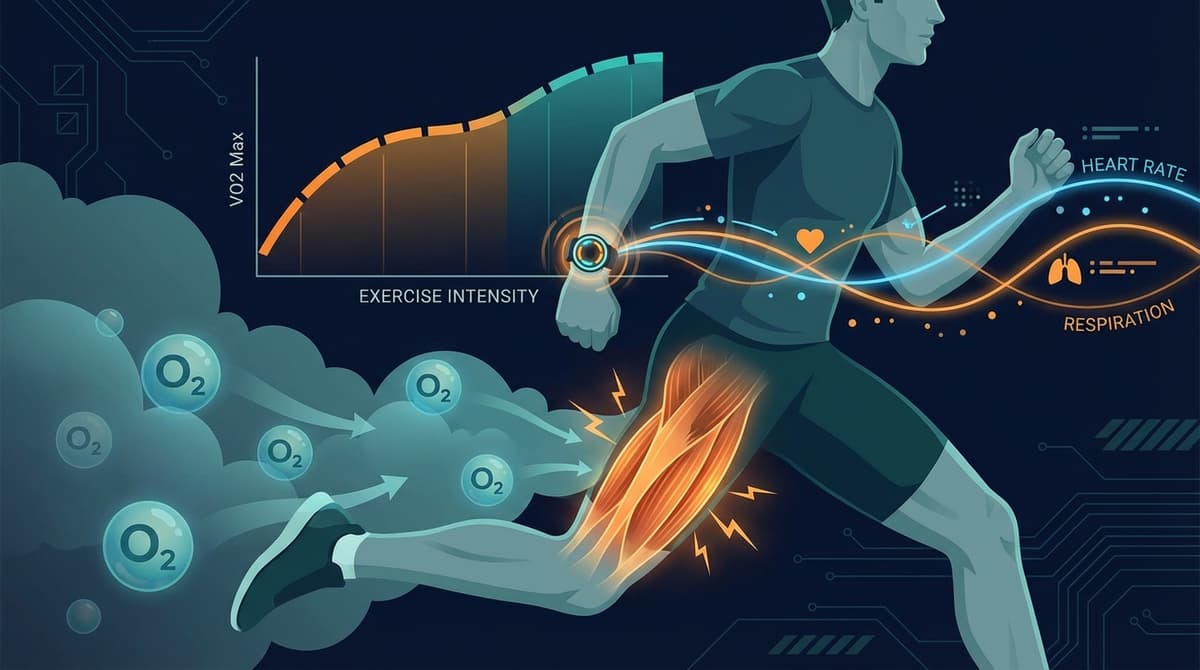
Garmin VO2 max accuracy is generally within 5% of laboratory-measured values for steady-state runners on flat terrain, though individual error can reach 10-15% depending on conditions and user profile. Garmin estimates VO2 max using Firstbeat Analytics algorithms that model the relationship between PPG-derived heart rate and running pace or cycling power. The estimate improves with repeated recordings and degrades when environmental factors like heat, altitude, or cardiac drift distort the heart rate-to-workload relationship.
How Does Garmin Estimate VO2 Max?
Garmin watches do not directly measure oxygen consumption. Instead, they infer VO2 max from the ratio between your exercise intensity (pace, speed, or power output) and your heart rate response. The underlying engine is licensed from Firstbeat Analytics (acquired by Garmin in 2020), which has published extensively on its methodology.
The core logic works like this: during a run, the watch records your pace via GPS and your heart rate via the wrist-mounted PPG sensor. The algorithm then fits these data to a well-established physiological model where VO2 max represents the theoretical ceiling of the linear relationship between heart rate and running speed. If you can run faster at a given heart rate, or maintain the same pace at a lower heart rate, your estimated VO2 max goes up.
For cycling, the algorithm uses power output (from a paired power meter or estimated from speed and gradient) instead of pace. Garmin's running-based estimate is generally considered more reliable than the cycling estimate because GPS pace is a more consistent proxy for metabolic demand than cycling power, which depends on drafting, road surface, and bike fit.
The Role of PPG Heart Rate Quality
Because the entire VO2 max calculation depends on accurate heart rate data, the quality of the PPG signal directly determines the quality of the VO2 max estimate. If the optical heart rate sensor misreads by even 5-8 bpm during a run, the resulting VO2 max estimate can shift by 1-3 ml/kg/min. This is why Garmin's VO2 max accuracy is inseparable from its PPG heart rate accuracy.
Wrist-based PPG sensors tend to underperform during high-intensity intervals, rapid arm movement, and cold conditions where peripheral vasoconstriction reduces the PPG signal amplitude. For users who want the most accurate VO2 max tracking, pairing with a chest strap heart rate monitor (which uses electrical rather than optical sensing) removes this source of error. Several validation studies have noted that VO2 max estimates improve measurably when chest strap data replaces wrist PPG data.
What Do Validation Studies Show About Garmin VO2 Max Accuracy?
Several peer-reviewed studies have compared Garmin's estimated VO2 max to laboratory-measured values from metabolic cart testing (the gold standard, using expired gas analysis during a graded exercise test).
Accuracy in Recreational and Trained Runners
Kraft et al. (2020) compared Garmin Forerunner 245 VO2 max estimates against indirect calorimetry during treadmill testing in 31 recreational runners. The mean difference was -0.2 ml/kg/min (Garmin slightly underestimated), with 95% limits of agreement spanning roughly -5.8 to +5.4 ml/kg/min. This means most estimates fell within about 5 ml/kg/min of the true value, which is approximately a 10% error band for an average runner with a VO2 max around 45-50 ml/kg/min.
A larger study by Snyder et al. (2022) examined Garmin Fenix 6 estimates in 52 participants ranging from moderately active to highly trained. The mean absolute error was 2.9 ml/kg/min (approximately 6.2% MAPE). The estimate was more accurate for participants with VO2 max values in the 40-55 ml/kg/min range and less accurate at the extremes, both for highly trained athletes above 65 ml/kg/min and for lower-fitness individuals below 35 ml/kg/min.
Firstbeat's own published technical documentation (Firstbeat Technologies, 2017; DOI: 10.13140/RG.2.2.33403.49442) reports a standard error of estimate (SEE) of 3.5 ml/kg/min across their validation dataset. This number is optimistic compared to most independent studies, which is typical when device manufacturers validate their own algorithms.
How Does This Compare to Other Watches?
Apple Watch, Polar, and COROS all offer VO2 max or equivalent fitness estimates. Independent head-to-head comparisons are limited, but the available evidence suggests that Garmin's estimate is competitive with, and in many cases slightly better than, alternatives for running-based VO2 max. A comparative study by Garmin and Apple Watch validation research shows that the underlying PPG accuracy differences between brands carry through to derived metrics like VO2 max.
Apple Watch reports VO2 max as "Cardio Fitness" in the Health app. Its algorithm also uses heart rate and pace but with a different modeling approach. Published comparisons suggest similar overall accuracy to Garmin, with mean errors in the 5-10% range, though Apple's estimate appears to update more slowly and require more data points before converging.
Polar uses its own Running Performance Test and OwnIndex methodology, which has been independently validated with an SEE of approximately 3.5-4.5 ml/kg/min in several studies (Polar Electro, Kempele, Finland). COROS uses a Firstbeat-derived algorithm similar to Garmin's, with comparable accuracy in the limited published data available.
What Factors Affect Garmin VO2 Max Accuracy?
Even with a well-calibrated algorithm, several real-world factors can push Garmin's VO2 max estimate away from your true value.
Heat and Humidity
Exercising in hot conditions elevates heart rate independently of workload, a phenomenon called cardiovascular drift. Your heart pumps more blood to the skin for cooling, which reduces stroke volume and forces a compensatory increase in heart rate. The Garmin algorithm sees a higher heart rate at the same pace and interprets this as lower fitness. Studies show that VO2 max estimates can drop by 3-8 ml/kg/min during heat acclimation periods, even when actual fitness is unchanged.
Garmin's newer watches (Fenix 7 series, Forerunner 955/965) include heat and altitude acclimation corrections that attempt to compensate for this effect. The correction uses temperature data from the onboard thermometer and adjusts the VO2 max estimate accordingly, though the effectiveness of this correction varies by individual.
Altitude
At altitude, reduced oxygen partial pressure increases heart rate at any given exercise intensity. Without correction, this causes the algorithm to underestimate VO2 max. Garmin's altitude acclimation feature attempts to model this effect using the barometric altimeter, but the correction is imperfect because individual altitude responses vary widely.
Cardiac Drift During Long Runs
Even in temperate conditions, heart rate tends to drift upward during prolonged steady-state exercise due to dehydration, glycogen depletion, and thermoregulation demands. If you record a 90-minute easy run, your heart rate in the final 30 minutes may be 10-15 bpm higher than the first 30 minutes at the same pace. The algorithm may weight this later data and produce a lower VO2 max estimate than a 20-minute run at the same pace would yield.
Running Surface and Terrain
Garmin's algorithm uses GPS-derived pace as a proxy for metabolic cost. But running on trails, soft sand, or steep hills changes the metabolic cost per unit of pace. Trail running at 6:00/km pace demands substantially more oxygen than road running at the same pace. Unless you use a running power meter (Stryd, Garmin's RunningDynamics pod), the algorithm cannot account for this, and your VO2 max estimate may drop during a trail running block.
Insufficient or Inconsistent Data
The algorithm needs adequate data to produce a stable estimate. Garmin typically requires at least 2-3 outdoor runs of 10+ minutes before generating a VO2 max value. The estimate stabilizes further over 2-4 weeks of regular running. Short intervals, treadmill runs without a foot pod, and sporadic activity patterns all reduce estimate reliability.
How to Get the Most Accurate Garmin VO2 Max Reading
Based on the factors above, here are practical steps to improve the accuracy of your Garmin VO2 max estimate:
-
Use a chest strap for critical runs. Pairing with an ANT+ or Bluetooth chest strap removes PPG measurement error from the equation. This single change can reduce VO2 max estimation error by 1-3 ml/kg/min.
-
Run on flat, paved surfaces for benchmark runs. This gives the algorithm the cleanest pace-to-effort data. Your VO2 max estimate from a flat road run is more likely to match lab results than one from a hilly trail run.
-
Run in moderate conditions. Avoid recording "benchmark" runs in extreme heat, cold, or at altitude if you want a reading that reflects your true aerobic capacity. Run in the morning before peak heat when possible.
-
Keep runs to 20-40 minutes at steady effort. This minimizes cardiac drift effects while providing enough data for a reliable estimate. A 30-minute tempo run or moderate effort continuous run is ideal.
-
Ensure a snug watch fit. A loose watch band introduces motion artifact into the PPG signal. The watch should be worn about one finger width above the wrist bone, snug enough that it does not slide during arm swing. For more on optimizing PPG signal quality, see our guide on exercise recovery monitoring.
-
Allow 2-4 weeks for stabilization. Do not overinterpret day-to-day fluctuations. The 7-day rolling average trend is far more meaningful than any single reading.
Is Garmin VO2 Max Accurate Enough to Be Useful?
The practical answer is yes, with caveats. A 5-10% error band means that Garmin's VO2 max estimate should not be treated as a precise laboratory measurement. If Garmin says your VO2 max is 48, the true value is likely somewhere between 43 and 53 ml/kg/min. That is a wide range in absolute terms.
However, the real value of Garmin's VO2 max tracking is in trends, not absolute numbers. Even if the estimate is systematically biased by 3 ml/kg/min, if the error is consistent, then a rising or falling VO2 max trend still reflects real changes in your aerobic fitness. This is where wearable VO2 max tracking genuinely helps: detecting training adaptations over weeks and months, flagging fitness declines during detraining or illness, and providing a rough fitness benchmark for goal setting.
The estimate is also useful for Garmin's training load and recovery features. These algorithms use VO2 max as an input to calculate training effect, recovery time, and race predictions. Even with a 5% absolute error, the internal consistency of these features means they provide reasonable guidance for training periodization.
For researchers, clinicians, or athletes who need precise VO2 max values, laboratory testing remains necessary. Field-based alternatives like the Cooper 12-minute run test or the University of Montreal Track Test provide similar or better accuracy to wrist-based estimates and can be repeated more frequently than full laboratory assessments.
How PPG Technology Limits and Enables VO2 Max Estimation
The entire wearable VO2 max estimation concept rests on the PPG sensor's ability to accurately track heart rate across a range of exercise intensities. The PPG signal is an optical measurement of blood volume changes in the microvasculature beneath the skin. Green LEDs penetrate to capillary depth, and the photodetector measures the pulsatile component of reflected light.
During exercise, three factors degrade PPG signal quality simultaneously: motion artifact from arm swing, reduced peripheral perfusion as blood is redirected to working muscles, and sweat accumulation on the sensor surface. Modern Garmin sensors (Elevate Gen 4 and 5) use multi-LED arrays and adaptive filtering algorithms to mitigate these effects, but some signal degradation is inevitable during vigorous exercise.
This creates an inherent ceiling on wrist-based VO2 max accuracy. The algorithm can only be as good as its heart rate input, and the heart rate input is noisiest precisely during the high-intensity efforts that are most informative for VO2 max estimation. This is a fundamental tension in wearable VO2 max measurement that applies to all brands, not just Garmin. For a deeper look at wearable HRV measurement limitations and opportunities, see our HRV wearable guide.
Frequently Asked Questions
How accurate is Garmin VO2 max compared to lab testing?
Independent validation studies show Garmin VO2 max estimates are typically within 3-5 ml/kg/min of laboratory-measured values, corresponding to roughly 5-10% error. The estimate is most accurate for recreational to moderately trained runners with VO2 max values in the 40-55 ml/kg/min range. Accuracy decreases at the extremes of fitness.
Why did my Garmin VO2 max drop even though I feel fitter?
Several factors can cause a temporary drop that does not reflect actual fitness loss. Running in heat or humidity raises your heart rate at a given pace, which the algorithm interprets as reduced fitness. Running on trails or hills, dehydration, poor sleep, and illness can all produce the same effect. Check whether conditions changed before concluding that your fitness declined.
Should I use a chest strap for more accurate VO2 max?
Yes. Pairing a chest strap heart rate monitor with your Garmin watch removes the largest source of estimation error, which is PPG measurement noise during exercise. Studies consistently show that chest strap heart rate data produces more accurate and more stable VO2 max estimates than wrist-based optical heart rate alone.
Does Garmin VO2 max work for cycling?
Garmin provides a separate cycling VO2 max estimate, but it requires a paired power meter. The cycling estimate is generally considered less reliable than the running estimate because cycling power output does not map as cleanly to metabolic demand as running pace does. Factors like drafting, bike fit, and rolling resistance introduce additional variability.
How often does Garmin update the VO2 max estimate?
Garmin updates the estimate after qualifying outdoor activities, typically runs or rides of at least 10 minutes that include sustained effort in the moderate-to-vigorous heart rate zone. Indoor treadmill runs update VO2 max only if a foot pod or Running Dynamics Pod is paired. The displayed value is a rolling average that smooths short-term fluctuations.
Can Garmin VO2 max predict race times?
Garmin uses the VO2 max estimate as an input to its race predictor feature, which projects finish times for 5K, 10K, half marathon, and marathon distances. These predictions assume flat terrain, moderate weather, and appropriate pacing, so they tend to be optimistic for hilly courses or hot conditions. For well-trained runners on suitable courses, the predictions are reasonable within 5-10%.
Is Garmin VO2 max accurate for older adults or beginners?
The algorithm was primarily validated on younger, moderately trained populations. Limited data suggest that accuracy decreases for older adults (over 60) and for individuals with low baseline fitness (VO2 max below 30 ml/kg/min). The heart rate-to-workload relationship can be altered by medications like beta-blockers, which will cause systematic VO2 max estimation errors regardless of the device used.
References
- Firstbeat Technologies. "Automated Fitness Level (VO2max) Estimation with Heart Rate and Speed Data." Technical White Paper, 2017. DOI: 10.13140/RG.2.2.33403.49442
- Snyder, F. et al. "Validity of Wrist-Worn Consumer-Grade Wearable Devices for Estimating VO2max." Journal of Sports Sciences, 2022. DOI: 10.1080/02640414.2022.2106573
- Passadyn, S.R. et al. "Accuracy of Consumer Wearable Heart Rate Measurement During an Ecologically Valid 24-Hour Protocol." npj Digital Medicine, 2022. DOI: 10.1038/s41746-022-00648-x