Wearable Blood Pressure Monitors 2026: Technology, Accuracy & What's Coming
A comprehensive guide to wearable blood pressure monitors in 2026 covering cuffless BP technology (PTT, PWA, PPG-based estimation, tonometry), current devices, accuracy standards, and the regulatory landscape for consumer BP monitoring.
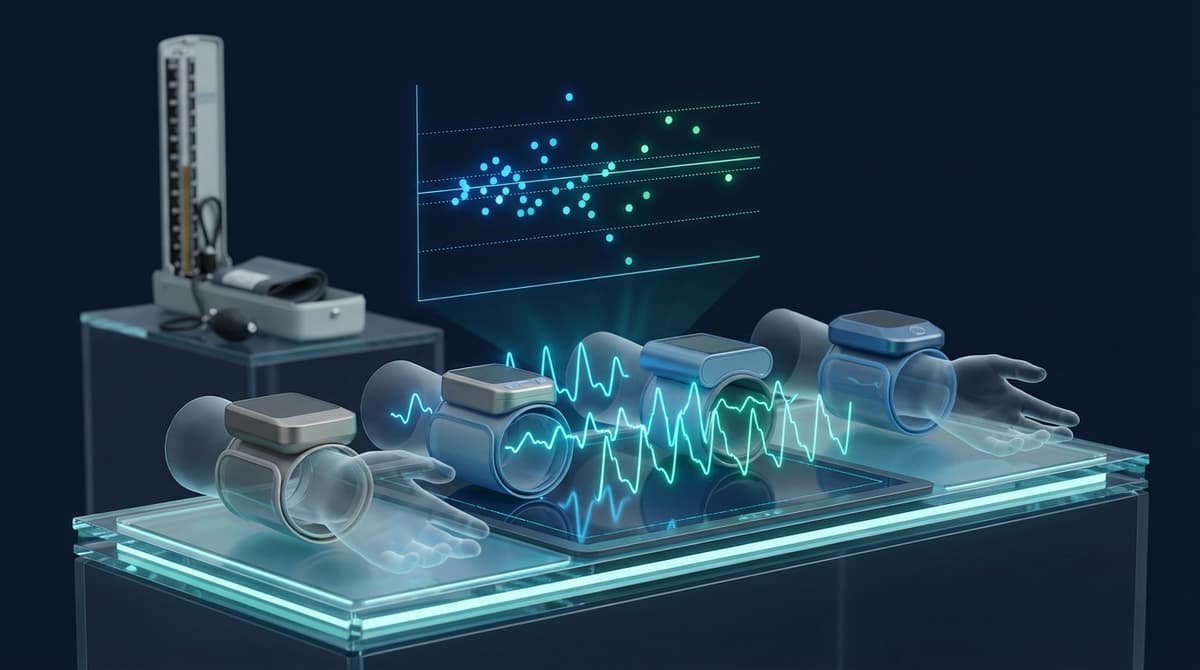
Wearable blood pressure monitors represent one of the most sought-after advances in consumer health technology. The ability to track blood pressure continuously and non-invasively from the wrist would transform the management of hypertension, which affects nearly half of all adults and remains the leading modifiable risk factor for cardiovascular disease and stroke. As of 2026, this technology exists but with significant limitations that every consumer should understand before purchasing.
The short answer: no wearable device currently matches the accuracy of a standard arm cuff for absolute blood pressure measurement. However, several devices offer valuable trend monitoring, and the technology is advancing rapidly. This guide explains the technologies behind wearable blood pressure monitoring, evaluates the current devices on the market, and provides an honest assessment of what is coming next.
Why Cuffless Blood Pressure Is So Hard
To understand why your smartwatch cannot reliably tell you your blood pressure, you need to understand what blood pressure actually is and why traditional cuffs work so well.
Blood pressure is the force exerted by circulating blood against the walls of arteries. It is expressed as two numbers: systolic (peak pressure during heart contraction) and diastolic (minimum pressure between beats). A traditional arm cuff (sphygmomanometer) measures this by physically occluding the brachial artery and detecting the pressure at which blood flow resumes (systolic) and flows freely (diastolic). This is a direct mechanical measurement with well-understood physics, validated by over a century of clinical use.
Cuffless approaches attempt to infer blood pressure from secondary signals rather than measuring it directly. This is inherently more challenging for several fundamental reasons:
The calibration problem. The relationship between PPG waveform features and blood pressure varies between individuals due to differences in arterial stiffness, vessel geometry, body composition, and cardiovascular health. A model trained on one person's data may not work for another. Most current cuffless devices require periodic calibration with a traditional cuff, which partially defeats the purpose of cuffless monitoring.
Calibration drift. Even with initial calibration, the relationship between the optical signal and blood pressure changes over time as vascular tone, hydration, medication levels, and other factors shift. Studies show that calibration accuracy degrades significantly after 2-4 weeks, requiring recalibration.
Positional sensitivity. Blood pressure measurements are affected by the position of the measurement site relative to the heart. With a wrist device, small changes in arm position can introduce errors of 5-10 mmHg. Traditional arm cuffs mitigate this by being positioned at heart level during measurement.
Population diversity. Blood pressure ranges from below 90/60 mmHg (hypotension) to above 180/120 mmHg (hypertensive crisis). Developing algorithms that are accurate across this entire range and across diverse populations of different ages, ethnicities, body compositions, and health conditions is extraordinarily challenging.
For context on how photoplethysmography works and what information its signals contain, see our technical PPG guide.
The Technologies Behind Wearable Blood Pressure
Several distinct technological approaches are being pursued for cuffless blood pressure monitoring. Understanding these helps you evaluate device claims and marketing language.
Pulse Transit Time (PTT)
How it works: PTT measures the time it takes for the pulse wave to travel between two points on the body. The faster the pulse travels, the higher the blood pressure (because higher pressure correlates with stiffer, faster-conducting arterial walls). PTT typically requires two sensors: an ECG electrode on the chest or wrist and a PPG sensor on the wrist or finger. The time delay between the ECG R-peak and the arrival of the PPG pulse gives the transit time.
Accuracy status: PTT correlates with blood pressure but the relationship is not strong enough for clinical accuracy. Individual calibration is required, and accuracy degrades over hours to days. Studies show mean errors of 5-15 mmHg for systolic pressure, which is outside clinical acceptance thresholds.
Devices using PTT: Some research prototypes and early commercial devices use PTT, often combined with other features.
Pulse Wave Analysis (PWA)
How it works: PWA analyzes the morphology (shape) of the PPG waveform to extract features that correlate with blood pressure. Features include the systolic rise time, diastolic decay time, dicrotic notch characteristics, and the second derivative of the PPG waveform. Machine learning models are trained to map these waveform features to blood pressure values.
Accuracy status: PWA-based approaches show promise in research settings, with some studies achieving mean errors of 3-7 mmHg for systolic pressure in controlled conditions. However, performance degrades significantly in free-living conditions due to motion, positional changes, and the confounding effects of hydration, temperature, and autonomic tone on the PPG waveform.
Connection to PPG: PWA is a pure PPG-based approach, which is why it is particularly relevant to wearable devices that already contain PPG sensors for heart rate monitoring. The challenge is that blood pressure is just one of many factors that affect PPG waveform morphology, making it difficult to isolate.
Tonometry
How it works: Tonometry measures blood pressure by pressing a sensor against an artery and detecting the pressure waveform transmitted through the arterial wall. The Samsung Galaxy Watch uses a form of this approach, pressing its optical sensor against the radial artery on the back of the wrist and analyzing the resulting signal.
Accuracy status: Tonometry-based wearable BP has shown the most commercial progress, with Samsung obtaining regulatory clearance in South Korea and several other markets. However, accuracy requires careful sensor placement and periodic calibration with a traditional cuff.
Key limitation: The sensor must be positioned precisely over the artery, and even small shifts in watch position on the wrist can affect readings. This makes casual, any-time measurement unreliable.
Oscillometric Miniaturization
How it works: This is not truly cuffless. Instead, it miniaturizes the traditional oscillometric cuff mechanism into a wearable form factor. The Omron HeartGuide, for example, contains a small inflatable cuff within the watch band that can be inflated to occlude the radial artery.
Accuracy status: Because this approach uses the same fundamental measurement principle as traditional cuffs, it can achieve comparable accuracy. The Omron HeartGuide has been FDA-cleared and clinically validated.
Trade-off: The device is bulkier than a standard smartwatch, the measurement process takes 30 seconds and is not continuous, and the cuff mechanism adds weight, size, and cost.
Current Wearable Blood Pressure Devices
Samsung Galaxy Watch (Blood Pressure Feature)
Technology: Tonometry-based pulse wave analysis using the optical heart rate sensor pressed against the wrist. Available on Galaxy Watch 4, 5, 6, and 7 series with the Samsung Health Monitor app.
Regulatory Status: Cleared in South Korea, approved in several other countries. The feature is classified for blood pressure trend monitoring rather than absolute measurement and requires calibration with a traditional cuff every 28 days.
How it works in practice: The user first calibrates by taking a traditional cuff measurement and entering the values into the Samsung Health Monitor app. The Galaxy Watch then uses its PPG sensor to perform on-demand blood pressure readings by analyzing the pulse wave against the calibration reference.
Accuracy assessment: Studies show mean errors of approximately 5-8 mmHg for systolic and 4-6 mmHg for diastolic blood pressure when recently calibrated. Accuracy degrades progressively after calibration, with errors increasing by 1-3 mmHg per week. This makes the Samsung approach useful for tracking trends and detecting significant changes, but insufficient for clinical blood pressure management decisions.
Pros:
- Integrated into a fully featured smartwatch
- Combines BP monitoring with HR, SpO2, ECG, and sleep tracking
- Large user base generating valuable population-level data
Cons:
- Requires regular cuff calibration
- Not available in all markets due to regulatory differences
- Accuracy degrades between calibrations
- Sensor positioning on the wrist is critical for reliable readings
For how the Samsung Galaxy Watch's PPG sensor handles other measurements like heart rate and SpO2, see our pulse oximeter readings guide.
Aktiia Wrist-Based Monitor
Technology: PPG-based pulse wave analysis with an initial calibration period using an included arm cuff. The Aktiia system uses a bracelet-form wearable that takes automatic measurements throughout the day and night.
Regulatory Status: CE-marked in Europe as a medical device for blood pressure monitoring.
How it works in practice: The user wears the Aktiia bracelet and performs an initial calibration session with the included arm cuff, taking multiple measurements over a calibration period. The bracelet then takes passive measurements automatically during periods of stillness, providing a longitudinal blood pressure profile.
Accuracy assessment: Clinical validation studies published in peer-reviewed journals show mean errors of approximately 4-7 mmHg for systolic blood pressure, which approaches but does not meet the AAMI/ISO standard of plus or minus 5 mmHg mean error with an 8 mmHg standard deviation. The strength of Aktiia lies in its ability to capture multiple readings per day, including nocturnal measurements, providing a more complete blood pressure profile than traditional spot checks.
Pros:
- Automatic passive measurements throughout day and night
- Captures nocturnal blood pressure (an important cardiovascular risk factor)
- Multiple daily readings provide better BP profiling than single spot checks
- CE-marked medical device with published clinical data
Cons:
- Requires initial cuff calibration
- Separate device (not a full smartwatch)
- Not FDA-cleared in the US
- Periodic recalibration needed
Omron HeartGuide
Technology: Miniaturized oscillometric cuff embedded in the watch band. This is the only wearable blood pressure device that uses the same fundamental measurement principle as a traditional arm cuff.
Regulatory Status: FDA-cleared as a blood pressure measuring device (510(k) clearance). This is the highest regulatory clearance of any watch-form BP device.
How it works in practice: The user initiates a measurement by pressing a button. The cuff in the watchband inflates, occluding the radial artery, and the device detects oscillometric signals during deflation to determine systolic and diastolic pressure. The measurement takes approximately 30 seconds.
Accuracy assessment: Because it uses oscillometric measurement, accuracy is comparable to validated wrist-cuff devices. The HeartGuide has been clinically validated with results meeting AAMI/ISO accuracy standards in published studies.
Pros:
- FDA-cleared with validated accuracy
- Uses proven oscillometric measurement principle
- No external calibration device needed
- Results comparable to traditional wrist cuffs
Cons:
- Bulkier and heavier than a standard smartwatch
- Measurement is on-demand only, not continuous
- Cuff inflation is noticeable and requires 30 seconds of stillness
- Limited smartwatch functionality compared to competitors
- Higher price point
Withings BPM Connect
Technology: While not a wrist-worn wearable in the traditional sense, the Withings BPM Connect is a connected arm-cuff blood pressure monitor that integrates seamlessly with Withings' ecosystem of wearable health devices, including the ScanWatch which provides PPG-based heart rate and SpO2 monitoring.
Regulatory Status: FDA-cleared and clinically validated oscillometric arm cuff.
Why include it: For users serious about blood pressure management, the most accurate option remains a validated arm cuff used consistently. The Withings BPM Connect represents the best integration between traditional accurate BP measurement and a digital health ecosystem. Pairing it with a PPG-based wearable for continuous heart rate, HRV, and SpO2 monitoring creates a comprehensive cardiovascular monitoring system.
Accuracy Standards: IEEE, AAMI, and ISO
Understanding the accuracy standards for blood pressure devices helps you evaluate marketing claims critically.
AAMI/ANSI/ISO 81060-2 is the international standard for non-invasive blood pressure devices. To meet this standard, a device must demonstrate a mean error of no more than plus or minus 5 mmHg with a standard deviation of no more than 8 mmHg when compared against a reference sphygmomanometer or invasive arterial blood pressure measurement.
The IEEE 1708-2014 standard specifically addresses wearable cuffless blood pressure devices and recognizes different performance grades. It establishes that cuffless devices may be valid for trend monitoring even if they do not meet the absolute accuracy requirements for clinical diagnosis.
The key distinction is between:
- Absolute accuracy: Can the device tell you your blood pressure is 130/85 mmHg with clinical reliability? Currently, only oscillometric devices (traditional cuffs and the Omron HeartGuide) meet this bar.
- Trend accuracy: Can the device reliably tell you that your blood pressure has increased by 15 mmHg from your baseline? This is a less demanding requirement that some cuffless devices can meet.
For hypertension management, trend accuracy has genuine value. Knowing that your blood pressure is consistently higher this week than last week, or that your nighttime blood pressure is not dipping (a significant cardiovascular risk factor), is clinically meaningful even without absolute accuracy.
Pulse Wave Velocity: The Theory Behind Cuffless BP
The theoretical link between PPG signals and blood pressure centers on pulse wave velocity (PWV), the speed at which the pressure pulse travels through the arterial system.
The Moens-Korteweg equation relates PWV to the elastic modulus of the arterial wall, wall thickness, vessel radius, and blood density. Since arterial wall stiffness increases with blood pressure (both acutely and chronically), a faster PWV generally indicates higher blood pressure.
In practice, PWV is estimated from either pulse transit time (PTT, requiring two measurement sites) or from features of the PPG waveform at a single site (such as the slope of the systolic upstroke or the timing of reflected wave components).
The challenges are that many factors besides blood pressure affect PWV and PPG morphology, including arterial stiffness (which changes with age and disease independently of acute BP), hydration status, sympathetic nervous system activation, temperature, and medications. Isolating the blood pressure signal from these confounders is the core algorithmic challenge that researchers and companies are working to solve.
For a detailed explanation of how PPG waveform features are extracted and processed, see our PPG signal analysis guide.
The Regulatory Landscape
The path to market for a wearable blood pressure monitor involves navigating a complex regulatory landscape that varies by country.
In the United States, the FDA classifies blood pressure monitors as Class II medical devices requiring 510(k) clearance. For a novel cuffless approach, a De Novo classification pathway may be required. The FDA has been increasingly engaged with cuffless BP technology, issuing guidance on clinical validation requirements and accuracy thresholds. To date, no fully cuffless, calibration-free wrist device has received FDA clearance for standalone blood pressure measurement.
In Europe, the CE marking process under the Medical Device Regulation (MDR) has allowed some cuffless devices to reach market with clinical evidence supporting their intended use. The Aktiia has received CE marking for its calibrated cuffless approach.
In South Korea and other Asian markets, regulatory pathways have been somewhat more receptive to cuffless BP technology, which is why Samsung's blood pressure feature launched first in South Korea.
What "medical-grade" actually means: This term is frequently used in marketing but has no standardized regulatory definition. A truly medical-grade blood pressure device should be FDA-cleared (in the US) or CE-marked (in Europe) as a medical device, with published clinical validation data demonstrating compliance with recognized accuracy standards. "Medical-grade" in a press release without regulatory clearance is essentially a marketing claim.
What Is Coming Next
The wearable blood pressure monitoring field is moving rapidly, with several promising developments on the horizon.
Multi-modal sensing. Combining PPG with additional sensors such as bioimpedance, microelectromechanical (MEMS) pressure sensors, and electrical biosignals may improve accuracy beyond what any single modality can achieve. Several companies are developing multi-sensor patches and wristbands that fuse data from multiple sensing modalities.
AI-driven personalization. Machine learning models that adapt to individual users over time, learning their specific physiological patterns and reducing calibration requirements, are showing promise in research. Transfer learning approaches that leverage population-level data while fine-tuning to individual users could reduce the calibration burden.
Continuous calibration-free approaches. The holy grail is a device that requires no calibration at all. This likely requires fundamentally new sensing modalities or a breakthrough in understanding the relationship between non-invasive signals and arterial blood pressure. Companies including Apple, Google, and Samsung are reportedly investing heavily in this space.
Regulatory evolution. The FDA and other regulatory bodies are developing new frameworks specifically for cuffless blood pressure devices, potentially creating pathways for devices that demonstrate value for trend monitoring even if they do not meet traditional absolute accuracy standards. This pragmatic approach could accelerate the availability of useful, if imperfect, cuffless BP devices.
For athletes and health-conscious users interested in cardiovascular monitoring while waiting for mature cuffless BP technology, combining a validated arm cuff with a PPG-based wearable for heart rate, HRV, and SpO2 monitoring provides the most comprehensive and accurate picture of cardiovascular health available today.
Practical Recommendations for Blood Pressure Monitoring in 2026
Given the current state of the technology, here are evidence-based recommendations:
-
Do not rely solely on a wearable device for blood pressure management. Continue using a validated arm cuff for clinical decision-making, medication adjustments, and reporting values to your healthcare provider.
-
Use wearable BP as a supplement, not a replacement. Trend data from devices like the Samsung Galaxy Watch or Aktiia can provide valuable insights into blood pressure patterns, especially nocturnal BP, that spot checks miss.
-
Calibrate regularly. If using a device that requires calibration, follow the manufacturer's recommended schedule strictly. Accuracy degrades significantly without regular recalibration.
-
Position matters. When taking a wearable BP reading, keep your wrist at heart level, sit quietly, and avoid movement. Follow the same measurement conditions each time for comparable trend data.
-
Understand the limitations. A cuffless reading that says 125/82 might be the actual value, or it might be off by 5-10 mmHg. Use the data for pattern recognition and trend detection, not for precise clinical decisions.
-
Combine with other cardiovascular metrics. Blood pressure is one component of cardiovascular health. Combining BP trend data with continuous heart rate, HRV trends, and SpO2 monitoring provides a richer picture of your cardiovascular status.
The promise of wearable blood pressure monitoring is real, and the technology is advancing steadily. But the gap between marketing claims and clinical reality remains significant. Stay informed, set realistic expectations, and never let a wearable reading replace professional medical advice.
Frequently Asked Questions
Refer to the FAQ section above for answers to the most common questions about wearable blood pressure monitors, including the accuracy of wrist-based devices, FDA-cleared options, the timeline for cuffless BP technology, and our recommendation for the best wearable BP monitor in 2026.
Frequently Asked Questions
- How accurate are wrist-based blood pressure monitors compared to arm cuffs?
- Wrist-based cuffless blood pressure monitors are currently less accurate than traditional arm cuff devices. Most cuffless devices show mean errors of 5-10 mmHg for systolic blood pressure, compared to plus or minus 3-5 mmHg for validated arm cuffs. The Samsung Galaxy Watch Blood Pressure feature, one of the most widely available cuffless options, requires periodic calibration with a traditional cuff and is cleared for tracking trends rather than providing absolute blood pressure values. No wrist-based cuffless device currently meets the full AAMI/ISO accuracy standard for standalone clinical BP measurement.
- Which wearable blood pressure monitors are FDA-cleared?
- As of early 2026, the Samsung Galaxy Watch (certain models sold in specific markets) has received regulatory clearance for blood pressure trend monitoring in several countries, though with the requirement for periodic cuff-based calibration. The Omron HeartGuide is FDA-cleared as a traditional oscillometric blood pressure monitor in watch form. The Aktiia wrist device has received CE marking in Europe. True cuffless, calibration-free blood pressure monitors with full FDA clearance for absolute BP measurement do not yet exist on the consumer market.
- When will accurate cuffless blood pressure monitors be widely available?
- Industry experts and researchers generally estimate that clinically validated, calibration-free cuffless blood pressure monitors could reach the consumer market between 2027 and 2030. The primary bottlenecks are achieving consistent accuracy across diverse populations without individual calibration, meeting regulatory accuracy standards, and solving the calibration drift problem where accuracy degrades over days to weeks. Several companies have devices in late-stage clinical trials, but the timeline depends heavily on regulatory outcomes.
- What is the best wearable for blood pressure monitoring in 2026?
- The best wearable for blood pressure monitoring depends on your needs. For trend tracking with a smartwatch, the Samsung Galaxy Watch with its tonometry-based BP feature offers the most integrated experience, though it requires calibration. For clinical-grade accuracy in a wearable form factor, the Omron HeartGuide is the most validated option since it uses a traditional cuff mechanism. For a non-watch approach, the Aktiia bracelet offers calibrated cuffless monitoring with good longitudinal trend data. None of these replaces regular measurement with a validated arm cuff for clinical decision-making.