How Your Wearable Stress Score Actually Works (2026)
How wearables calculate stress scores from PPG-derived HRV. Explains the signal pipeline, scoring algorithms, what the numbers mean, and why scores differ between devices.
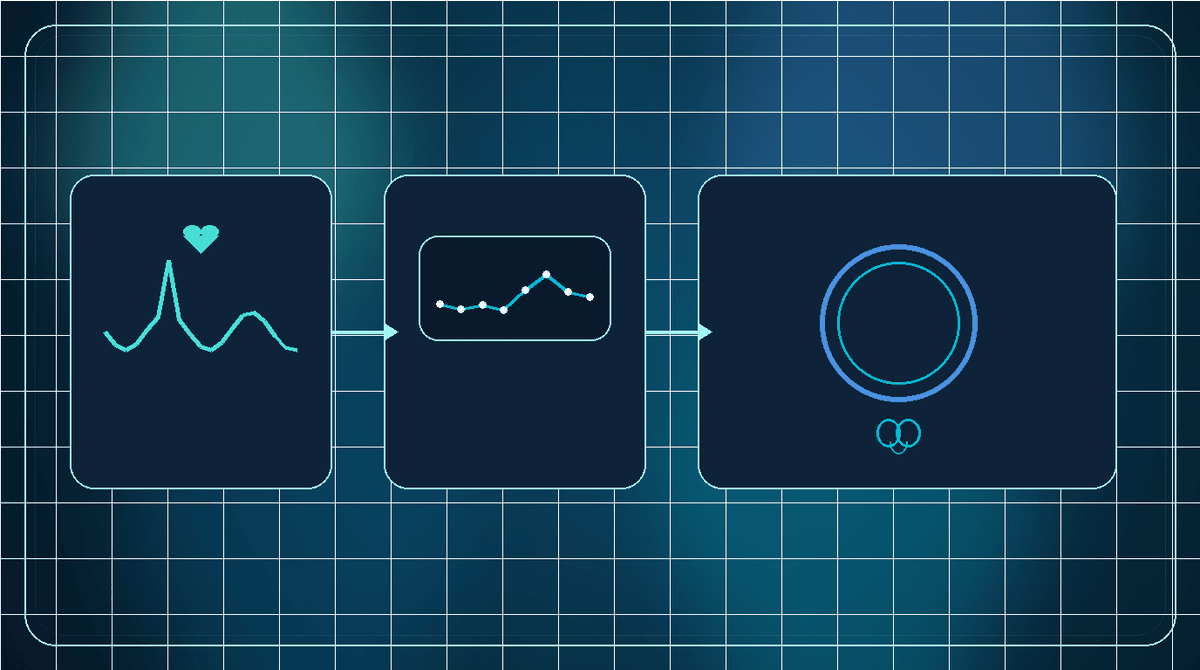
The stress score displayed on your wearable is the end product of a multi-stage signal processing pipeline that converts raw optical pulse data into a single number representing your autonomic nervous system balance. Understanding each stage of this pipeline reveals what the score captures, what it misses, and why the same stressful moment can produce different numbers on different devices.
Stage 1: PPG Signal Acquisition
Everything starts with the PPG sensor on the back of your watch or ring. Green LEDs (typically 520-535 nm wavelength) illuminate the skin, and a photodetector measures the light reflected back after passing through capillary blood. Each heartbeat pushes a pulse of blood into the wrist arteries, transiently increasing light absorption and decreasing the detected signal.
The raw PPG waveform is a quasi-periodic signal riding on a baseline that shifts with respiration, motion, and sensor contact pressure. The wearable samples this signal at 25 to 100 Hz (device-dependent) and begins filtering.
Stage 2: Beat Detection and IBI Extraction
The first processing step is identifying individual heartbeats in the PPG signal. The algorithm detects the systolic peak (or foot) of each pulse wave and measures the time interval between consecutive beats. These inter-beat intervals (IBIs), measured in milliseconds, are the raw material for HRV computation.
Peak detection in PPG is more challenging than R-wave detection in ECG because:
- The PPG systolic peak is broader and rounder than the sharp ECG R-wave
- Motion artifact can create false peaks
- Vasoconstriction changes pulse amplitude, making adaptive thresholding necessary
Modern wearables use a combination of bandpass filtering (0.5-4 Hz), derivative analysis, and adaptive peak detection to achieve IBI accuracy within 5 to 15 ms of ECG-derived values under resting conditions.
Stage 3: Artifact Rejection
Before HRV features are computed, the IBI series undergoes quality control:
- Physiological range check: IBIs outside 300 to 1500 ms (corresponding to heart rates of 40 to 200 bpm) are flagged
- Ectopic beat detection: IBIs that differ by more than 20-25% from neighboring intervals are identified as potential premature beats and either corrected or excluded
- Motion detection: Accelerometer data flags periods of significant movement, and IBI data from those periods may be excluded from stress calculation
- Signal quality index: Metrics like perfusion index and signal-to-noise ratio determine whether the current PPG quality is sufficient for HRV analysis
If too many IBIs are rejected, the device pauses stress scoring until a clean data window is available. This is why you sometimes see gaps in your daily stress timeline.
Stage 4: HRV Feature Computation
From a clean IBI series (typically 1 to 5 minutes of data), the algorithm computes several HRV features:
Time-Domain Features
| Feature | What It Measures | Stress Association |
|---|---|---|
| RMSSD | Beat-to-beat variability | Decreases with stress |
| SDNN | Overall variability | Decreases with stress |
| pNN50 | Proportion of large beat-to-beat changes | Decreases with stress |
| Mean HR | Average heart rate | Increases with stress |
Frequency-Domain Features
The IBI series is interpolated and subjected to spectral analysis (typically using the Lomb-Scargle periodogram or FFT after resampling):
| Band | Frequency Range | Physiological Meaning |
|---|---|---|
| VLF | 0.003-0.04 Hz | Thermoregulation, hormonal |
| LF | 0.04-0.15 Hz | Mixed sympathetic + parasympathetic |
| HF | 0.15-0.40 Hz | Primarily parasympathetic (vagal) |
| LF/HF ratio | N/A | Sympathovagal balance estimate |
Under stress, LF power typically increases, HF power decreases, and the LF/HF ratio rises. However, the physiological interpretation of the LF/HF ratio as a pure sympathovagal balance index has been debated in the literature (Shaffer and Ginsberg, 2017).
For a deeper exploration of HRV metrics, see our heart rate variability guide.
Nonlinear Features
Some algorithms also compute:
- Sample entropy: Measures signal complexity (lower entropy correlates with higher stress)
- Poincare plot indices (SD1, SD2): Geometric HRV measures where SD1 reflects short-term variability
Stage 5: Scoring Algorithm
The computed HRV features are fed into a classification or regression model that outputs the stress score. The exact model architecture is proprietary for each manufacturer, but the general approaches are:
Garmin (Firstbeat Analytics)
Firstbeat uses a proprietary algorithm that combines RMSSD, LF/HF ratio, and respiratory rate estimation to compute a 0-100 stress score updated every 3 minutes. The model was developed using laboratory stress protocols with simultaneous ECG reference and has been refined with data from millions of users.
The 0-100 scale maps to:
- 0-25: Rest (high parasympathetic dominance)
- 26-50: Low stress
- 51-75: Medium stress
- 76-100: High stress
Samsung
Samsung computes stress in percentile form based on a 1-minute HRV measurement. The user's current HRV is compared to their personal baseline to generate a relative stress level. This personalized approach reduces inter-individual variability but requires a calibration period.
Fitbit
Fitbit's Stress Management Score (1-100, higher is better) combines three sub-scores: exertion balance (physical activity recovery), responsiveness (HRV responsiveness during sleep), and sleep patterns. This daily composite approach smooths out momentary fluctuations.
Oura Ring
Oura focuses on overnight HRV analysis, computing a Readiness Score that reflects recovery from the previous day's stress. The emphasis on sleep-time measurement reduces motion artifact and provides a stable baseline for trend tracking.
Why the Same Stressor Produces Different Scores
If you wear a Garmin and a Samsung simultaneously during the same stressful meeting, the scores will differ because:
- Different features: Each uses a different combination of HRV metrics
- Different window lengths: 3-minute vs. 1-minute windows capture different temporal dynamics
- Different scaling: 0-100 absolute vs. percentile-based relative scoring
- Different baselines: One uses population norms, the other uses your personal history
- Different PPG processing: Sensor hardware and beat detection algorithms vary
This is analogous to two different bathroom scales both measuring weight but displaying different numbers due to calibration differences. The trend direction should agree even if the absolute values do not.
For a device-by-device accuracy comparison, see our stress tracker accuracy guide.
The Feedback Loop: Breathing Exercises
Many wearables offer guided breathing exercises that directly target the stress score. Slow breathing at 4 to 6 breaths per minute maximizes respiratory sinus arrhythmia, a pattern where heart rate accelerates during inhalation and decelerates during exhalation. This increases HF power and RMSSD, which the stress algorithm interprets as reduced stress.
The effect is measurable within 60 to 90 seconds and can reduce the displayed stress score by 10 to 30 points during a 5-minute session. This is a genuine physiological response, not a scoring artifact: slow breathing activates the vagus nerve and shifts autonomic balance toward parasympathetic dominance (Laborde et al., 2017).
Limitations of Single-Number Stress Scores
Compressing the complexity of stress into a single number necessarily loses information:
- Cause is unknown: A score of 80 could be exam anxiety, a hard workout, three cups of coffee, or a fever
- Acute vs. chronic stress: The score captures momentary autonomic state, not accumulated allostatic load
- Individual calibration varies: What registers as "high stress" HRV for one person may be baseline for another
- Cognitive stress may not show: Some forms of mental strain (focused concentration, creative problem-solving) do not reliably alter HRV
Despite these limitations, stress scores provide a practical and accessible entry point for understanding autonomic health that would otherwise require clinical HRV testing.
Frequently Asked Questions
What does a stress score actually measure?
It measures sympathetic-parasympathetic balance through HRV. A high score means heightened autonomic activation regardless of whether the cause is emotional, physical, or chemical.
How is the stress score calculated from PPG?
The device extracts inter-beat intervals, computes HRV features (RMSSD, LF/HF ratio, etc.), and runs them through a trained model that outputs a scaled score.
Why does my stress score differ between devices?
Different HRV features, window lengths, algorithms, and scales. No industry standard exists, so cross-device comparison is not meaningful.
Can I lower my stress score in real time?
Yes. Slow breathing at 4 to 6 breaths per minute increases HRV within 1 to 3 minutes, which devices register as decreased stress.
Is a stress score of 0 possible?
Scores near 0 occur during deep sleep. They are rare during waking hours and indicate strong parasympathetic dominance.
How long does the device need to calculate a stress score?
Most devices need 1 to 3 minutes of still data. Garmin uses 3-minute windows; Samsung allows 1-minute readings.
Summary
Your wearable's stress score is built from a pipeline of PPG acquisition, beat detection, artifact rejection, HRV feature extraction, and algorithmic scoring. Each manufacturer implements this pipeline differently, which is why scores vary between devices. The underlying measurement, autonomic nervous system balance via heart rate variability, is well-validated in clinical literature, but the translation to a consumer-friendly number involves proprietary decisions about features, windows, baselines, and scaling that affect what you see on your wrist.
Frequently Asked Questions
- What does a stress score actually measure?
- A stress score measures the balance between your sympathetic (fight-or-flight) and parasympathetic (rest-and-digest) nervous systems through heart rate variability analysis. It quantifies physiological load, not psychological stress specifically. A high score means your autonomic nervous system is in a state of heightened activation, regardless of whether the cause is emotional, physical, or chemical.
- How is the stress score calculated from PPG?
- The wearable extracts pulse-to-pulse intervals from the PPG signal, computes HRV features (typically RMSSD, LF power, HF power, and LF/HF ratio), and feeds them into a classification or regression model trained on labeled stress/rest data. The model output is scaled to a consumer-friendly range, usually 0 to 100.
- Why does my stress score differ between devices?
- Different manufacturers use different HRV features, window lengths, algorithms, and scoring scales. Garmin uses Firstbeat Analytics with a 0-100 scale, Samsung uses a percentile-based system, and Fitbit computes a daily composite score. There is no industry standard for stress scoring, so cross-device comparisons are not meaningful.
- Can I lower my stress score in real time?
- Yes. Slow, deep breathing (4 to 6 breaths per minute) activates the parasympathetic nervous system and increases HRV within 1 to 3 minutes, which most devices will register as decreased stress. This is the basis for guided breathing features on Garmin, Apple Watch, and Fitbit devices.
- Is a stress score of 0 possible?
- A score of 0 (or very low) indicates deep rest with high parasympathetic dominance, such as during deep sleep. It is rare during waking hours. Consistently very low scores may indicate either excellent stress resilience or, in some cases, autonomic dysfunction where the sympathetic nervous system is underresponsive.
- How long does the device need to calculate a stress score?
- Most wearables require 1 to 3 minutes of relatively still PPG data to compute a reliable stress score. Garmin uses 3-minute windows, while Samsung allows 1-minute on-demand readings. Shorter windows have higher variability between consecutive measurements.