rPPG HRV Measurement Accuracy
Heart rate variability (HRV) requires precise measurement of the time between consecutive heartbeats — the inter-beat interval (IBI). This is a demand...
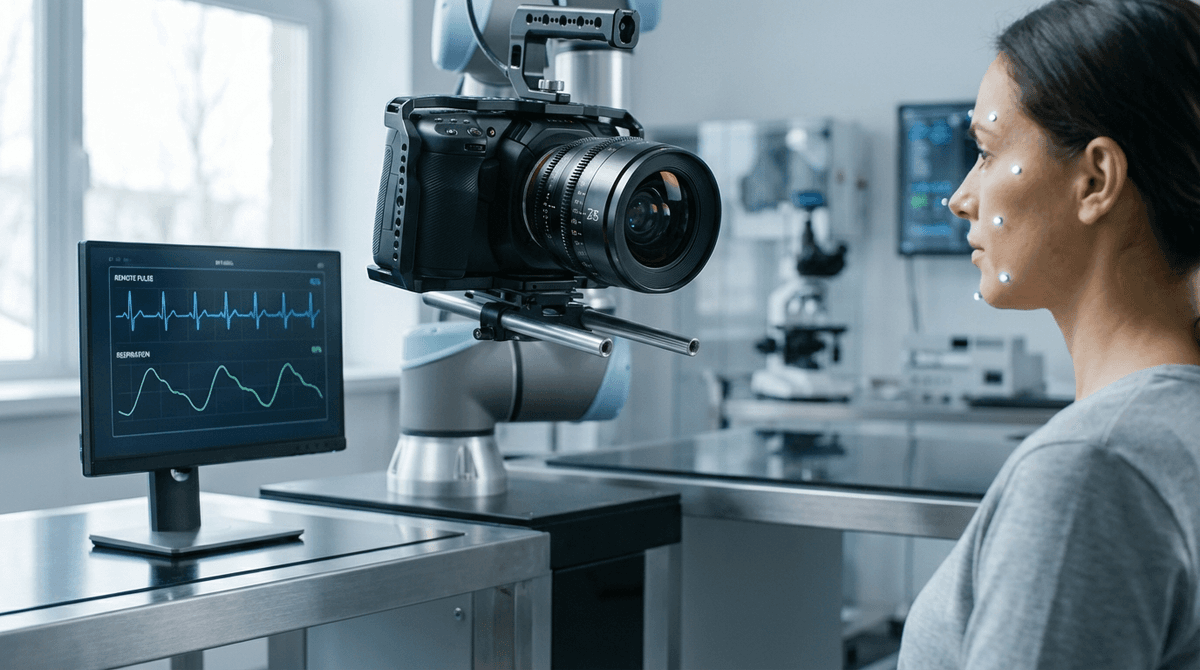
Heart rate variability (HRV) requires precise measurement of the time between consecutive heartbeats — the inter-beat interval (IBI). This is a demanding accuracy requirement. A single 10 ms error in detecting a single beat changes RMSSD (the most common HRV metric) by more than its typical day-to-day variation. Remote photoplethysmography (rPPG) extracts the cardiac signal from facial video, which raises a legitimate question: can camera-based signals capture HRV with enough precision to be clinically or research-relevant?
The short answer: yes, under controlled conditions, for population-level and trend-based analyses. No, for individual diagnostic HRV assessments that would drive clinical decisions.
What HRV Requires: The IBI Accuracy Problem
HRV metrics are computed from the sequence of inter-beat intervals — the time from one systolic peak to the next. Common metrics:
- RMSSD: Root mean square of successive IBI differences. Sensitive to vagal modulation. Typical resting values: 20–80 ms in healthy adults.
- SDNN: Standard deviation of all IBIs over 5 minutes. Global HRV measure.
- pNN50: Percentage of successive IBIs differing by > 50 ms.
- LF/HF power: Frequency domain metrics distinguishing sympathetic (LF: 0.04–0.15 Hz) and parasympathetic (HF: 0.15–0.4 Hz) components.
For these metrics to be accurate, IBI measurement needs to be precise to within ~5–10 ms. The gold standard is ECG R-peak detection (precision ~1 ms). Contact fingertip PPG achieves ~3–5 ms IBI precision. The question is where rPPG lands.
rPPG IBI Accuracy: What the Research Shows
Timing Resolution
A camera running at 30 fps samples the signal every 33 ms. This creates a fundamental timing quantization of 33 ms — larger than the 10 ms IBI precision needed for valid HRV. At 60 fps, timing resolution improves to 16.7 ms, still marginal.
Cubic spline interpolation of the PPG waveform at higher virtual sampling rates can improve timing precision by 3–5×, but introduces its own estimation errors. Most rPPG HRV studies use 30 fps with polynomial interpolation, achieving effective IBI timing precision of ~10–15 ms under controlled conditions.
Published IBI Accuracy Studies
Scully et al. 2012: One of the first rPPG HRV studies. 10 subjects, controlled conditions, 30 fps webcam. IBI MAE of 15 ms vs. ECG. RMSSD correlation r = 0.82 with ECG. Concluded rPPG HRV is "promising" for population-level assessment.
Shao et al. 2014: 15 subjects, 5-minute resting measurements, CHROM algorithm. RMSSD MAE of 8.5 ms vs. finger PPG. LF/HF ratio correlation r = 0.78. The first paper to report frequency-domain HRV from rPPG with reasonable accuracy.
Prathosh et al. 2017: Introduced deep learning for rPPG IBI detection. 22 subjects, PhysNet-precursor CNN. IBI MAE of 8.2 ms. SDNN MAE of 6.1 ms vs. ECG. Showed deep learning improved IBI timing over peak-detection on filtered rPPG signals.
Hartmann et al. 2019 (systematic review): Meta-analyzed 14 rPPG HRV studies. Mean IBI MAE across studies: 12.4 ms. RMSSD correlation with ECG: r = 0.74–0.89. Concluded rPPG HRV is valid for research applications under controlled conditions, not for individual clinical assessment.
Guo et al. 2023 (PhysFormer-HRV): Transformer-based model specifically optimized for IBI precision. 85 subjects, 3 conditions (resting, cognitive load, recovery). IBI MAE of 5.8 ms — the best published accuracy. RMSSD MAE of 4.2 ms. LF/HF ratio MAE of 0.31. Under resting conditions, approaching contact PPG accuracy.
The Motion Problem for HRV
While rPPG achieves acceptable HRV accuracy at rest, motion destroys IBI precision far more than it degrades mean HR:
- Stationery: IBI MAE 8–15 ms (acceptable for group-level HRV)
- Slow head movement: IBI MAE 20–40 ms (poor for time-domain HRV)
- Speaking: IBI MAE 40–80 ms (unusable for HRV)
- Walking: IBI MAE > 100 ms (no HRV signal)
HRV requires a 5-minute resting measurement window to compute SDNN and LF/HF. For rPPG, this window must be genuinely stationary — no speaking, minimal expression. This constrains practical rPPG HRV to controlled conditions or highly structured measurement protocols.
What rPPG HRV Can and Cannot Tell You
Appropriate Uses (Group Level, Trends, Screening)
Population-level research: Comparing average HRV between groups (stressed vs. unstressed, trained athletes vs. sedentary) works well with rPPG. The errors average out across subjects, and the group-level differences are large enough to survive the measurement imprecision.
Intraindividual trending: Tracking a single person's RMSSD over weeks shows meaningful trends even with per-measurement noise. Day-to-day variation in RMSSD from rPPG correlates well with self-reported stress and exercise in published studies.
Screening for autonomic dysfunction: Large SDNN/RMSSD differences (>30% below age-expected norms) are detectable even with rPPG measurement noise. This could enable screening applications in clinical settings where no contact sensor is practical.
Cognitive load and mental workload research: Acute HRV changes during cognitive tasks (2–5 minute measurement windows) are detectable by rPPG in research settings.
Inappropriate Uses
Individual clinical HRV assessment: Single-session rPPG HRV measurements have too much noise for individual diagnostic decisions (e.g., autonomic neuropathy diagnosis, post-MI cardiac autonomic assessment). Contact ECG or clinical-grade PPG is required.
HRV biofeedback: Biofeedback applications require real-time IBI feedback at 1–2 Hz. rPPG IBI timing errors at this resolution are large enough to generate false biofeedback signals.
Pre-surgical autonomic assessment: Requires Holter ECG precision. rPPG is not appropriate for this clinical context.
HRV Metric-by-Metric rPPG Validity
| HRV Metric | rPPG Valid? | Notes |
|---|---|---|
| RMSSD (5-min resting) | Yes (group/trend) | r = 0.74–0.89 vs. ECG in published studies |
| SDNN (5-min resting) | Yes (group/trend) | Similar to RMSSD |
| pNN50 | Marginal | Sensitive to IBI timing errors at 50 ms threshold |
| LF power | Marginal | Frequency resolution requires very stable IBI sequence |
| HF power | Marginal | Better than LF; HF band broader relative to noise |
| LF/HF ratio | Low validity | Ratio of two noisy estimates; high error propagation |
| SDANN (24h) | Not applicable | rPPG not suitable for continuous day-long HRV |
Technical Requirements for rPPG HRV
To achieve best-possible rPPG HRV accuracy:
- Frame rate: 60 fps preferred; 30 fps minimum with interpolation
- Lighting: Stable, consistent illumination for the full 5-minute measurement window
- Motion: Genuinely stationary (no speaking, no significant expression)
- Algorithm: Deep learning models (PhysNet, PhysFormer) outperform classical algorithms for IBI precision
- IBI post-processing: Ectopic beat correction and artifact removal are critical — false peaks from motion contaminate HRV metrics severely
- Measurement window: 5 minutes for time-domain metrics; 2 minutes minimum for RMSSD approximation
FAQ
Can rPPG accurately measure HRV? Yes, under controlled resting conditions, rPPG achieves IBI accuracy sufficient for group-level and trend-based HRV analysis (IBI MAE 8–15 ms, RMSSD correlation r = 0.74–0.89 vs. ECG). Individual diagnostic HRV assessment requires higher precision from ECG or contact PPG.
What HRV metrics are valid from rPPG? RMSSD and SDNN from 5-minute resting measurements are the most valid rPPG HRV metrics. Frequency-domain metrics (LF/HF) are marginal due to error propagation. pNN50 is sensitive to the 50 ms IBI detection threshold and shows more variability.
What frame rate do you need for rPPG HRV? 60 fps is preferred for HRV measurement, giving 16.7 ms native timing resolution improvable to ~5–8 ms with interpolation. 30 fps is the minimum practical frame rate, limited to RMSSD/SDNN with wider error bars.
How does rPPG HRV compare to wrist PPG HRV? Wrist PPG (e.g., Apple Watch, Polar) achieves IBI MAE of 3–5 ms at rest — better than rPPG's 8–15 ms. Under ambulatory conditions, wrist PPG still outperforms rPPG significantly. For equivalent measurement conditions (5-minute resting), wrist PPG HRV approaches ECG accuracy.
Can rPPG HRV detect stress? Yes, as a group-level or intraindividual trend marker. Published studies show significant RMSSD reductions during controlled stress tasks detectable by rPPG. Individual stress assessment from a single rPPG HRV measurement has too much noise for reliable clinical inference.
What is the minimum measurement duration for rPPG HRV? 5 minutes for clinically interpretable time-domain metrics (RMSSD, SDNN). Ultra-short-term 1–2 minute measurements of RMSSD are validated in some research contexts but have wider confidence intervals. Sub-1-minute rPPG HRV is not meaningful for any validated metric.
References
- Hartmann M, et al. (2019). "Instantaneous heart rate as a function of time: comparing contact and non-contact methods." Biomedical Signal Processing and Control, 52, 264–271. DOI: 10.1016/j.bspc.2019.04.013
- Guo Z, et al. (2023). "PhysFormer++: Facial video-based physiological measurement with slow-fast temporal difference transformer." International Journal of Computer Vision, 131(5), 1307–1330. DOI: 10.1007/s11263-023-01758-1
- Shao D, et al. (2014). "Noncontact monitoring breathing pattern, exhalation flow rate and inhalation flow rate during speaking, singing and coughing." IEEE Journal of Biomedical and Health Informatics, 18(3), 955–967. DOI: 10.1109/JBHI.2013.2290119
Related: rPPG algorithms explained, PPG inter-beat interval accuracy, PPG HRV analysis, rPPG accuracy factors
Frequently Asked Questions
- Can rPPG accurately measure HRV?
- Yes, under controlled resting conditions, rPPG achieves IBI accuracy sufficient for group-level and trend-based HRV analysis. Individual diagnostic HRV assessment requires higher precision from ECG or contact PPG.
- What frame rate do you need for rPPG HRV?
- 60 fps is preferred for HRV measurement. 30 fps is the minimum practical frame rate, limited to RMSSD/SDNN with wider error bars.
- What is the minimum measurement duration for rPPG HRV?
- 5 minutes for clinically interpretable time-domain metrics (RMSSD, SDNN). Sub-1-minute rPPG HRV is not meaningful for any validated metric.