rPPG Telehealth Remote Monitoring
Remote photoplethysmography (rPPG) measures heart rate, respiratory rate, and blood oxygen saturation using nothing more than a smartphone or laptop c...
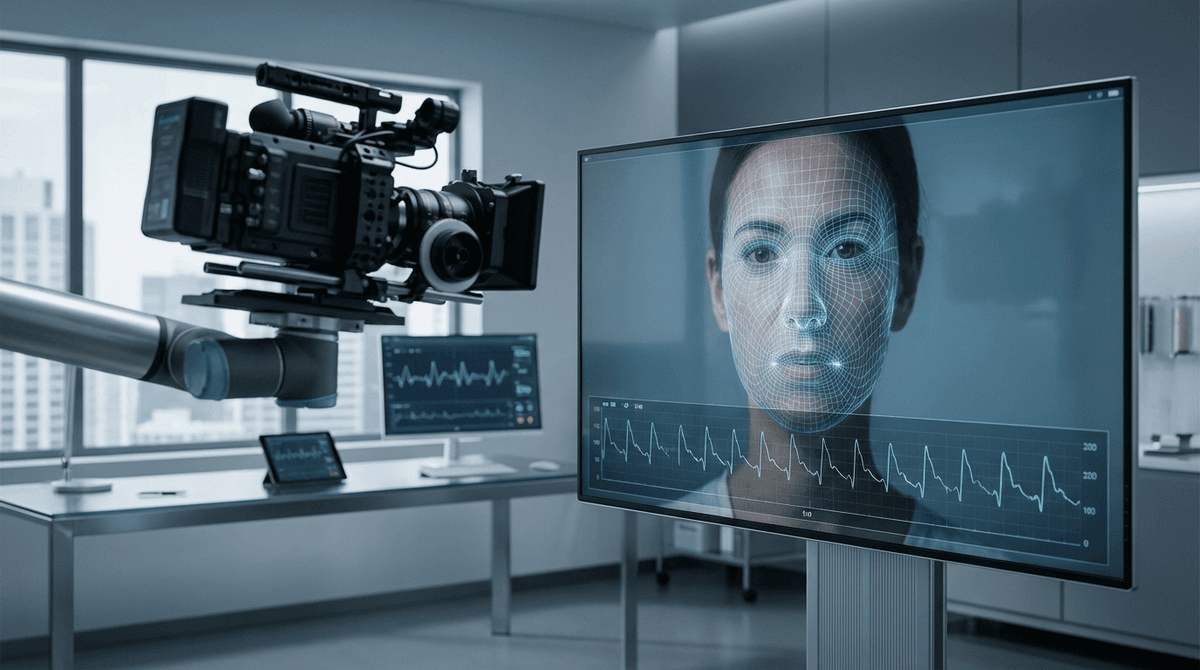
Remote photoplethysmography (rPPG) measures heart rate, respiratory rate, and blood oxygen saturation using nothing more than a smartphone or laptop camera. By analyzing subtle color changes in facial skin caused by blood flow, rPPG delivers clinically relevant vital signs without wires, patches, or wearables — making it a natural fit for telehealth and remote patient monitoring (RPM) platforms.
This shift matters because over 115 million Americans now live in areas with provider shortages, and telehealth usage has stabilized at roughly 5x its pre-pandemic baseline. The question is no longer whether telehealth scales — it's whether the vital sign data collected remotely is good enough to make clinical decisions. rPPG is one answer to that question.
What Is rPPG and How Does It Work?
Traditional contact PPG uses a light source and photodetector placed directly on skin — a fingertip pulse oximeter or a wrist-based smartwatch sensor. The detector reads the ratio of absorbed to transmitted light as blood volume pulses through the tissue.
rPPG does the same thing with a camera. A standard RGB camera captures the green, red, and blue reflectance of facial skin at 30 frames per second or more. Blood volume changes with each cardiac cycle cause tiny, periodic color variations — particularly in the green channel — that can be extracted algorithmically.
The challenge is noise. A person shifting in their chair, ambient light flickering from a window, or JPEG compression artifacts all contaminate the signal. Early rPPG algorithms (CHROM, POS, PBV) handled this with signal processing and color space transformations. Modern deep learning approaches go further, learning to separate cardiac signal from motion and illumination artifacts across thousands of training videos.
Key rPPG Signal Processing Steps
- Face detection and ROI tracking — isolate cheeks, forehead, or nose as the measurement zone
- Spatial averaging — average pixel values within the ROI per frame to build a raw temporal signal
- Color space projection — transform RGB into a physiologically informed space (e.g., CHROM projects onto chrominance axes orthogonal to specular reflection)
- Bandpass filtering — retain 0.5–4 Hz to isolate cardiac frequencies
- Peak detection and IBI extraction — identify systolic peaks to compute heart rate and inter-beat intervals
rPPG Accuracy: What Clinical Validation Shows
The accuracy of rPPG under controlled conditions is well-established. A 2022 meta-analysis by McDuff et al. covering 37 studies found mean absolute errors (MAE) of 2–5 BPM for heart rate under controlled lighting and limited motion. Respiratory rate estimation achieves MAE of 2–3 breaths/min in comparable conditions.
The harder problem is real-world deployment. A 2023 study published in npj Digital Medicine (Vilesov et al.) tested five rPPG algorithms on 128 participants including dark-skinned individuals and found accuracy degraded significantly under fluorescent lighting and with head movement, with MAE exceeding 8 BPM in some subgroups. This skin tone bias — arising from lower signal-to-noise ratios in individuals with higher melanin concentrations — is an active area of research with regulatory implications.
For SpO2, rPPG-based estimation remains challenging. The ratio-of-ratios method used in contact pulse oximetry requires calibration against known oxygen saturation values and degrades rapidly with motion. Current rPPG SpO2 systems report errors of ±3–5% SpO2 in research settings, below the ±2% threshold required for FDA clearance as a medical pulse oximeter. Several companies are pursuing limited-use claims rather than full diagnostic clearance.
How rPPG Integrates With Telehealth Platforms
Passive Monitoring During Video Visits
The most immediate telehealth application is passive vital sign capture during a standard video consultation. The clinician opens a telehealth session; the platform's rPPG module runs in the background; heart rate and respiratory rate appear as overlays visible only to the provider. The patient needs no additional hardware.
Binah.ai, Anura (NuraLogix), and Lifelight have all deployed this model. In a pilot at NHS Northampton General Hospital, Lifelight measured heart rate with MAE of 2.78 BPM and respiratory rate with MAE of 2.14 breaths/min during routine telehealth consultations. These numbers are clinically acceptable for triage-level assessment.
Asynchronous Home Monitoring
A second model uses rPPG for asynchronous RPM: the patient takes a 30–60 second facial selfie video each morning, uploads it, and the platform extracts vitals that feed into a care management dashboard. This eliminates the need for patients to own or charge a dedicated wearable device.
This model is particularly appealing for post-acute care, chronic disease management (CHF, COPD, hypertension), and pediatric populations where wearable adherence is low. Companies like Bodify and Caregility are pursuing this approach.
Emergency Department Triage
A less obvious application is triage support in overwhelmed emergency departments. A camera mounted at a triage desk can begin extracting heart rate and respiratory rate while a nurse is taking a patient history — parallel data capture without requiring the patient to pause for a manual pulse check. A 2021 study in Emergency Medicine Journal demonstrated that rPPG could identify tachycardia (HR > 100 BPM) with 87% sensitivity and 91% specificity in a simulated ED environment.
Regulatory Landscape for rPPG in Telehealth
FDA considers rPPG software that makes diagnostic claims a Software as a Medical Device (SaMD) subject to 510(k) clearance or De Novo authorization. The regulatory class depends on the intended use:
- Heart rate monitoring (wellness/fitness): likely exempt or Class I
- Arrhythmia detection or respiratory rate as clinical biomarker: Class II, requiring substantial equivalence demonstration
- SpO2 in clinical settings: Class II with performance testing per ISO 80601-2-61
As of early 2026, no rPPG product holds FDA clearance for clinical SpO2 measurement. Several companies hold 510(k) clearances for heart rate monitoring in wellness contexts. The CE mark landscape in Europe is slightly more permissive, with a few rPPG products cleared as Class IIa medical devices.
Technical Challenges in Real-World Telehealth Deployment
Lighting variability is the single largest accuracy barrier. rPPG algorithms trained on laboratory data with controlled LED illumination frequently fail under mixed indoor lighting — especially when sunlight from windows creates half-lit faces or color casts. Solutions include illumination normalization preprocessing and training on diverse lighting datasets.
Compression artifacts matter more than most practitioners realize. Video conferencing platforms including Zoom, Teams, and WebRTC pipelines apply lossy compression (typically H.264 or VP9) that discards high-frequency color information. The cardiac signal in rPPG spans 0.5–3 Hz in the temporal domain but rides on spatial color gradients that compression degrades. Several groups have demonstrated that even moderate compression (500 kbps vs. 4 Mbps) increases heart rate MAE by 1.5–2 BPM.
Privacy and consent require explicit handling. Facial video processed for medical vital signs falls under HIPAA if used in a covered entity context, and under state biometric privacy laws (Illinois BIPA, Texas CUBI) regardless. Telehealth platforms deploying rPPG need clear consent flows and data retention policies.
rPPG vs. Traditional Wearables for Remote Monitoring
| Feature | rPPG (Camera) | Wrist PPG Wearable | Finger Pulse Oximeter |
|---|---|---|---|
| Hardware required | None (existing webcam) | Yes (device + charging) | Yes (device) |
| Heart rate accuracy (MAE) | 2–8 BPM | 1–4 BPM | <1 BPM |
| SpO2 accuracy | ±3–5% (research) | ±2–3% (limited) | ±1–2% (cleared) |
| Patient burden | Zero | Moderate | Low |
| Motion tolerance | Low–moderate | Moderate–high | Low |
| Skin tone bias | Documented | Documented | Documented |
The comparison is not competitive — rPPG and wearables serve different use cases. rPPG excels when zero hardware burden is the priority; wearables excel when accuracy under motion is needed.
FAQ
What is rPPG in telehealth? rPPG (remote photoplethysmography) measures vital signs like heart rate and respiratory rate using a standard camera, with no physical contact. In telehealth, it captures vitals passively during video visits or from uploaded video clips, removing the need for dedicated monitoring hardware.
How accurate is rPPG for clinical telehealth use? Under controlled conditions, rPPG achieves heart rate MAE of 2–5 BPM and respiratory rate MAE of 2–3 breaths/min — acceptable for triage-level monitoring. Accuracy degrades with motion, poor lighting, and in individuals with darker skin tones. Current rPPG systems are not equivalent to contact pulse oximetry for SpO2.
Is rPPG FDA cleared for medical use? As of 2026, no rPPG product holds FDA clearance for clinical SpO2 measurement. Some rPPG tools hold clearances for wellness heart rate monitoring. Clinical diagnostic claims require 510(k) or De Novo authorization as Software as a Medical Device.
Can rPPG work through video conferencing compression? Lossy compression (H.264/VP9) in platforms like Zoom degrades rPPG signal quality, increasing heart rate error by ~1.5–2 BPM at typical conferencing bitrates. Some platforms offer raw video API access that reduces this effect.
What skin tones does rPPG work for? rPPG accuracy decreases with higher Fitzpatrick skin tone scores (V–VI) due to lower optical signal amplitude in the green channel. This bias is documented across multiple validation studies and is an active area of algorithm development and regulatory concern.
Does rPPG require special lighting? rPPG works best with stable, diffuse frontal lighting — a well-lit room with consistent indoor lighting. Flickering fluorescent lights, mixed sunlight/artificial light, and backlighting significantly degrade accuracy.
What vital signs can rPPG measure? Heart rate and inter-beat intervals (IBI) are the most accurate rPPG outputs. Respiratory rate can be derived from amplitude and frequency modulation of the cardiac signal. SpO2 estimation is possible but below clinical accuracy thresholds. Blood pressure and HRV estimation from rPPG remain research-stage.
References
- McDuff D, et al. (2022). "Advancing non-contact vital sign measurement using a camera." Science. DOI: 10.1126/sciadv.abn6498
- Vilesov A, et al. (2023). "Reconciling diverse machine learning proposals for blood pressure estimation from photoplethysmography." npj Digital Medicine, 6(1), 94. DOI: 10.1038/s41746-023-00863-4
- Verkruysse W, Svaasand LO, Nelson JS. (2008). "Remote plethysmographic imaging using ambient light." Optics Express, 16(26), 21434–21445. DOI: 10.1364/OE.16.021434
Explore more on ChatPPG: rPPG algorithms overview, wearable PPG device comparisons, PPG in sleep staging, smartphone camera vitals
Frequently Asked Questions
- What is rPPG in telehealth?
- rPPG (remote photoplethysmography) measures vital signs like heart rate and respiratory rate using a standard camera, with no physical contact. In telehealth, it captures vitals passively during video visits or from uploaded video clips, removing the need for dedicated monitoring hardware.
- How accurate is rPPG for clinical telehealth use?
- Under controlled conditions, rPPG achieves heart rate MAE of 2–5 BPM and respiratory rate MAE of 2–3 breaths/min — acceptable for triage-level monitoring. Accuracy degrades with motion, poor lighting, and in individuals with darker skin tones.
- Is rPPG FDA cleared for medical use?
- As of 2026, no rPPG product holds FDA clearance for clinical SpO2 measurement. Some rPPG tools hold clearances for wellness heart rate monitoring. Clinical diagnostic claims require 510(k) or De Novo authorization as Software as a Medical Device.
- What vital signs can rPPG measure?
- Heart rate and inter-beat intervals (IBI) are the most accurate rPPG outputs. Respiratory rate can be derived from amplitude and frequency modulation of the cardiac signal. SpO2 estimation is possible but below clinical accuracy thresholds.