PPG Sensors in Wearable Technology: From Wrist Bands to Smart Rings and Earbuds
How PPG sensors work across wearable form factors. Compare wrist bands, smart rings, earbuds, and patches for heart rate accuracy and motion artifacts.
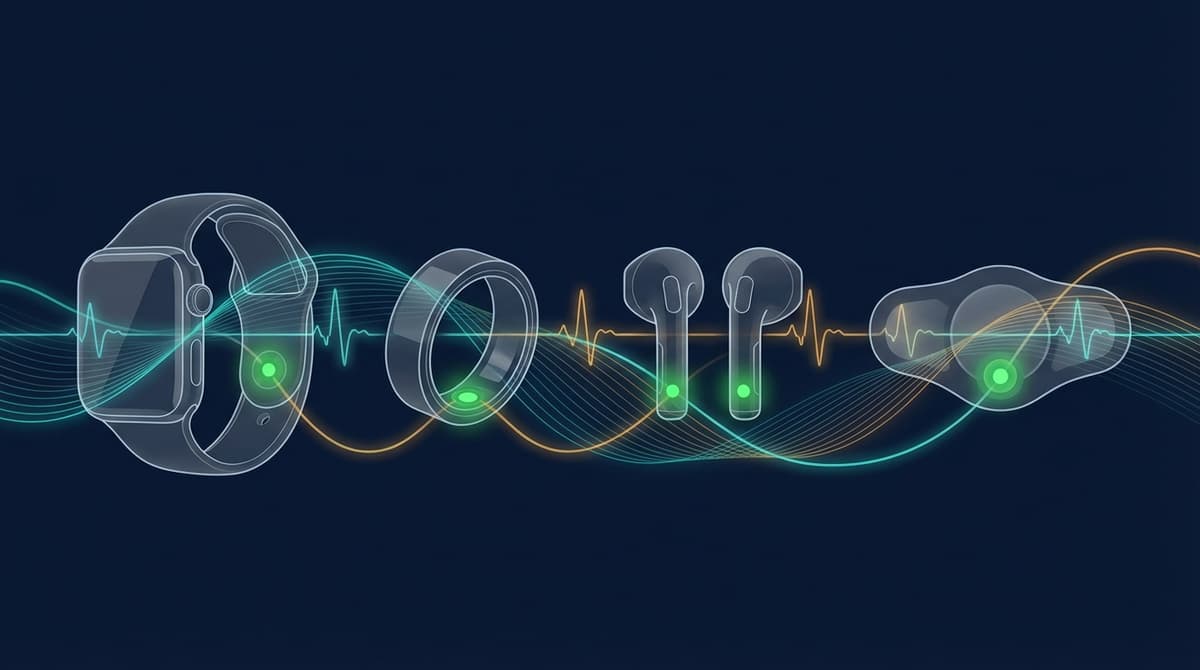
PPG sensors have become the dominant optical sensing technology in consumer wearables, appearing in smartwatches, fitness bands, smart rings, wireless earbuds, and adhesive patches. Each form factor places the sensor on a different part of the body, and that placement choice drives almost every performance characteristic: signal strength, motion artifact susceptibility, comfort, and which physiological metrics the device can reliably extract. Understanding these tradeoffs helps you choose the right wearable for your use case and set realistic expectations for accuracy.
How PPG Sensors Adapt to Different Form Factors
The core physics of PPG stays the same regardless of where you place the sensor. An LED shines light into tissue, blood volume changes modulate the reflected light, and a photodetector captures that modulation. But the engineering reality shifts dramatically between body locations.
Three factors vary most between form factors:
Vascular density and depth. Fingertips and earlobes have dense, shallow capillary beds. The wrist has capillaries too, but they sit deeper beneath skin, fat, and tendon layers. Signal amplitude depends directly on how much pulsatile blood sits in the optical path.
Motion artifact exposure. A wrist sensor moves every time you swing your arm, type, or grip something. An ear sensor stays relatively stable during walking but shifts with jaw movement. A chest patch barely moves during most activities. Motion is the dominant source of noise in wearable PPG, so placement determines how much algorithmic work is needed to extract a clean signal.
Contact stability. How consistently the sensor presses against the skin affects signal quality. Watches slide on the wrist. Rings maintain tighter contact on the finger. Earbuds create a snug fit in the ear canal. Better contact means less variability in the optical coupling, which means a more stable baseline signal.
For a broader comparison of form factor characteristics, see our PPG wearable form factors overview.
Wrist-Based PPG: Smartwatches and Fitness Bands
The wrist is the most common location for consumer PPG sensors. The Apple Watch, Fitbit, Garmin, Samsung Galaxy Watch, and dozens of other devices all place reflective PPG sensors against the dorsal (back) side of the wrist.
Why the Wrist Works
The wrist offers a socially accepted, comfortable location for an always-on device. People are already accustomed to wearing watches. The flat back of a watch case provides a stable surface for multi-LED sensor arrays, and the band provides adjustable compression to maintain contact.
Where the Wrist Struggles
The wrist is, unfortunately, one of the harder locations for clean PPG signals. The radial and ulnar arteries run along the sides of the wrist, not directly beneath a dorsal sensor. The capillary bed on the back of the wrist is less dense than on the fingertip or ear. Tendons, bones, and varying amounts of subcutaneous fat sit between the sensor and the blood vessels.
Motion artifacts are severe. Walking causes rhythmic arm swing that creates periodic noise often at or near heart rate frequencies, making it particularly hard to filter out. Typing, cooking, and lifting create irregular motion that can corrupt the signal for seconds at a time.
Real-World Performance
Modern wrist-based devices achieve impressive accuracy despite these challenges. Apple Watch Series 9 and Ultra 2 use multi-LED arrays with green, red, and infrared LEDs plus accelerometer-based motion compensation. Under resting conditions, heart rate accuracy is typically within 1-2 BPM of ECG reference. During moderate exercise like jogging, expect 3-5 BPM deviation. High-intensity activities with significant wrist motion, like CrossFit or cycling on rough terrain, can push errors above 10 BPM.
Fitbit and Garmin devices show similar patterns. The gap between brands has narrowed in recent years as sensor hardware and algorithms have improved across the industry. Validation studies like Bent et al. (2020) published in npj Digital Medicine document these accuracy ranges across devices and activities.
Metrics Available from Wrist PPG
- Continuous heart rate (green LED)
- Resting heart rate trends
- Heart rate variability (HRV), best measured during sleep or stationary periods
- SpO2 blood oxygen (requires red + IR LEDs)
- Respiratory rate (derived from PPG waveform modulation)
- Irregular rhythm notifications (atrial fibrillation screening on some devices)
Smart Rings: Finger-Based PPG
Smart rings like the Oura Ring, Ultrahuman Ring Air, and Samsung Galaxy Ring place PPG sensors on the inner surface of the finger, reading from the palmar digital arteries.
Why the Finger is an Excellent PPG Location
The finger has one of the densest capillary networks in the body, directly beneath thin skin. PPG signals from the finger are typically 10-100x stronger than from the wrist. Finger arteries are superficial, and the ring creates consistent contact pressure around the circumference.
Rings also stay relatively still compared to wrist devices. Your fingers do not swing with each step the way your wrist does. During sleep, the finger is almost entirely stationary, making ring-based PPG exceptionally clean for overnight monitoring.
Limitations of the Ring Form Factor
The small size constrains battery capacity and limits the number of LEDs and photodetectors that fit. Most rings use 2-3 LEDs compared to the 4-8 found on watch-class sensors. The ring must also fit a range of finger sizes, which means sensor positioning relative to the digital arteries varies between users.
During hand-intensive activities (weightlifting, cycling, manual work), the ring can rotate, losing optimal sensor alignment. Temperature-related finger swelling and shrinkage can change fit throughout the day.
For a direct comparison with wrist devices, see our ring vs. wrist sensor comparison.
Real-World Performance
The Oura Ring (Generation 3) uses infrared PPG and reports heart rate with a mean absolute error of roughly 1.5 BPM during sleep compared to polysomnography ECG reference. HRV measurement from the Oura Ring correlates strongly with chest-strap ECG, with several validation studies showing r > 0.95 for RMSSD during stationary nighttime recordings.
Daytime accuracy is less studied, partly because most ring manufacturers position their devices as sleep and recovery trackers rather than exercise monitors. The small battery makes continuous daytime heart rate monitoring impractical on most ring designs.
Metrics Best Suited to Rings
- Overnight resting heart rate (high accuracy due to stable contact and minimal motion)
- Sleep-stage HRV analysis
- Nocturnal SpO2 monitoring
- Skin temperature trends (using additional thermistor, not PPG)
- Respiratory rate during sleep
Earbuds: Ear Canal and Concha PPG
Wireless earbuds from Jabra, Amazfit, and others have integrated PPG sensors that read from the ear canal (in-ear) or the concha (outer ear bowl). The ear is a surprisingly good location for optical vital signs.
Why the Ear Works Well
The ear canal and concha have thin skin with shallow capillary beds. The superficial temporal artery and its branches supply blood to this region, providing a strong pulsatile signal. The ear canal is also relatively motion-isolated. Head movement is smoother and more predictable than limb movement, and the ear canal itself does not deform much during locomotion.
Earbuds create a snug, compressive fit that maintains consistent sensor contact. This is similar to the advantage rings have over watches. The tight fit also helps block ambient light, reducing a common noise source for PPG sensors.
For more on ear-based sensing, see our ear canal and earable monitoring guide.
Limitations
Jaw movement during talking, chewing, or yawning creates motion artifacts. Sweat accumulation in the ear canal can degrade optical coupling over long exercise sessions. Earbuds also shift or fall out during high-impact activities.
Fit variability between users is a challenge. Ear canal shapes differ substantially, and a sensor optimized for one ear shape may perform poorly in another. Some manufacturers offer multiple tip sizes, but the sensor position relative to the vascular bed still varies.
Real-World Performance
Jabra Elite Sport and Elite 85t earbuds demonstrated heart rate accuracy within 2-3 BPM of chest strap during running in internal validation. The Amazfit PowerBuds Pro reported similar numbers. Academic studies like Passler et al. (2019), published in Sensors, confirm that in-ear PPG achieves accuracy comparable to or better than wrist-based devices, particularly during walking and running.
Metrics Available from Ear PPG
- Heart rate during exercise and rest
- Heart rate variability (cleaner signal than wrist during activity)
- SpO2 (some devices, using multi-wavelength ear sensors)
- Core body temperature estimation (ear canal temperature is close to core, though this uses a thermistor, not PPG)
Adhesive Patches and Chest Straps
Adhesive biosensor patches (like Biostrap EVO, Vital Connect VitalPatch) and chest straps (like Polar H10 with optical sensor) represent the least consumer-friendly but often most accurate wearable PPG form factors.
Why the Chest and Torso Excel
The chest and torso offer a large, flat surface with minimal motion during most activities. The sensor stays in a fixed position relative to underlying tissue, eliminating the contact-instability problem that plagues wrist sensors. During walking and running, the torso moves as a rigid body, producing far fewer high-frequency motion artifacts than the extremities.
Adhesive patches add another advantage: guaranteed contact. The adhesive holds the sensor against the skin with consistent pressure, and the patch does not rotate or shift like a watch or ring might. This makes patches popular for multi-day clinical monitoring.
Limitations
Comfort and convenience are the main tradeoffs. Chest straps are uncomfortable for many users and impractical for daily wear. Adhesive patches cause skin irritation after extended use and need replacement every 1-5 days depending on the adhesive.
Social acceptance is lower than for watches or rings. Most people will not wear a chest patch to the office. This limits patches to clinical monitoring, athletic training, and research applications.
Real-World Performance
Polar H10 chest strap heart rate accuracy is routinely within 1 BPM of ECG across all activity levels, making it the de facto consumer reference device for heart rate validation studies. Adhesive patches like VitalPatch achieve similar accuracy and add continuous multi-day monitoring capability.
Contact Pressure and Its Impact
The pressure between a PPG sensor and the skin affects signal quality in a non-linear way. Too little pressure results in poor optical coupling and air gaps that scatter light. Too much pressure compresses the capillary bed, reducing blood volume changes and flattening the pulsatile signal.
The optimal contact pressure for PPG has been studied experimentally and falls in the range of 20-60 mmHg for most body locations. For detailed analysis of how contact pressure affects waveform morphology, see our contact pressure optimization guide.
Accuracy Comparison Across Form Factors
| Form Factor | Resting HR (MAE) | Exercise HR (MAE) | Sleep HRV | SpO2 Capable | Motion Artifact Severity |
|---|---|---|---|---|---|
| Wrist (Watch) | 1-2 BPM | 3-8 BPM | Moderate | Yes | High |
| Finger (Ring) | 1-2 BPM | Limited data | Excellent | Some devices | Low-Moderate |
| Ear (Earbuds) | 1-3 BPM | 2-5 BPM | Good | Some devices | Moderate |
| Chest (Patch) | <1 BPM | 1-3 BPM | Good | Yes | Low |
| Chest (Strap) | <1 BPM | 1-2 BPM | Good | Rare | Very Low |
Note: These ranges represent typical performance from recent-generation devices with good sensor contact. Individual results vary with fit, skin tone, activity type, and environmental conditions.
Choosing the Right Form Factor
The best form factor depends on what you are trying to measure and when.
For 24/7 continuous monitoring with exercise tracking: A smartwatch gives you the broadest coverage. It handles daytime activity, exercise, and sleep, though with moderate accuracy tradeoffs during high-motion activities.
For sleep quality and overnight recovery: A smart ring excels. The stable finger contact and minimal motion during sleep produce exceptionally clean signals for HRV and resting heart rate analysis.
For exercise heart rate without a wrist device: Earbuds provide a viable alternative, particularly for running and cycling. They free up the wrist and offer accuracy comparable to watches.
For clinical or research monitoring: Adhesive patches or chest straps provide the highest accuracy and multi-day continuous data. They are the right choice when data quality matters more than convenience.
For multi-metric monitoring (HR + SpO2 + ECG): Watches with multi-sensor arrays (like Apple Watch with its combined PPG + ECG capability) currently offer the broadest metric coverage in a single device.
The Future: Multi-Site and Multi-Modal PPG
Several research groups and companies are exploring multi-site PPG, where sensors on different body locations provide complementary data. Pulse transit time (PTT), measured as the delay between a chest ECG R-wave and a peripheral PPG pulse, can estimate blood pressure without a cuff. Ring-to-watch PTT measurements are already being explored in research settings.
Multi-modal sensors that combine PPG with ECG, bioimpedance, skin temperature, and galvanic skin response are becoming smaller and more power-efficient. The convergence of multiple sensing modalities into a single wearable will continue to expand what these devices can measure.
Frequently Asked Questions
Which wearable form factor gives the most accurate PPG heart rate?
Chest straps and adhesive patches provide the highest accuracy because they have stable contact and minimal motion artifacts. Among consumer form factors, smart rings tend to be most accurate during sleep, while smartwatches offer the best balance of accuracy and continuous monitoring throughout the day.
Why do some smartwatches have more LEDs than others on the back?
More LEDs provide better skin coverage, redundancy against poor positioning, and multi-wavelength capability. A basic heart rate sensor might use one or two green LEDs. Adding red and infrared LEDs enables SpO2 measurement. Some devices use 6-8 LEDs to ensure at least some are well-positioned over capillary beds regardless of how the watch sits on the wrist.
Can PPG sensors in earbuds replace a chest strap for exercise?
For moderate-intensity activities like jogging, earbud PPG accuracy approaches chest strap performance. For high-intensity or high-impact activities, chest straps remain more reliable. Earbuds can struggle during activities with significant jaw movement, like talking during a group run, or when sweat loosens the fit.
How does skin tone affect PPG accuracy across wearable types?
Green-wavelength PPG can show reduced accuracy on darker skin tones because melanin absorbs green light, reducing the signal reaching the vascular bed. This effect varies by form factor. Finger and ear locations tend to be less affected than the wrist because the skin is thinner and capillaries are more superficial. Devices using infrared wavelengths show less skin-tone dependency across all body locations.
Why is the Oura Ring primarily a sleep tracker rather than an exercise tracker?
The ring form factor limits battery size, which constrains how long continuous high-frequency PPG sampling can run. During exercise, fingers also experience significant temperature changes and variable blood flow, and the ring can rotate on the finger. The stable, low-motion conditions of sleep play to the ring's strengths: excellent signal quality with minimal power consumption.
What is pulse transit time and why does multi-site PPG matter?
Pulse transit time (PTT) is the delay between a cardiac event (like the ECG R-wave) and the arrival of the pulse wave at a peripheral site. PTT correlates with blood pressure because stiffer arteries (higher BP) transmit pulse waves faster. Measuring PPG at two body sites, or combining wrist PPG with a ring or earbud, can estimate PTT without an ECG, potentially enabling cuffless blood pressure monitoring.
How do wearable PPG sensors handle motion artifacts?
Most wearable PPG devices include an accelerometer (and sometimes a gyroscope) alongside the optical sensor. The motion data is used to identify and remove motion-correlated components from the PPG signal using adaptive filtering, signal decomposition, or machine learning algorithms. Some devices also use multi-LED configurations where signals from different LEDs are combined to cancel common-mode motion noise.