Driver Alertness Monitoring with PPG: What Wearables and In-Cabin Sensors Can Detect
Learn how PPG, remote cameras, and in-cabin sensors track driver alertness through pulse, variability, motion, and signal quality for safer road driving.
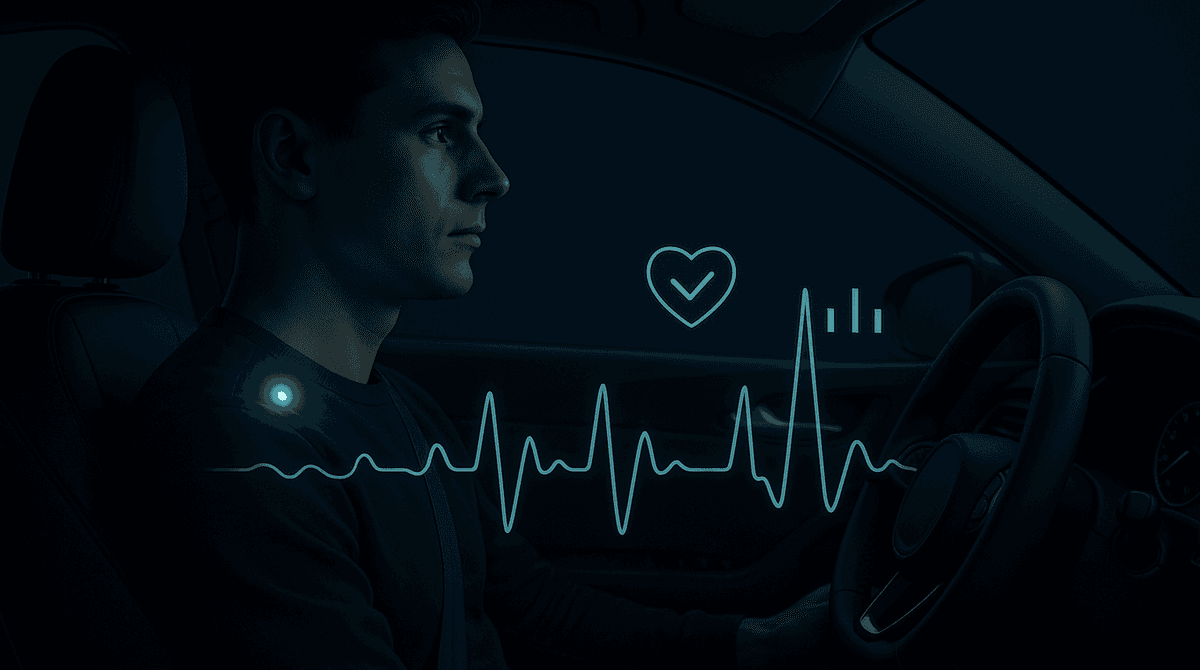
Yes. PPG can support driver alertness monitoring by tracking pulse rate, heart rate variability, pulse amplitude, and signal changes that often shift when attention, arousal, or sleep pressure changes. It works best alongside steering, seat, and camera data because alertness is broader than fatigue, and no single sensor captures every cause of reduced driving readiness.
Most discussions about driver state focus on drowsiness alone. That matters, but real-world alertness monitoring is wider. A driver can lose alertness because of sleep loss, monotony, heavy mental load, stress, distraction, medication, or a long recovery period after intense driving. Some of those states look sleepy. Others look tense, overstimulated, or visually disengaged. PPG is useful here because it gives a physiological view of autonomic state rather than only an outward behavior signal.
Photoplethysmography measures blood volume changes using light and a photodetector. In wearables, it usually sits on the wrist or finger. In vehicles, similar optical sensing can be built into a steering wheel, armrest, or other contact point when the driver keeps skin in place long enough for a stable reading. From that waveform, a system can estimate heart rate, beat-to-beat interval trends, heart rate variability proxies, pulse amplitude, pulse transit related features when combined with another sensor, and signal quality. Those features do not give a full mental-state diagnosis on their own, but they can help a model detect when alertness is drifting away from a safe baseline.
If you want the narrower fatigue view first, see /blog/driver-drowsiness-detection-ppg. If you want the camera-based optical path, see /blog/rppg-driver-drowsiness-monitoring. If you want to understand why contact quality and motion matter so much, see /blog/ppg-signal-quality-assessment.
Alertness is not the same as fatigue
Fatigue detection asks a focused question: is the driver becoming sleepy or physiologically exhausted? Alertness monitoring asks a broader one: is the driver in a state that supports safe, consistent attention right now? That distinction changes the sensor strategy.
A fatigued driver may show slower blinking, longer eye closures, reduced steering correction activity, and lower-arousal autonomic patterns. A distracted driver might have normal eyelid behavior but irregular gaze allocation, abrupt steering inputs, and short bursts of sympathetic activation. A stressed driver in dense traffic may look highly alert from the outside while the cardiovascular pattern shows high load and reduced reserve. PPG is helpful because it can contribute to all three categories, but only when interpreted in context.
This is why a single heart-rate threshold is not enough. Higher pulse can mean effort, stress, caffeine, heat, or active engagement. Lower pulse can mean relaxation, monotony, or simply an individual baseline. Good alertness systems use trends, personal baseline comparison, time-of-day effects, driving context, and signal confidence rather than a fixed universal rule.
What PPG can actually detect in a vehicle setting
PPG does not directly read attention like a camera can estimate gaze. What it detects is the cardiovascular response that accompanies shifts in alertness and workload. In practice, the useful outputs are:
- heart rate and short-term changes from the driver's baseline
- rhythm regularity and heart rate variability style features
- pulse amplitude or perfusion changes linked to autonomic tone
- respiratory coupling and slower oscillatory patterns visible in the waveform
- motion artifact patterns that, if modeled well, can distinguish poor contact from real physiological change
- signal quality itself, which tells the system when not to trust the estimate
That last point matters a lot. In a moving car, bad signal can look like real physiology. Wrist movement during turns, rough roads, grip changes, sweat, cold hands, loose straps, and skin tone or ambient light issues can all distort optical readings. A mature system should gate predictions when signal quality drops instead of forcing a confident alertness score from noisy data.
PPG is strongest when the question is, "Has this driver's autonomic state moved away from their normal attentive range?" It is weaker when the question is, "Exactly what behavior is causing that change?" For that second question, cameras and vehicle dynamics help fill the gap.
Wrist wearables: strong personalization, weaker control of contact
Wrist PPG is appealing because the hardware already exists in watches and bands. That means alertness monitoring can continue before, during, and after a drive, giving the model more context than a vehicle-only system ever gets. It can learn the driver's morning baseline, resting level, recovery after exercise, and how their pulse behavior changes during familiar commutes.
That personal history is valuable. Alertness is highly individual. One driver may stay stable at a heart rate that would signal overload in another. A wearable can build the reference frame needed to interpret change instead of treating everyone the same.
The weakness is motion and fit. Driving includes repeated hand movement, grip shifts, and vibration. A loose watch can produce intermittent contact exactly when the model needs stability. Even good wearables often smooth or average the data, which is fine for wellness summaries but less ideal for second-by-second safety inference. There is also a compliance issue: if the driver forgets the device, removes it, or wears it poorly, the monitoring chain breaks.
So wrist PPG is often best for baseline-aware risk scoring over minutes rather than instant lane-level intervention. It can say, "This driver has been trending toward lower alertness for twenty minutes," or, "This stress pattern is rising abnormally for this person." It is less dependable as the only source for an immediate warning.
Steering wheel and seat sensors: better placement, more opportunistic use
Vehicle-integrated sensing changes the tradeoff. A steering wheel can place optical sensors where the hands naturally contact the car, and contact geometry can be more controlled than a consumer watch. When contact is good, steering-wheel PPG can capture cleaner pulse data than a poorly fitted wrist device. It also removes the compliance problem because the sensing hardware lives in the car.
The drawback is intermittent availability. If the driver changes hand position, drives one-handed, or uses driver-assist modes with reduced steering contact, the optical path can disappear. Dry skin, gloves, sunlight, and rapid wheel movement can still affect signal quality. That means steering-wheel PPG works best as an opportunistic sensor that joins a larger fusion stack.
Seat-based sensing is slightly different. A seat can measure posture shifts, respiration-like motion, pressure redistribution, and fidget patterns even when optical contact is absent. Pure PPG from a seat is harder unless there is a designed skin-contact interface, but seats are still useful in alertness monitoring because posture collapse, reduced micro-movement, or unstable restlessness can signal declining readiness. In practice, seat data often complements PPG rather than replacing it.
A good comparison is this: wrist PPG is personal and portable, steering-wheel PPG is potentially cleaner but less continuous, and seat sensing is broader about body state but less direct about pulse. Combining the three lets a system keep working through handoffs in contact and behavior.
In-cabin camera systems: strong behavior visibility, weaker physiology
Camera-based driver monitoring sees what PPG cannot. It can estimate gaze direction, blink rate, blink duration, eyelid closure, head pose, face orientation, and sometimes signs of distraction such as looking away from the road. That makes it very effective for attention allocation problems. If a driver is texting, turning toward a passenger, or keeping their eyes off the road for too long, a camera can detect the visible behavior directly.
But cameras have their own limits. Sunglasses, poor lighting, occlusion, night driving, and privacy expectations all affect performance and acceptance. A camera can also see sleepy-looking eyes without knowing whether the driver's physiology is recovering quickly or dropping further. It observes behavior, not the cardiovascular regulation behind it.
That is why PPG and camera systems fit together well. PPG can say, "the body is moving toward lower alertness or higher strain." The camera can say, "the eyes and head confirm reduced road attention," or, just as useful, "the driver looks behaviorally engaged despite elevated heart rate." Fusion reduces false positives on both sides.
The best systems model patterns, not single signals
The strongest alertness monitoring systems are not asking whether one sensor crosses one threshold. They model a pattern over time. For example:
- Wrist PPG shows falling pulse amplitude and a drift away from the driver's normal morning variability profile.
- Steering correction becomes less frequent and more abrupt.
- The camera shows longer blink duration and a slight increase in gaze dwell away from the road center.
- Vehicle context shows steady highway conditions with low stimulation.
Together, that pattern supports a strong reduced-alertness hypothesis. Now compare a different case:
- PPG shows elevated heart rate and lower variability.
- The camera shows eyes open and active scanning.
- Steering input is high because of heavy traffic.
- Vehicle context shows dense urban driving and recent braking events.
That is more consistent with stress or workload than sleepiness. The response should be different. Instead of a drowsiness alarm, the system might suppress false warnings, change assistance thresholds, or recommend a break only if the state persists.
This is the core value of positioning PPG within alertness monitoring rather than fatigue alone. It adds the body's signal, but the body signal has to be interpreted alongside what the driver is doing and what the road is demanding.
Practical design choices for a real alertness product
A production system needs more than a model with good validation metrics. It needs sensor logic that survives messy driving. Five design choices usually matter most.
First, establish a personal baseline. Even a short rolling baseline, such as the first few minutes of a drive plus recent wearable history, is better than population averages alone.
Second, score signal quality before scoring alertness. If the PPG waveform is unstable, the safest action may be to down-weight it or ignore it temporarily.
Third, separate low alertness from high workload. Both can degrade driving, but they require different interventions and different user messaging.
Fourth, use graded outputs. A binary sleepy or not-sleepy label is too blunt. Better outputs are stable, watch, impaired, and unsafe, each tied to different confidence levels.
Fifth, design for trust. Drivers will reject a system that warns at the wrong time or feels invasive. Clear explanations such as "limited by low sensor contact" or "possible low alertness detected across pulse and eye signals" are more acceptable than opaque alarms.
Where the field is heading
The near-term direction is sensor fusion with better personalization. Wearables continue to improve optical quality and onboard processing. Vehicles continue to add cabin cameras, steering sensors, and driver assistance features. That creates a path toward systems that understand both the driver's body state and their visible behavior.
Remote PPG, sometimes called rPPG, also adds an interesting bridge. A camera can estimate pulse-related variation from the face under the right conditions, blending physiological and behavioral sensing in one channel. Even so, contact PPG usually remains more stable when lighting or facial visibility is poor. The likely outcome is not one winning sensor. It is a layered system where each method covers another's blind spots.
For teams building in this area, the best question is not "Can PPG detect drowsiness?" It is "What part of alertness can PPG detect reliably, under what contact conditions, and how should that evidence be fused with cameras and vehicle signals?" That framing leads to better models and safer product decisions.
FAQs
Can PPG alone tell if a driver is drowsy?
PPG alone can indicate a change in autonomic state that is consistent with drowsiness, stress, or reduced alertness, but it cannot explain the cause with high confidence in every case. It is most reliable when combined with behavior signals such as eye closure, gaze, steering behavior, or posture.
Is wrist PPG or steering-wheel PPG better for driving?
Neither is always better. Wrist PPG is better for personal baselines and continuous history across the day. Steering-wheel PPG can be better for contact quality when the hands stay in place, but it disappears when grip changes or hands leave the wheel.
How does PPG compare with in-cabin camera systems?
PPG measures physiology, while cameras measure visible behavior. Cameras are stronger for distraction, gaze, and eyelid monitoring. PPG is stronger for detecting internal arousal and workload changes that may appear before visible fatigue signs.
What PPG features matter most for alertness monitoring?
Heart rate alone is rarely enough. Systems usually get more value from changes relative to baseline, heart rate variability style features, pulse amplitude, temporal waveform stability, and signal quality measures that prevent noisy data from triggering false alerts.
Does motion make vehicle PPG unusable?
No, but motion is one of the hardest engineering problems. Good systems use filtering, contact checks, artifact labeling, and confidence scoring so that poor signal is recognized as poor signal instead of misread as a physiological event.
Why is alertness monitoring broader than fatigue detection?
A driver can be unsafe because of sleepiness, monotony, overload, stress, or distraction. Fatigue detection mainly targets sleep-related decline. Alertness monitoring tries to estimate whether the driver can sustain safe attention, even when the problem is not classic drowsiness.
References
- Nature, Scientific Reports: https://www.nature.com/articles/s41598-025-08582-2
- MDPI, Electronics 12(13):2923: https://www.mdpi.com/2079-9292/12/13/2923
- Springer chapter on driver monitoring methods: https://link.springer.com/chapter/10.1007/978-3-031-28663-6_5
- European Heart Journal Digital Health, wearable PPG context: https://doi.org/10.1093/ehjdh/ztab050
Frequently Asked Questions
- Can PPG alone tell if a driver is drowsy?
- PPG alone can indicate a change in autonomic state that is consistent with drowsiness, stress, or reduced alertness, but it cannot explain the cause with high confidence in every case. It is most reliable when combined with behavior signals such as eye closure, gaze, steering behavior, or posture.
- Is wrist PPG or steering-wheel PPG better for driving?
- Neither is always better. Wrist PPG is better for personal baselines and continuous history across the day. Steering-wheel PPG can be better for contact quality when the hands stay in place, but it disappears when grip changes or hands leave the wheel.
- How does PPG compare with in-cabin camera systems?
- PPG measures physiology, while cameras measure visible behavior. Cameras are stronger for distraction, gaze, and eyelid monitoring. PPG is stronger for detecting internal arousal and workload changes that may appear before visible fatigue signs.
- What PPG features matter most for alertness monitoring?
- Heart rate alone is rarely enough. Systems usually get more value from changes relative to baseline, heart rate variability style features, pulse amplitude, temporal waveform stability, and signal quality measures that prevent noisy data from triggering false alerts.
- Does motion make vehicle PPG unusable?
- No, but motion is one of the hardest engineering problems. Good systems use filtering, contact checks, artifact labeling, and confidence scoring so that poor signal is recognized as poor signal instead of misread as a physiological event.
- Why is alertness monitoring broader than fatigue detection?
- A driver can be unsafe because of sleepiness, monotony, overload, stress, or distraction. Fatigue detection mainly targets sleep-related decline. Alertness monitoring tries to estimate whether the driver can sustain safe attention, even when the problem is not classic drowsiness.