How Accurate Is Apple Watch Heart Rate? Clinical Evidence Review
A comprehensive clinical evidence review of Apple Watch heart rate accuracy, covering PPG sensor design, resting and exercise accuracy data from Shcherbina et al. (2017) and other studies, factors affecting accuracy like skin tone and tattoos, and comparison to chest strap monitors.
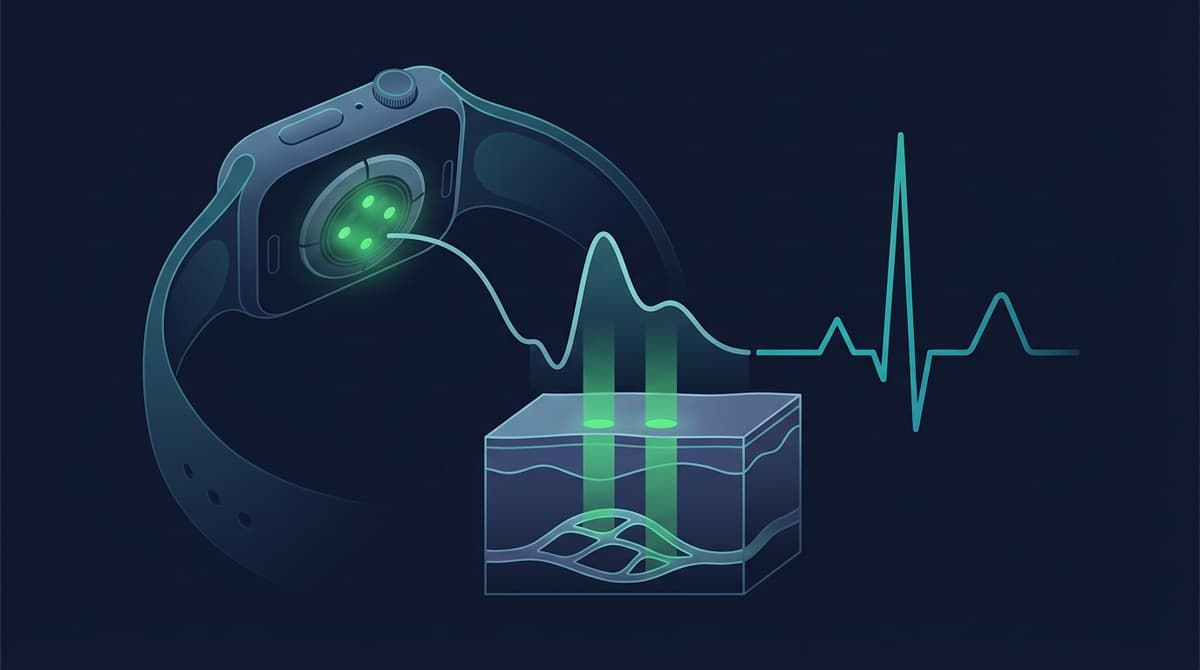
Apple Watch heart rate measurement is accurate to within approximately 2 bpm at rest and approximately 6 bpm across mixed activities including exercise, based on the widely cited Shcherbina et al. (2017) study from Stanford University. This makes it one of the most accurate consumer wrist-based optical heart rate monitors available, though its accuracy varies significantly depending on the type of activity, wrist fit, skin characteristics, and environmental conditions. Apple Watch is not a medical device for heart rate monitoring, but the clinical evidence shows it provides reliable data for general health tracking, fitness monitoring, and trend detection for most users.
This article reviews the published clinical evidence on Apple Watch heart rate accuracy, explains the PPG sensor technology behind the measurement, identifies the factors that affect accuracy, and compares Apple Watch performance to chest strap heart rate monitors. For a foundational understanding of PPG technology, see our guide to photoplethysmography.
The Shcherbina et al. (2017) Stanford Study
The most cited study on Apple Watch heart rate accuracy is the investigation by Shcherbina et al. published in the Journal of Personalized Medicine in 2017. Researchers at Stanford University evaluated seven consumer wearable devices, including Apple Watch, during controlled exercise protocols on treadmills and cycling ergometers.
Key Findings for Apple Watch
- Overall mean absolute error (MAE): approximately 6 bpm across all activity conditions
- Resting accuracy: approximately 1-3 bpm MAE compared to a clinical-grade ECG reference
- Walking accuracy: approximately 3-5 bpm MAE at moderate walking speeds
- Running accuracy: approximately 4-8 bpm MAE varying with intensity
- Cycling accuracy: approximately 5-10 bpm MAE depending on cadence and grip
Apple Watch was among the top performers for heart rate accuracy in this study, outperforming several other wrist-based devices. The study used a 12-lead ECG as the reference standard and tested 60 participants across diverse demographics.
Important Context
The 2017 study evaluated Apple Watch Series 2, which used an earlier generation of Apple's PPG sensor. Subsequent models (Series 3 through Series 10 and Ultra 2) have incorporated progressively improved PPG hardware with more LEDs, better photodetectors, and refined motion artifact rejection algorithms. While no comparable large-scale academic study has been published for the latest Apple Watch models, it is reasonable to expect that current-generation accuracy is equal to or better than the 2017 figures. For more on how PPG motion artifact rejection works, see our motion artifact removal guide.
How Apple Watch Measures Heart Rate
The PPG Sensor Array
Apple Watch uses a custom-designed reflectance-mode PPG sensor array mounted on the back crystal of the watch case. The array includes:
- Multiple green LEDs (approximately 525 nm): The primary wavelength for heart rate measurement. Green light is strongly absorbed by hemoglobin and provides a high-amplitude pulsatile signal from the superficial capillary beds in the wrist.
- Red LEDs (approximately 660 nm): Used in combination with infrared for SpO2 measurement and as a secondary heart rate channel.
- Infrared LEDs (approximately 940 nm): Used for SpO2 and for background heart rate measurement when the always-on display is showing content other than the heart rate complication.
- Multiple silicon photodiodes: Detect the reflected light and convert it to electrical signals for processing.
The LEDs and photodiodes are arranged in a specific geometric pattern designed to maximize spatial diversity. By sampling from multiple locations on the wrist simultaneously, the system can identify which optical channels have the best signal quality at any given moment and weight them accordingly in the heart rate calculation.
Signal Processing Pipeline
The raw PPG signal from the wrist contains far more noise than useful signal during movement. Apple's signal processing pipeline includes several stages:
-
Ambient light subtraction: The photodiodes measure ambient light between LED pulses, and this baseline is subtracted from the PPG measurement to remove interference from sunlight, indoor lighting, and other light sources.
-
Accelerometer-assisted motion artifact rejection: The Apple Watch's 3-axis accelerometer detects wrist motion, and the signal processing algorithms use this motion data to adaptively filter the PPG signal. The fundamental approach is to identify frequency components in the PPG signal that correlate with motion frequencies and remove them, preserving the cardiac-frequency component.
-
Multi-channel signal fusion: Data from multiple LED-photodetector pairs are combined using algorithms that weight each channel based on its current signal quality. Channels with strong pulsatile signals are weighted heavily, while channels contaminated by motion or poor skin contact are downweighted or excluded.
-
Peak detection and interval calculation: The cleaned PPG signal undergoes peak detection to identify individual pulse waves. The time between successive peaks yields the pulse-to-pulse interval, from which instantaneous heart rate is calculated. For the heart rate displayed on the watch face, these instantaneous values are filtered and smoothed to provide a stable reading. To learn more about the algorithms behind heart rate and HRV extraction from PPG, visit our HRV analysis algorithms page.
Accuracy by Activity Type
Understanding how Apple Watch heart rate accuracy varies across different activities is essential for interpreting your data correctly.
Resting Heart Rate
Apple Watch excels at resting heart rate measurement. When the wrist is still, the PPG signal is clean and the only significant challenge is maintaining consistent optical contact with the skin. Studies consistently show resting heart rate accuracy within 1 to 3 bpm of ECG for Apple Watch, which is comparable to or better than clinical-grade pulse oximeters used in hospital settings.
Apple Watch samples heart rate in the background throughout the day and reports resting heart rate as the lowest sustained rate during periods of inactivity. This metric is one of the most reliable data points the device provides and has genuine clinical utility for tracking cardiovascular fitness trends and detecting potential health changes over time.
Walking and Light Activity
During walking and light daily activity, Apple Watch maintains good accuracy with MAE typically in the 3 to 5 bpm range. The rhythmic nature of walking produces predictable motion patterns that the accelerometer-assisted algorithms can effectively separate from the cardiac signal. Arm swing during walking is relatively consistent, making it an easier signal processing challenge than more chaotic movements.
Running
Running accuracy varies with intensity and running form. During steady-state moderate running, Apple Watch typically achieves MAE of 4 to 7 bpm. The rhythmic arm swing of running creates a strong periodic motion component that can be identified and filtered. However, accuracy can degrade during sprint intervals, hill running with significant arm drive, or trail running with irregular arm movements.
One common issue during running is "cadence lock," where the PPG signal processing algorithm erroneously locks onto the motion artifact frequency (which corresponds to running cadence) instead of the true heart rate frequency. Modern Apple Watch models have algorithms designed to detect and break cadence lock, but it can still occur transiently, particularly when the true heart rate is close to the running cadence (approximately 160 to 180 steps per minute, which overlaps with heart rate in beats per minute during high-intensity running).
Cycling
Cycling presents a mixed picture for wrist-based PPG. On one hand, the wrist is relatively stable during road cycling with hands on the bars or hoods. On the other hand, vibration from the road surface transmits through the handlebars to the wrist, creating high-frequency noise in the PPG signal. Grip pressure can also affect wrist blood flow. Apple Watch typically achieves MAE of 5 to 10 bpm during cycling, with better accuracy on smooth roads and stationary bikes.
Strength Training and HIIT
This is where Apple Watch heart rate accuracy is weakest. Grip-intensive exercises cause massive motion artifacts at the wrist due to tendon movement, and tight gripping can restrict arterial blood flow through the wrist, reducing the pulsatile signal that PPG depends on. During exercises like barbell squats, deadlifts, bench press, and pull-ups, Apple Watch can display heart rate values that lag significantly behind the true rate or lock onto artifact frequencies.
Studies documenting wrist-based PPG accuracy during strength training have reported MAE values of 10 to 25+ bpm, with the worst accuracy occurring during exercises involving wrist flexion or heavy gripping. This is not unique to Apple Watch but is a fundamental limitation of the wrist as a PPG measurement site for these activities.
Factors Affecting Apple Watch Heart Rate Accuracy
Skin Tone and Pigmentation
The green LEDs used for heart rate measurement must penetrate the skin and reach the underlying capillary bed. Melanin in the epidermis absorbs green light, reducing the total signal amplitude in individuals with darker skin tones. However, the heart rate is encoded in the pulsatile variation of the signal rather than the absolute amplitude, so moderate reductions in signal strength do not necessarily impair accuracy.
Studies examining the effect of skin pigmentation on wrist-based PPG accuracy have found statistically significant but generally small differences. The effect is more pronounced for SpO2 measurement, where the absolute ratio of red to infrared absorption matters, than for heart rate measurement, where only the timing of pulse peaks is needed. Apple has made iterative improvements to address this, including adjusting LED drive current and applying adaptive gain control. For more on SpO2 accuracy across skin tones, see our pulse oximeter readings chart.
Tattoos
Tattoos over the wrist sensor area can significantly impair Apple Watch heart rate accuracy. Tattoo ink absorbs and scatters light at the wavelengths used by the PPG sensor, particularly dark inks (black, dark blue, dark green). This can reduce the PPG signal amplitude to the point where the sensor cannot reliably detect pulse peaks.
Apple acknowledges this limitation in its support documentation and recommends wearing the watch on an untattoed wrist or using an external heart rate monitor. The severity of the effect depends on the tattoo's color, density, and coverage over the sensor area.
Watch Fit and Positioning
Proper fit is essential for accurate PPG measurement. The sensor must maintain consistent contact with the skin without excessive pressure that could occlude blood flow. Apple recommends:
- Wearing the watch snugly but comfortably on the top of the wrist
- Positioning the watch above the wrist bone (ulnar styloid)
- Tightening the band slightly during exercise for improved contact
- Ensuring the sensor window is clean and free of sunscreen, lotion, or debris
A loose-fitting watch allows ambient light to enter between the sensor and the skin, introducing noise, and causes the sensor to shift position during movement, creating additional motion artifact.
Environmental Conditions
Cold temperatures can reduce peripheral perfusion through vasoconstriction, weakening the PPG signal at the wrist. In cold weather, the body prioritizes blood flow to the core, and the superficial capillary beds in the wrist may have significantly reduced pulsatile volume. This can impair heart rate accuracy during outdoor cold-weather exercise.
Excessive sweating can also affect optical coupling by creating a water film between the sensor and the skin that scatters light differently than dry skin contact.
Apple Watch vs. Chest Strap Heart Rate Monitors
Chest strap heart rate monitors like the Polar H10, Garmin HRM-Pro Plus, and Wahoo TICKR use electrical detection rather than optical. They measure the electrical signal of each heartbeat through electrodes pressed against the chest, essentially performing a simplified single-lead ECG.
Accuracy Comparison
| Condition | Apple Watch (PPG) | Chest Strap (ECG) |
|---|---|---|
| Resting | 1-3 bpm MAE | <1 bpm MAE |
| Walking | 3-5 bpm MAE | 1-2 bpm MAE |
| Running | 4-8 bpm MAE | 1-2 bpm MAE |
| Cycling | 5-10 bpm MAE | 1-2 bpm MAE |
| Strength training | 10-25+ bpm MAE | 1-3 bpm MAE |
The chest strap maintains consistent accuracy across all activity types because electrical detection is not affected by the motion artifacts that plague optical wrist sensors. The ECG signal at the chest is strong and relatively immune to movement, though chest straps can occasionally lose contact during certain body positions or when dry (most require moisture to establish good electrode contact).
When to Use Each
Apple Watch heart rate is sufficient for general fitness tracking, health trend monitoring, and moderate-intensity exercise. For most recreational exercisers and general health-conscious users, the Apple Watch provides adequately accurate heart rate data without the inconvenience of a separate chest device.
A chest strap is recommended for users who need highly accurate heart rate data during intense training, heart rate zone-based training programs, competitive athletes, or anyone performing activities that challenge wrist-based PPG accuracy (strength training, HIIT, rowing, and similar grip-intensive sports). Both Apple Watch and most chest straps use Bluetooth connectivity, and the devices can be paired so that the Apple Watch displays chest strap data instead of its own PPG readings. For a broader comparison of wearable heart rate accuracy across devices, see our Garmin vs Apple Watch comparison.
Apple Watch ECG vs. Heart Rate
It is important to distinguish Apple Watch's PPG-based heart rate measurement from its ECG feature. The heart rate complication, workout heart rate, and background heart rate readings all use the optical PPG sensor on the back of the watch.
The ECG feature, accessed through the ECG app, uses electrical electrodes in the back crystal and the Digital Crown. When you place your finger on the Crown, you complete an electrical circuit and the watch records a 30-second single-lead ECG (Lead I) tracing. This ECG is used for rhythm analysis (detecting atrial fibrillation and sinus rhythm) rather than continuous heart rate monitoring. The ECG provides a point-in-time assessment and is not designed for ongoing heart rate tracking during exercise. For more on how PPG-based AFib detection works, visit our AFib detection algorithms page.
Clinical Utility and Limitations
Apple Watch heart rate data has demonstrated clinical utility in several areas:
- Resting heart rate trends can reveal changes in cardiovascular fitness, medication effects, and early signs of illness
- Heart rate notifications alert users to unusually high or low heart rates that may warrant medical evaluation
- Irregular rhythm notifications use PPG data to screen for possible atrial fibrillation (validated in the Apple Heart Study, Perez et al., 2019)
- Heart rate recovery after exercise provides a marker of cardiovascular fitness and autonomic function
However, Apple Watch is not a medical device for heart rate monitoring. It is not FDA-cleared for continuous heart rate accuracy, and its readings should not be used for clinical decision-making without confirmation from medical-grade equipment. The device is best understood as a screening and trending tool that provides actionable health insights for the general population while flagging potential concerns that should be evaluated by a healthcare provider. For additional heart rate monitoring context, visit our heart rate measurement guide.
Frequently Asked Questions
Refer to the FAQ section above for answers to common questions about Apple Watch heart rate accuracy, including average error rates, skin tone effects, weightlifting limitations, and comparison to chest strap monitors.
Frequently Asked Questions
- What is the average error of Apple Watch heart rate measurement?
- Based on the landmark Shcherbina et al. (2017) study from Stanford, Apple Watch achieved a mean absolute error (MAE) of approximately 6 beats per minute across a range of activities including rest, walking, running, and cycling. However, this average masks important variation: at rest, Apple Watch is accurate to within 1 to 3 bpm, while during vigorous exercise, errors can reach 10 to 20+ bpm depending on the activity type and intensity. More recent Apple Watch models with improved PPG sensor arrays have likely narrowed these figures, particularly during moderate-intensity steady-state exercise.
- Does Apple Watch heart rate work accurately on dark skin tones?
- Apple Watch heart rate measurement can be affected by skin pigmentation, though the effect is relatively small for heart rate compared to SpO2. Melanin absorbs green light, which reduces the overall signal amplitude in individuals with darker skin. However, the pulsatile component (which encodes heart rate) is affected proportionally, so the ratio-based detection of pulse peaks remains functional. Where skin tone has a larger impact is SpO2 measurement, where studies have documented clinically meaningful accuracy differences across skin pigmentation levels. Apple has made iterative improvements to its sensor algorithms to reduce skin tone bias, including adjusting LED drive current and signal processing parameters.
- Why is Apple Watch heart rate inaccurate during weightlifting?
- Apple Watch heart rate accuracy degrades significantly during weightlifting and other grip-intensive exercises because of motion artifact and hemodynamic changes at the wrist. When you grip a barbell or dumbbell, the tendons and muscles in the wrist flex directly beneath the PPG sensor, creating large motion artifacts that can overwhelm the true pulse signal. Additionally, tight gripping can temporarily occlude blood flow in the wrist, reducing the pulsatile signal amplitude. Wrist flexion and extension during exercises like curls, presses, and rows further disrupt the optical path. This is a fundamental limitation of wrist-based PPG measurement, not a deficiency specific to Apple Watch.
- Is Apple Watch heart rate as accurate as a chest strap?
- No. Chest strap heart rate monitors that use electrical (ECG-based) detection remain significantly more accurate than any wrist-based PPG device, including Apple Watch. Chest straps detect the electrical impulse of each heartbeat directly through the chest wall, which is largely immune to the motion artifacts that affect optical wrist sensors. During exercise, a quality chest strap like the Polar H10 achieves accuracy within 1 to 2 bpm of a clinical ECG across all activity types. Apple Watch achieves comparable accuracy at rest but diverges during intense or high-motion activities. For users who need reliable heart rate data during high-intensity training, a chest strap remains the gold standard.