Abnormal Arterial Waveforms: Visual Guide to Pulsus Paradoxus, Alternans, and More
Visual guide to abnormal arterial waveforms including pulsus paradoxus, alternans, bisferiens, wide and narrow pulse pressure, and dicrotic notch changes.
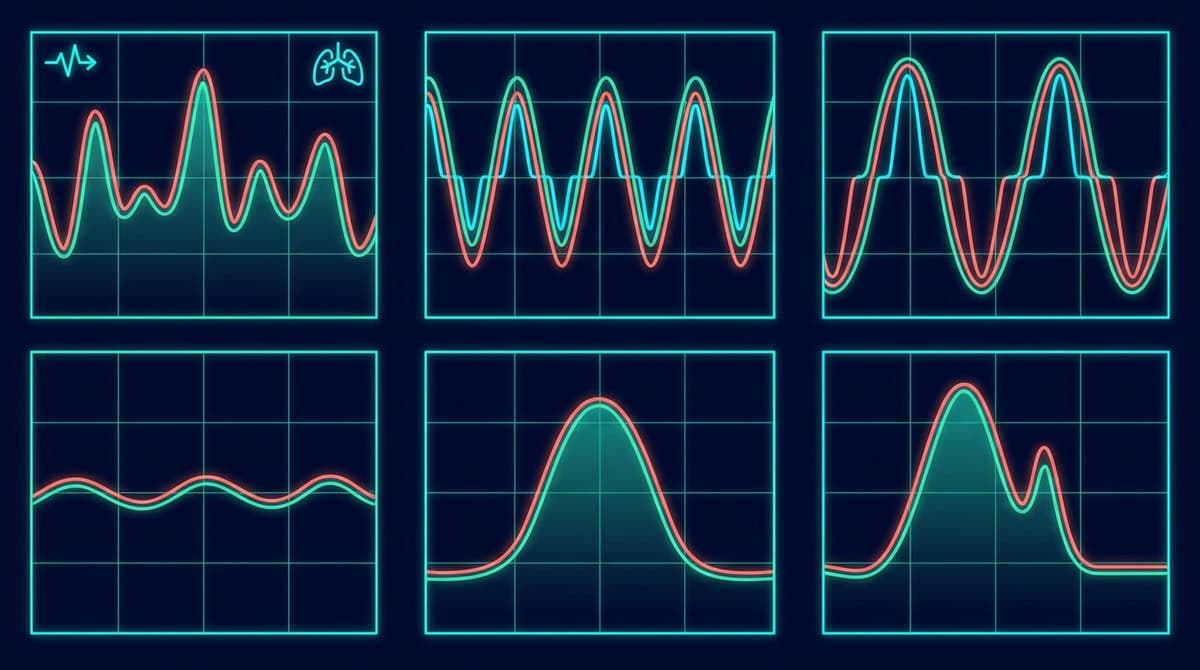
Abnormal arterial waveforms are systematic deviations from the normal arterial pressure tracing that signal specific cardiac or hemodynamic pathology. The most clinically significant patterns include pulsus paradoxus (exaggerated systolic pressure drop during inspiration, seen in cardiac tamponade and severe asthma), pulsus alternans (beat-to-beat alternation in pulse amplitude, indicating severe left ventricular dysfunction), pulsus bisferiens (double systolic peak, associated with aortic regurgitation and HOCM), wide pulse pressure (large gap between systolic and diastolic pressure, as in aortic regurgitation or sepsis), narrow pulse pressure (reduced gap, as in heart failure or tamponade), absent dicrotic notch (severe vasoconstriction or aortic regurgitation), and a prominent dicrotic notch with exaggerated diastolic wave (low vascular resistance states such as sepsis). Several of these patterns are detectable through non-invasive PPG waveform analysis, while others require direct arterial line monitoring.
A normal arterial waveform consists of a rapid systolic upstroke, a single systolic peak, a dicrotic notch marking aortic valve closure, and a gradual diastolic decline. When any of these components changes in shape, timing, amplitude, or beat-to-beat consistency, it tells a specific story. This guide walks through each major abnormality, its pathophysiology, and its clinical significance. For a detailed breakdown of normal waveform anatomy, see our guide on PPG morphology features.
Pulsus Paradoxus
Pulsus paradoxus is defined as a systolic blood pressure drop of more than 10 mmHg during normal inspiration. The name is somewhat misleading. The phenomenon is not truly paradoxical; it is an exaggeration of a normal physiological variation. During inspiration, negative intrathoracic pressure increases venous return to the right heart, which transiently expands the right ventricle and shifts the interventricular septum leftward. This reduces left ventricular filling and stroke volume, lowering systolic pressure.
In healthy individuals, this inspiratory drop is less than 10 mmHg and clinically undetectable. In pathological states, it becomes pronounced.
Common Causes
- Cardiac tamponade. The pericardial fluid compresses the heart, making ventricular filling highly dependent on small pressure changes. Inspiratory shifts in septal position have an outsized effect on left ventricular output.
- Severe asthma and COPD exacerbations. Large negative intrathoracic pressures generated during labored breathing amplify the normal ventricular interdependence mechanism.
- Constrictive pericarditis. Although less reliably present than in tamponade, pulsus paradoxus can appear when the rigid pericardium limits cardiac expansion.
On an arterial line tracing, pulsus paradoxus appears as a cyclical rise and fall in systolic peak amplitude synchronized with the respiratory cycle. The beat-to-beat variation creates an envelope pattern. Quantifying it requires comparing peak systolic pressure during expiration versus inspiration.
Pulsus Alternans
Pulsus alternans is a regular rhythm with alternating strong and weak beats. One cardiac cycle produces a tall systolic peak; the next produces a shorter one. The pattern repeats: tall, short, tall, short. The heart rate and rhythm remain regular throughout, distinguishing it from bigeminy (where premature beats create an irregular rhythm with alternating pulse strengths).
The mechanism involves impaired calcium cycling in failing myocardium. When the left ventricle is severely dysfunctional, beat-to-beat variations in intracellular calcium availability produce alternating strong and weak contractions. The Frank-Starling mechanism also contributes: a weaker beat leaves more residual volume, loading the ventricle more for the subsequent beat and producing a stronger contraction, which then leaves less residual volume, and so on.
Pulsus alternans is a specific and ominous sign of severe left ventricular systolic dysfunction. It typically appears when ejection fraction falls below 30% and indicates decompensating heart failure. Its presence on a monitored patient should prompt urgent evaluation of cardiac function.
On an arterial line, the pattern is unmistakable: regular alternation of systolic peak height with constant heart rate. The diastolic pressure may remain relatively stable while the systolic peak oscillates.
Pulsus Bisferiens
Pulsus bisferiens produces two systolic peaks within a single cardiac cycle, both occurring before the dicrotic notch. The first peak (percussion wave) results from the initial rapid ejection of blood, and the second peak (tidal wave) arises from reflected pressure waves returning during late systole. A mid-systolic dip separates the two peaks.
This pattern appears most commonly in:
- Combined aortic stenosis and regurgitation. The large stroke volume from regurgitation and the flow obstruction from stenosis accentuate the mid-systolic pressure dip.
- Severe isolated aortic regurgitation. The volume overload creates a forceful ejection that, combined with early wave reflection from the wide pulse pressure state, generates two distinct systolic peaks.
- Hypertrophic obstructive cardiomyopathy (HOCM). Dynamic LVOT obstruction from systolic anterior motion of the mitral valve creates a "spike and dome" pattern, where the early ejection spike is followed by obstruction and then a secondary dome.
For an in-depth discussion of pathophysiology and detection, see our pulsus bisferiens waveform guide.
Wide Pulse Pressure
Wide pulse pressure refers to a systolic-to-diastolic gap exceeding 60 mmHg. The arterial waveform shows a tall systolic peak combined with a low diastolic trough. The waveform appears stretched vertically, with a steep upstroke and a rapid diastolic decay.
Causes
- Aortic regurgitation. Incompetent aortic valve closure allows backflow during diastole, pulling diastolic pressure down while the compensatory large stroke volume pushes systolic pressure up. This is the classic cause.
- Hyperdynamic states. Sepsis, thyrotoxicosis, anemia, and fever all increase cardiac output and reduce peripheral resistance, widening pulse pressure.
- Atherosclerotic aortic stiffening. Reduced aortic compliance increases systolic peak pressure (less elastic buffering) while reflected waves arrive earlier, augmenting systolic rather than diastolic pressure. Isolated systolic hypertension in the elderly follows this mechanism.
- Patent ductus arteriosus. Continuous shunting of blood from the aorta to the pulmonary artery during diastole lowers diastolic pressure.
Wide pulse pressure is associated with increased cardiovascular risk independently of mean arterial pressure, as demonstrated by the Framingham Heart Study data analyzed by Franklin et al. (1999), which showed pulse pressure as a predictor of coronary heart disease events in older adults (DOI: 10.1161/01.CIR.100.4.354).
Narrow Pulse Pressure
Narrow pulse pressure, typically less than 25 mmHg, indicates reduced stroke volume or increased peripheral resistance compressing the systolic-diastolic gap. On the arterial tracing, the waveform looks "pinched": a blunted systolic peak sitting close to the diastolic baseline with limited amplitude.
Causes
- Heart failure with reduced ejection fraction. The weakened ventricle cannot generate adequate stroke volume, so the systolic peak is low.
- Cardiac tamponade. External compression limits ventricular filling and output. Narrow pulse pressure combined with pulsus paradoxus is a hallmark of tamponade.
- Aortic stenosis (pulsus tardus et parvus). The stenotic valve slows ejection, producing a delayed and diminished systolic peak. The upstroke is slow, the peak is rounded and late, and the overall pulse amplitude is small.
- Hypovolemia. Reduced preload limits ventricular filling and stroke volume.
Narrow pulse pressure in the ICU setting is a warning sign of low cardiac output. When combined with tachycardia and evidence of end-organ hypoperfusion, it should trigger consideration of volume resuscitation, inotropic support, or intervention for obstructive causes.
Dicrotic Notch Abnormalities
The dicrotic notch, the small inflection on the descending limb marking aortic valve closure, carries substantial diagnostic information. Changes in its appearance correlate with specific hemodynamic states. For the full physiology behind this feature, see our dicrotic notch physiology guide.
Absent or Blunted Dicrotic Notch
An absent dicrotic notch suggests one of several conditions:
- Severe vasoconstriction. High peripheral resistance eliminates the diastolic rebound that creates the notch. In cardiogenic shock with maximal sympathetic activation, the notch can disappear entirely.
- Aortic regurgitation. Without proper valve closure, the transient that produces the notch is eliminated at its source.
- Severe arterial stiffening. In elderly patients with calcified, non-compliant arteries, the reflected wave merges with the systolic peak, obliterating the notch.
- Overdamped arterial line system. Technical artifact from air bubbles, clots, or excessively compliant tubing can flatten the notch. This is a measurement problem, not a patient problem.
Prominent Dicrotic Notch (or Dicrotic Pulse)
An unusually prominent dicrotic notch with a large diastolic wave occurs in low vascular resistance states:
- Sepsis. Vasodilation reduces peripheral resistance, creating a large reflected wave that arrives during diastole and produces a tall secondary hump.
- Fever. Similar mechanism through vasodilation.
- Young, healthy patients. Compliant arteries naturally produce a more visible notch and diastolic peak. This is normal, not pathological.
The dicrotic pulse is an extreme version of this pattern, where the diastolic peak is so prominent that it approaches the systolic peak amplitude. It is seen in severe low-output states with low vascular resistance, such as septic shock with myocardial depression.
Which Abnormalities Can PPG Detect?
Not all arterial waveform abnormalities require an invasive arterial line for identification. PPG waveforms, measured non-invasively at the finger, wrist, or ear, can capture several of these patterns with varying degrees of reliability.
Detectable by PPG
Pulsus alternans. Because alternans involves beat-to-beat variation in pulse amplitude, it is readily apparent on PPG tracings. The alternating tall and short waveforms are visible in the raw PPG signal. Studies have confirmed PPG-based detection of alternans in heart failure patients, making this one of the most accessible non-invasive markers of severe ventricular dysfunction.
Pulsus paradoxus. PPG can detect the respiratory-linked amplitude variation characteristic of paradoxus. Feinstein et al. (2011) demonstrated that pulse oximetry plethysmographic waveform variation correlated with arterial pulsus paradoxus measured by cuff sphygmomanometry, offering a continuous and automated alternative to manual cuff-based assessment (DOI: 10.1378/chest.10-1461). Modern algorithms quantify the respiratory variation in PPG amplitude to estimate the degree of paradoxus. This is particularly valuable in emergency settings where rapid detection of tamponade physiology is needed.
Dicrotic notch changes. The dicrotic notch is visible on finger PPG in many patients, especially younger ones. Changes in notch prominence, timing, and depth can reflect alterations in vascular resistance and arterial compliance. However, finger PPG attenuates the notch compared to central arterial recordings, so subtle changes may be missed. For a detailed exploration of PPG morphology and how these features are extracted, see our cardiac cycle phases guide.
Wide pulse pressure indicators. While PPG does not directly measure blood pressure in mmHg, the waveform shape changes associated with wide pulse pressure (steep upstroke, rapid diastolic decay, large amplitude) are reflected in PPG morphology. Pulse contour analysis algorithms can flag these patterns.
Difficult or Unreliable with PPG
Pulsus bisferiens. The double systolic peak can sometimes be identified on high-quality finger PPG, but peripheral attenuation frequently smooths out the mid-systolic dip, making it indistinguishable from a single broad peak. Reliable detection typically requires tonometry or arterial line monitoring.
Narrow pulse pressure and pulsus tardus et parvus. PPG amplitude depends on many local factors (probe placement, skin perfusion, ambient temperature), making it unreliable for detecting small absolute pulse pressures. The slow upstroke of tardus et parvus may be partially visible on PPG, but differentiation from signal artifact is difficult.
Precise quantification. While PPG can identify patterns, it cannot provide the calibrated mmHg values that an arterial line delivers. Quantifying the exact degree of pulsus paradoxus or the precise pulse pressure still requires either arterial catheterization or calibrated non-invasive blood pressure monitoring.
The Practical Takeaway
PPG is best suited for detecting beat-to-beat amplitude variations (alternans, paradoxus) and gross waveform morphology changes (absent notch, large diastolic wave). It is less reliable for within-beat fine features (bisferiens) and for any abnormality defined by absolute pressure values. For continuous bedside screening, PPG offers a practical, non-invasive first-line tool that can flag patients who need more detailed invasive hemodynamic assessment.
Frequently Asked Questions
What does pulsus paradoxus look like on an arterial line?
Pulsus paradoxus appears as a cyclical variation in systolic peak height that tracks with the respiratory cycle. During inspiration, the systolic peaks are shorter; during expiration, they are taller. The difference between the highest expiratory peak and the lowest inspiratory peak exceeds 10 mmHg. The pattern creates a visible "envelope" superimposed on the beat-to-beat waveform, and it is most easily seen when the arterial line scale is zoomed in to show beat-to-beat pressure changes clearly.
Can a pulse oximeter detect pulsus paradoxus?
Yes. The plethysmographic waveform from a pulse oximeter reflects changes in pulse amplitude that parallel arterial pressure variations. When pulsus paradoxus is present, the pulse oximeter waveform shows the same cyclical amplitude variation with breathing. Some modern monitors calculate a "pleth variability index" that quantifies this variation automatically. While this method is not as precise as direct arterial measurement, it serves as a useful screening tool, especially in emergency departments and during procedural sedation.
What is the difference between pulsus alternans and electrical alternans?
Pulsus alternans is a mechanical phenomenon: alternating strong and weak cardiac contractions producing alternating pulse amplitudes, with a constant ECG morphology. Electrical alternans is an ECG finding: alternating QRS complex amplitudes, often caused by the heart swinging within a large pericardial effusion. Both can coexist in cardiac tamponade, but they arise from different mechanisms. Pulsus alternans specifically indicates severe myocardial dysfunction, while electrical alternans is primarily a sign of pericardial effusion.
Why does the dicrotic notch disappear in some patients?
The dicrotic notch disappears when the conditions that produce it are altered. Severe vasoconstriction increases the speed of wave reflection so that the reflected wave merges with the systolic peak rather than arriving after valve closure. Aortic regurgitation eliminates proper valve closure, removing the transient that generates the notch. Arterial stiffening (from aging, diabetes, or hypertension) increases pulse wave velocity, shifting the reflected wave into systole. Technical issues with the monitoring setup, such as overdamped tubing, can also flatten the notch artifactually.
How is wide pulse pressure different from hypertension?
Hypertension refers to elevated blood pressure, which can involve high systolic pressure, high diastolic pressure, or both. Wide pulse pressure specifically describes the gap between systolic and diastolic values. A patient can have wide pulse pressure without hypertension (systolic 130, diastolic 50, pulse pressure 80) or hypertension without wide pulse pressure (systolic 160, diastolic 110, pulse pressure 50). Wide pulse pressure indicates increased arterial stiffness, high stroke volume, or low peripheral resistance, while hypertension reflects overall hemodynamic load.
Can PPG waveforms replace arterial line monitoring in the ICU?
Not yet. PPG provides continuous, non-invasive waveform data and can detect abnormalities like pulsus alternans and paradoxus. However, it cannot replace arterial lines for calibrated blood pressure measurement, beat-to-beat trending during vasoactive medication titration, arterial blood gas sampling, or detection of subtle within-beat features like pulsus bisferiens. PPG is best used for screening and trending, with arterial lines reserved for patients requiring precise hemodynamic data.
Which arterial waveform abnormality is most dangerous?
Pulsus alternans is generally considered the most ominous isolated finding because it specifically indicates severe left ventricular systolic failure with ejection fraction typically below 30%. However, clinical context determines urgency. Pulsus paradoxus in suspected tamponade demands immediate pericardiocentesis. Narrow pulse pressure with shock requires emergent hemodynamic support. No single waveform abnormality should be interpreted in isolation; each must be considered alongside vital signs, exam findings, imaging, and laboratory data.