Apple Watch Heart Rate Accuracy: What Validation Studies Actually Show
How accurate is the Apple Watch heart rate sensor? We review published validation studies covering resting, exercise, and arrhythmia detection accuracy across generations.
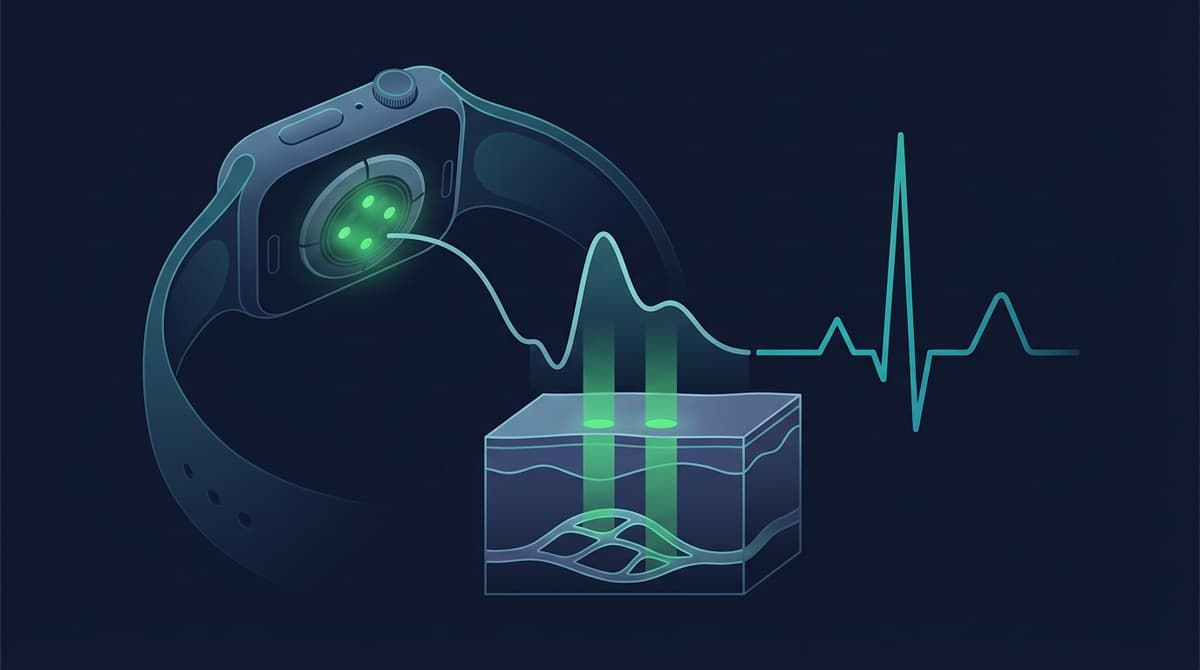
The Apple Watch heart rate sensor is generally accurate within 1 to 3 bpm at rest compared to medical-grade ECG, making it one of the most validated consumer wearables on the market. During vigorous exercise, accuracy drops to within 5 to 10 bpm of true heart rate, depending on activity type and wrist motion. These numbers come from peer-reviewed studies, not Apple's own marketing claims.
This article breaks down what published research says about Apple Watch heart rate accuracy across conditions, generations, skin tones, and clinical applications, with links to the original papers so you can evaluate the evidence yourself.
How Does the Apple Watch Measure Heart Rate?
The Apple Watch uses photoplethysmography (PPG), an optical sensing method that shines green LED light into the skin and measures how much light is absorbed by blood flowing through the capillaries. Because blood absorbs green light more than surrounding tissue, the sensor detects volumetric changes in blood flow with each heartbeat. The inter-beat intervals are then processed by Apple's proprietary algorithms running on the device's system-on-chip to produce a continuous heart rate reading.
Apple's PPG implementation has evolved substantially across generations. The original Apple Watch (Series 0) used 4 green LEDs and 4 photodetectors. By Series 4, Apple added an electrical heart rate sensor (ECG) alongside the optical sensor. The Series 6 introduced a blood oxygen sensor using red and infrared LEDs. The current Series 9 and Ultra 2 feature an 18-LED array with green, red, infrared, and near-UV channels, paired with 6 photodetectors and a dedicated machine learning coprocessor on the S9 chip.
This hardware progression matters for accuracy. More LEDs and photodetectors allow better spatial averaging across the wrist, reducing the impact of sensor-skin contact variability. For a deeper look at how PPG sensors work and how accuracy is measured, see our guide to PPG heart rate accuracy.
How Accurate Is the Apple Watch Heart Rate at Rest?
Resting heart rate is where the Apple Watch performs best, and the published evidence is consistent across multiple independent studies.
Shcherbina et al. (2017) conducted one of the most widely cited wearable validation studies, published in the Journal of Personalized Medicine. The study tested the Apple Watch alongside six other wrist-worn devices in 60 participants performing a range of activities. At rest, the Apple Watch showed a median error rate of approximately 2% for heart rate, which corresponds to roughly 1 to 2 bpm at typical resting rates of 60 to 80 bpm (DOI: 10.3390/jpm7020028).
A larger-scale evaluation by Bent et al. (2020) in npj Digital Medicine compared heart rate measurements from multiple consumer devices against a clinical-grade ECG reference in 53 participants. The Apple Watch showed a mean absolute error (MAE) of 1.8 bpm at rest, with 95% limits of agreement within plus or minus 5.2 bpm on Bland-Altman analysis (DOI: 10.1038/s41746-020-0226-6).
Several subsequent studies have confirmed resting MAE below 3 bpm across Series 4 through Series 9 hardware. This level of accuracy is clinically meaningful for tracking resting heart rate trends over time, which can signal changes in cardiovascular fitness, stress, and overall health status. For context on how this compares to other wearables, our Garmin vs. Apple Watch validation comparison covers the competitive data.
Apple Watch Heart Rate Accuracy During Exercise
Exercise is where every wrist-based PPG device faces its hardest test. Wrist motion generates mechanical artifacts in the PPG signal at frequencies that overlap with the cardiac signal, especially during walking and running. The arm swing cadence during running (around 2.5 to 3.5 Hz) directly interferes with heart rates in the 150 to 210 bpm range.
Walking and Light Activity
During walking and low-intensity exercise, the Apple Watch maintains good accuracy. Shcherbina et al. (2017) reported heart rate error rates of 3 to 5% during treadmill walking, translating to roughly 3 to 5 bpm at moderate heart rates. The predictable, rhythmic motion of walking is relatively easy for motion-compensation algorithms to handle.
Moderate-Intensity Exercise
At moderate intensities (cycling, jogging at conversational pace, elliptical), published MAE values range from 3 to 7 bpm. Falter et al. (2019) evaluated the Apple Watch Series 4 during cycling in 62 healthy adults and found MAE of 3.9 bpm at moderate intensity, with accuracy degrading as workload increased. The study noted that cycling produces less wrist motion artifact than running, which is why wrist PPG devices tend to perform better on the bike.
High-Intensity and Interval Training
This is where accuracy drops most. Pasadyn et al. (2022) in npj Digital Medicine tested the Apple Watch Series 6 during high-intensity cycling and reported a mean absolute percentage error (MAPE) of 3.5%. While that sounds reasonable, individual readings could deviate by 10 bpm or more during rapid heart rate transitions.
The lag effect is a consistent finding across studies: during intervals, the Apple Watch takes 5 to 15 seconds longer than an ECG or chest strap to register sharp heart rate increases at the start of a sprint, and similarly delays in registering the drop during recovery periods. This lag results from the PPG algorithm's smoothing window, which trades responsiveness for noise rejection.
For athletes relying on precise heart rate zone training during HIIT sessions, a chest strap remains meaningfully more accurate than any wrist-based optical sensor, including the Apple Watch. Our article on PPG during exercise and recovery covers the physiological reasons for this in detail.
Strength Training and Non-Rhythmic Exercise
Resistance training presents unique challenges for wrist PPG. Gripping barbells and dumbbells compresses the blood vessels in the wrist, distorting the PPG signal. Isometric muscle contractions raise blood pressure acutely, which changes the PPG waveform morphology. Jo et al. (2019) found that the Apple Watch Series 3 had MAE of 7 to 10 bpm during resistance exercises, with the worst performance during exercises involving tight grip (deadlifts, pull-ups, farmer's carries).
Does Skin Tone Affect Apple Watch Heart Rate Accuracy?
This is an important question, and the research paints a mixed picture. PPG sensors work by shining light into the skin and measuring reflected light. Higher melanin concentrations absorb more of the green light that most PPG sensors use, which reduces the signal-to-noise ratio of the cardiac pulse component.
Bent et al. (2020) specifically examined accuracy across skin tones and found that devices including the Apple Watch showed higher heart rate error in participants with darker skin. The difference was statistically significant, with MAE approximately 1.5 to 3 bpm higher in the darkest Fitzpatrick skin type categories (V and VI) compared to the lightest categories (I and II).
Colvonen et al. (2020) reported similar findings in a sleep study context. Apple has addressed this partly through hardware improvements, as the multi-wavelength approach in newer Series models (using infrared and red LEDs alongside green) can improve signal quality in higher-melanin skin. However, no published study has fully demonstrated that the accuracy gap has been eliminated.
This is an active area of research and product development. For a comprehensive review of how skin tone affects PPG measurements across devices, see our analysis of PPG skin tone bias and accuracy.
Apple Watch ECG vs. Optical Heart Rate: What Is the Difference?
Since Series 4, the Apple Watch includes an electrical heart rate sensor (single-lead ECG) alongside the optical PPG sensor. The optical PPG sensor runs continuously in the background, providing the heart rate data in your Health app. The electrical ECG sensor requires touching the Digital Crown with a finger from the opposite hand and records a 30-second Lead I ECG tracing.
For pure heart rate measurement, the ECG is inherently more accurate because it directly measures the heart's electrical activity. But it requires active user participation and only captures a snapshot, so it cannot replace continuous PPG monitoring.
How Accurate Is Apple Watch for Arrhythmia Detection?
The Apple Heart Study, published by Perez et al. (2019) in the New England Journal of Medicine, enrolled 419,297 participants and evaluated the Apple Watch's ability to detect irregular pulse rhythms suggestive of atrial fibrillation (AFib). Of participants who received an irregular pulse notification, 34% were confirmed to have AFib on subsequent ambulatory ECG monitoring (DOI: 10.1056/NEJMoa1901183).
The positive predictive value of the notification was 84% among the subset who wore a follow-up ECG patch. This is a screening tool, not a diagnostic one. The study demonstrated that PPG-based irregular rhythm detection can identify individuals who warrant further clinical evaluation, but it does not replace a formal diagnostic workup.
The on-device ECG app (not the PPG-based notification) has been separately validated. Seshadri et al. (2020) reported sensitivity of 98.3% and specificity of 99.6% for detecting AFib from the Apple Watch ECG in a controlled clinical setting. The FDA cleared the Apple Watch ECG app as a De Novo Class II medical device for AFib detection, making it the first consumer wearable to receive this classification.
For users with known or suspected arrhythmias, the Apple Watch provides a useful screening layer. It should not replace medical monitoring for patients with diagnosed cardiac conditions. Our overview of PPG-based arrhythmia classification explains the machine learning approaches behind these detection algorithms.
How Has Apple Watch Heart Rate Accuracy Changed Across Generations?
Apple has not published generation-over-generation accuracy comparisons, but independent testing reveals a clear improvement trajectory. The early models (Series 0 to 3) used fewer LEDs and simpler algorithms, with resting MAE of 2 to 4 bpm and exercise MAE of 7 to 15 bpm. The biggest jump came with Series 4 and 5, which added the electrical heart rate sensor and a more capable chip, bringing resting MAE down to 1.5 to 3 bpm.
Series 6 and 7 added red and infrared channels for blood oxygen sensing, but heart rate improvements were incremental. The current Series 9 and Ultra 2 feature an 18-LED array and a dedicated machine learning coprocessor on the S9 chip. Early independent testing suggests resting MAE below 2 bpm and exercise MAE of 4 to 8 bpm for sustained aerobic activity.
The pattern is consistent: hardware improvements yield diminishing returns as the technology matures. Current sensors are approaching the physical limits of wrist-based optical sensing. For perspective on how PPG and HRV measurements differ across platforms, see our HRV wearable guide.
What Factors Most Affect Apple Watch Heart Rate Accuracy?
Several factors influence how accurate your readings will be:
Fit and positioning. A loose band is the most common cause of inaccurate readings. The sensor needs consistent skin contact without restricting blood flow.
Motion and activity type. Activities with high wrist acceleration (running, boxing, rowing) degrade accuracy more than low-wrist-motion activities (cycling, walking).
Tattoos. Solid dark tattoos covering the sensor area can interfere with the optical signal. Apple has acknowledged this limitation.
Temperature. Cold causes peripheral vasoconstriction, reducing blood flow to the wrist and weakening the PPG signal.
Skin tone. As discussed above, higher melanin levels reduce signal-to-noise ratio. Multi-wavelength approaches in recent models partially mitigate this.
Frequently Asked Questions
Is the Apple Watch heart rate accurate enough for medical use?
No. The Apple Watch is a consumer wellness device, not a medical heart rate monitor. While its accuracy is impressive for a consumer product, with resting MAE of 1 to 3 bpm, it has not been validated or cleared for clinical heart rate monitoring. The ECG app is FDA-cleared specifically for AFib classification, but the optical heart rate function is a wellness feature. Clinical decisions should not be based on Apple Watch heart rate data alone.
How does Apple Watch heart rate accuracy compare to a chest strap?
Chest strap heart rate monitors (like the Polar H10 or Garmin HRM-Pro) use electrical impedance to detect heartbeats and are consistently more accurate than any wrist-based optical sensor. Chest straps typically show MAE below 1 bpm across all conditions, including high-intensity exercise. The Apple Watch closes the gap at rest but falls behind during vigorous activity.
Why does my Apple Watch sometimes show a wrong heart rate during workouts?
The most common causes are a loose band allowing sensor movement, high wrist motion during the activity, a wet or sweaty wrist surface disrupting optical contact, or a very rapid heart rate transition that the smoothing algorithm has not yet captured. Tightening the band slightly and ensuring the sensor sits flat against the skin can improve readings.
Can the Apple Watch detect heart attacks?
No. The Apple Watch cannot detect heart attacks (myocardial infarction). Heart attacks are caused by blocked coronary arteries and do not always produce detectable heart rate changes or rhythm abnormalities. The ECG app detects atrial fibrillation, which is a rhythm disorder, not a sign of acute coronary blockage. Apple explicitly states this limitation in its documentation.
Is the Apple Watch heart rate more accurate than Fitbit or Garmin?
In published head-to-head comparisons, the Apple Watch generally performs comparably to or slightly better than Fitbit and Garmin at rest and during moderate exercise. The differences are typically 1 to 2 bpm, which is within the measurement uncertainty of the studies themselves. At high intensity, all wrist-worn devices degrade similarly. The Apple Watch's advantage is more apparent in its arrhythmia detection capability, which is FDA-cleared, rather than in raw heart rate accuracy.
Does the Apple Watch measure heart rate variability accurately?
The Apple Watch calculates HRV (specifically SDNN over a fixed time window) from PPG-derived inter-beat intervals. At rest, wrist PPG HRV correlates moderately well with ECG-derived HRV (correlation coefficients of 0.7 to 0.85 in published studies), but absolute values may differ. HRV trend tracking over weeks and months is more reliable from wrist PPG than any single-session absolute measurement.
How often does the Apple Watch measure heart rate?
During a workout, the Apple Watch attempts continuous heart rate measurement, sampling approximately every 5 seconds. In normal daily wear, it measures heart rate periodically in the background, roughly every few minutes. During sleep, measurement frequency increases to support sleep stage classification. The exact sampling strategy varies by watchOS version and is managed dynamically to balance accuracy against battery life.
The Bottom Line
The Apple Watch is among the most accurate consumer wrist-worn heart rate monitors available, supported by more published validation data than nearly any competing device. At rest, you can expect accuracy within 1 to 3 bpm of a medical ECG. During moderate exercise, errors of 3 to 7 bpm are typical. During high-intensity or high-motion activities, errors of 5 to 15 bpm are possible.
For general health monitoring, fitness tracking, and resting heart rate trends, the Apple Watch provides reliable data. For precision heart rate zone training during intense workouts, a chest strap remains the better tool. For arrhythmia screening, the Apple Watch ECG is a genuinely useful clinical innovation with strong evidence behind it.
The accuracy story is not just about hardware. Apple's continued software updates and algorithm refinements mean that the same physical sensor can get better over time. But the fundamental limits of wrist-based optical sensing, including motion artifacts, skin tone effects, and the physics of green light absorption, mean that perfect accuracy from the wrist remains out of reach.