rPPG Neonatal Infant Monitoring
Preterm infants in the neonatal intensive care unit face a paradox: they need the most intensive monitoring of any patient population, but their skin ...
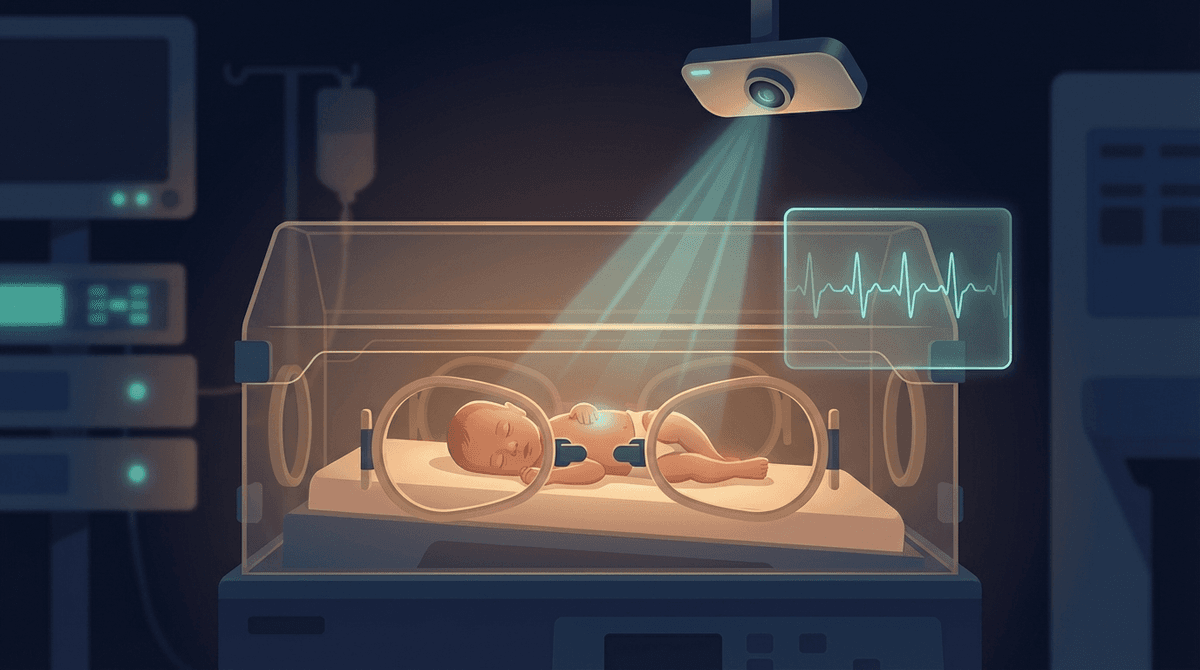
Preterm infants in the neonatal intensive care unit face a paradox: they need the most intensive monitoring of any patient population, but their skin is so fragile that the adhesive electrodes and pulse oximeter probes used for that monitoring cause harm. Adhesive sensor removal can strip epidermis from a 24-week premature infant. Tape residue causes skin breakdown. Even the pressure of a probe against thin, underdeveloped skin can cause bruising or pressure injury.
Contactless monitoring is not just convenient for neonates — it's genuinely protective. Camera-based rPPG for neonatal monitoring is one of the most compelling clinical use cases in the field, driven by a clear unmet need that conventional contact sensors cannot solve.
Why Neonatal Skin Is a Special Case
The skin of a full-term newborn is already substantially thinner and more fragile than adult skin. A preterm infant at 24-28 weeks gestational age has skin that is even more underdeveloped — the stratum corneum (the protective outer layer) is incomplete or absent. This means:
- Adhesive sensors cause skin injury on application and removal
- Pressure from probes creates marks and potential ischemic injury
- The skin barrier against infection is compromised by any breach
- Routine care procedures (electrode replacement, positioning) are painful and stressful
In contrast, rPPG requires only that light reach the infant's face or torso from a camera positioned overhead or to the side of the incubator. No contact. No adhesives. No scheduled replacements.
Physiological Challenges in Neonatal rPPG
Neonates present specific physiological characteristics that make rPPG both easier and harder than adult face-based measurement:
Higher heart rates: Neonatal resting heart rate ranges from 100 to 160 bpm (1.67 to 2.67 Hz), higher than adults. This is actually favorable for frequency-domain rPPG analysis because it places the signal further from typical motion artifact frequencies.
Faster respiratory rates: Neonatal respiratory rates of 40-60 breaths/minute also fall at higher frequencies than adults, potentially enabling simultaneous heart rate and respiratory rate extraction.
Thinner skin with superficial vasculature: The thin epidermis and dermis of neonates means superficial vessels are closer to the skin surface, increasing the rPPG signal amplitude relative to adult skin. Several studies have found higher SNR in neonatal rPPG than adult rPPG under similar conditions.
Motion and movement: Neonates exhibit irregular movement patterns including startle responses, limb cycling, and active and quiet sleep states with different movement characteristics. Motion artifact management requires neonatal-specific movement detection.
Incubator environment: Preterm infants are maintained in enclosed incubators with specific temperature and humidity control. Cameras must be positioned outside or mounted to the incubator, affecting image geometry and potentially introducing condensation or reflections in the camera path.
Published Accuracy in Neonatal Studies
The research base for neonatal rPPG, while smaller than adult rPPG, shows genuinely promising results.
Barbero et al. (2023, DOI: 10.1038/s41598-023-32259-5) compared camera-based rPPG heart rate with clinical-grade contact SpO2 monitoring in 25 preterm infants (gestational age 29-36 weeks). They reported mean absolute error of 2.8 bpm and 97% alarm concordance for bradycardia episodes — a clinically meaningful outcome given that bradycardia detection is a primary monitoring goal in the NICU.
Blanik et al. (2016, DOI: 10.1117/1.JBO.21.11.117002) used multispectral camera imaging in a NICU setting, achieving heart rate monitoring accuracy of 3.1 bpm RMSE in stable preterm infants. This early work established that the NICU environment, despite its challenges, doesn't fundamentally prevent rPPG measurement.
Kwon et al. (2012, DOI: 10.1016/j.neunet.2012.02.005) focused on respiratory rate estimation from camera-based monitoring, achieving correlation of r=0.91 with contact reference. This validated that thoracic movement-based respiratory rate can be extracted simultaneously with cardiac signals.
Respiratory Rate and Apnea Detection
Apnea of prematurity (AOP) — episodes where the infant stops breathing — is a critical monitoring target in the NICU. Current gold-standard detection uses thoracic impedance monitoring (electrical) or end-tidal CO2. Both require contact sensors.
Camera-based respiratory rate estimation from chest wall movement offers a contactless alternative. The approach is distinct from cardiac rPPG: it uses optical flow or structured light to detect the periodic expansion and contraction of the thorax with each breath.
Several groups have demonstrated apnea detection sensitivity above 90% in controlled NICU conditions. The challenge is distinguishing apnea (no chest movement, heart rate may initially continue) from bradycardia with continued breathing — the two often co-occur in preterm infants, and accurate simultaneous heart rate and respiratory monitoring is needed to distinguish them.
Challenges Still to Solve
Despite promising accuracy data, several practical challenges limit current deployment:
Prone positioning: Many preterm infants are nursed prone (on their stomach). This puts the face against the mattress and the back toward the camera. Neonatal rPPG systems must work from chest or back skin, where signal characteristics differ from facial rPPG.
Thermal control and phototherapy: Preterm infants sometimes receive phototherapy (blue light treatment for jaundice) that saturates camera sensors in the relevant wavelength bands. Phototherapy must either be paused for rPPG measurements or NIR wavelengths used that are outside the phototherapy lamp spectrum.
Clinical alarm integration: For rPPG to function as a monitoring modality rather than a research tool, it must integrate with clinical alarm systems, support alarm thresholds, and produce FDA-cleared or CE-marked output. No commercial neonatal rPPG system has yet achieved broad regulatory clearance for standalone clinical monitoring.
False alarm burden: NICU staff already face substantial alarm fatigue from contact monitoring systems. Any new monitoring modality that adds false alarms without reducing contact sensor burden is unlikely to be adopted. Clinical deployment requires demonstrating not just equivalent accuracy but reduced false alarm rates.
The Regulatory Pathway
For neonatal camera monitoring to reach clinical deployment, it must navigate:
FDA 510(k) clearance: A predicate device approach could use existing neonatal pulse oximeters as the substantial equivalence predicate. The FDA has increasingly engaged with software-as-medical-device (SaMD) frameworks that could accommodate rPPG algorithms.
ISO 80601-2-61: This standard governs pulse oximeter accuracy requirements. An rPPG system claiming to monitor oxygen saturation would need to meet similar statistical accuracy standards.
IEC 60601 electrical safety: Even contactless systems that interface with electronic incubators must meet patient electrical safety standards for hospital environments.
Several academic medical centers are actively pursuing IDE (Investigational Device Exemption) studies for neonatal camera monitoring systems, which represents the current regulatory pathway toward clearance.
What Nurses and Parents Notice
Beyond the technical metrics, there are qualitative dimensions to neonatal rPPG that matter:
Parents of NICU infants consistently report distress when watching their baby's skin being irritated by sensors. Removing that source of visible harm — even if clinical outcomes aren't directly affected — has psychological value that's difficult to quantify but real.
NICU nurses, for their part, spend significant time on sensor maintenance: repositioning probes that have slipped, replacing adhesive electrodes that have lost contact, troubleshooting artifact-driven alarms. A reliable contactless monitoring system reduces this cognitive and physical workload.
The clinical case for neonatal rPPG isn't purely about accuracy equivalence. It's about a harm reduction opportunity that accuracy-equivalent contact monitoring cannot provide.
- PPG Neonatal Monitoring — contact PPG in NICU context
- PPG Pediatric Critical Care — broader pediatric monitoring overview
- rPPG vs Contact PPG Accuracy — head-to-head accuracy comparison
- Contactless Vital Signs Detection — general contactless monitoring overview
- PPG Skin Tone Bias Accuracy — accuracy across different patient characteristics
Frequently Asked Questions
Why are contact sensors harmful to premature infants? Preterm infants have extremely fragile, underdeveloped skin. Adhesive sensors can strip the epidermis on removal, cause skin breakdown, and create infection entry points. Even probe pressure can cause bruising. Contactless monitoring eliminates these injury mechanisms.
How accurate is camera-based heart rate monitoring for neonates? Published studies report mean absolute errors of 2.8-4.0 bpm for neonatal rPPG in NICU conditions. This is somewhat higher than for adult subjects but clinically meaningful for trending and alarm generation. Accuracy varies significantly with motion level and lighting.
Can rPPG detect apnea in premature infants? Camera-based respiratory monitoring can detect apnea via thoracic movement analysis. Published studies show sensitivity above 90% for apnea episodes in controlled NICU conditions. Full clinical deployment requires FDA clearance and alarm integration.
Is neonatal rPPG monitoring FDA approved? No commercial neonatal rPPG monitoring system has received broad FDA clearance for standalone clinical use as of 2026. Several devices are in clinical studies under IDE status, and regulatory clearance is an active goal of multiple research groups.
Does phototherapy interfere with neonatal rPPG? Yes. Blue-spectrum phototherapy for jaundice can saturate camera sensors in the wavelength bands used for rPPG. NIR-based approaches or pausing phototherapy during measurements are current workarounds.
What camera setup is used for NICU rPPG monitoring? Most research setups use cameras mounted overhead or to the side of the incubator, at distances of 0.3-1.0 meters. Some use NIR cameras with controlled NIR illumination (invisible to the infant) to ensure measurement under any ambient lighting condition. Full incubator integration with weatherproof camera mounting is an engineering goal.
Frequently Asked Questions
- Why are contact sensors harmful to premature infants?
- Preterm infants have extremely fragile, underdeveloped skin. Adhesive sensors can strip the epidermis on removal, cause skin breakdown, and create infection entry points. Even probe pressure can cause bruising. Contactless monitoring eliminates these injury mechanisms.
- How accurate is camera-based heart rate monitoring for neonates?
- Published studies report mean absolute errors of 2.8-4.0 bpm for neonatal rPPG in NICU conditions. This is clinically meaningful for trending and alarm generation, though somewhat higher error than adult subjects.
- Is neonatal rPPG monitoring FDA approved?
- No commercial neonatal rPPG monitoring system has received broad FDA clearance for standalone clinical use as of 2026. Several devices are in clinical studies under IDE status.
- Can rPPG detect apnea in premature infants?
- Camera-based respiratory monitoring can detect apnea via thoracic movement analysis. Published studies show sensitivity above 90% for apnea episodes in controlled NICU conditions. Clinical deployment requires FDA clearance and alarm system integration.