PPG Nocturnal Hypoxemia Monitoring: How Wearables Track Overnight Oxygen Drops
PPG nocturnal hypoxemia monitoring helps track overnight oxygen drops, screening risk, data quality limits, and when wearables should lead to formal testing.
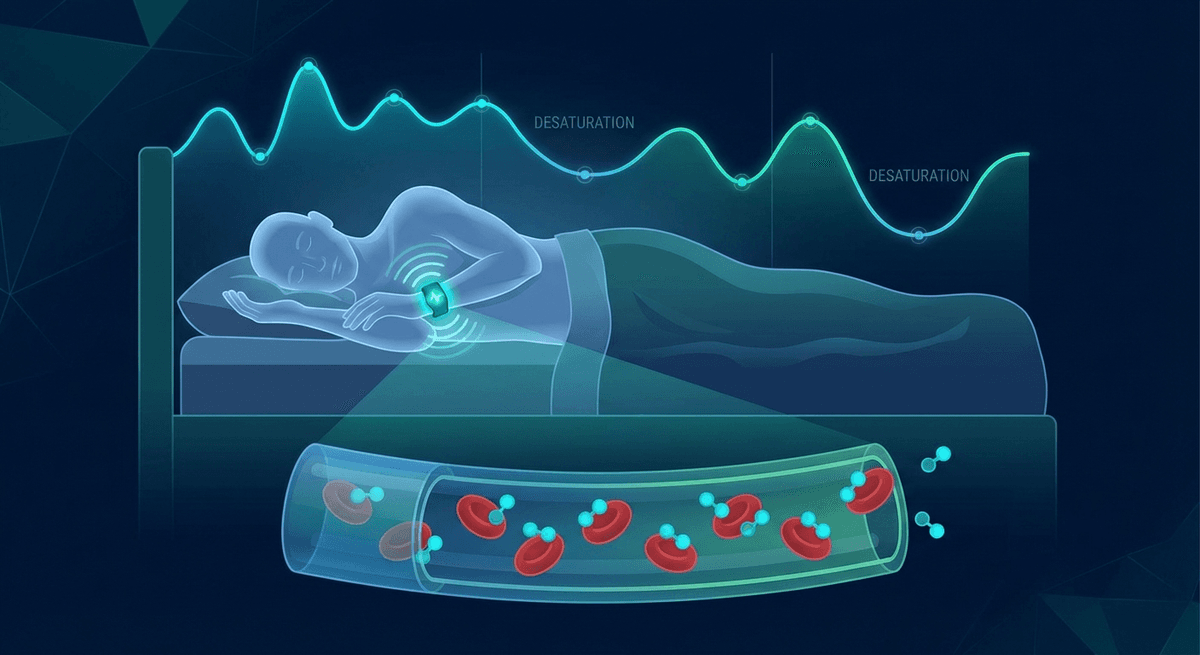
PPG nocturnal hypoxemia monitoring uses optical pulse sensing to estimate oxygen saturation throughout sleep and highlight repeated overnight oxygen drops. In practice, it is useful as a screening layer for sleep-disordered breathing and chronic lung or cardiac disease, but it is not a standalone diagnosis tool because signal quality, perfusion, and device design all shape the result.
Definition box: Nocturnal hypoxemia means abnormally low blood oxygen saturation during sleep, usually discussed as repeated dips in SpO2 or prolonged time spent below a threshold such as 90%.
If you are trying to understand whether a wearable can reliably track overnight oxygen, the short answer is yes, within limits. Modern dual-wavelength PPG systems can detect broad patterns of nocturnal desaturation, but they are much better at spotting trends and burden than at replacing a formal sleep study.
What is PPG nocturnal hypoxemia monitoring?
Photoplethysmography measures how light absorption changes with each cardiac pulse. In pulse oximetry mode, the sensor typically uses red and infrared wavelengths. Because oxyhemoglobin and deoxyhemoglobin absorb those wavelengths differently, the device can estimate arterial oxygen saturation from the pulsatile component of the signal.
At night, that matters because oxygen physiology changes. Ventilation is lower during sleep than wakefulness. Upper-airway collapse can cause repeated pauses in breathing. Chronic lung disease can produce sustained lower oxygen levels. Heart failure can change ventilation and circulation patterns. A wearable does not diagnose the cause, but it can detect the pattern.
Compared with daytime spot checks, overnight monitoring reveals things a single clinic reading may miss:
- event clusters during REM sleep
- position-dependent desaturation
- prolonged time below 90%
- cyclical desaturation and resaturation patterns
- mismatch between symptoms and daytime oxygen values
How does a wearable estimate overnight oxygen saturation?
The basic workflow is straightforward:
- The PPG sensor emits red and infrared light into tissue.
- A photodetector captures the returning signal.
- The algorithm separates pulsatile arterial changes from the static tissue background.
- A ratio-of-ratios method estimates SpO2 from wavelength-specific pulse amplitudes.
- The software smooths, rejects noisy windows, and summarizes overnight trends.
This is related to the same AC/DC logic we discuss in PPG AC/DC ratio explained. It also depends heavily on waveform quality, which is why PPG signal quality assessment matters so much in sleep applications.
Why nocturnal hypoxemia matters clinically
Overnight desaturation is more than a device metric. It maps to real physiology and real risk.
Sleep apnea screening
In obstructive sleep apnea, recurrent airway collapse causes intermittent hypoxia and sympathetic surges. A wearable may show repetitive desaturations, pulse variability, and recovery spikes. That pattern does not replace polysomnography, but it can raise suspicion when a patient has snoring, daytime sleepiness, resistant hypertension, or atrial fibrillation.
Chronic lung disease monitoring
Patients with COPD or interstitial lung disease may maintain acceptable oxygen during the day yet desaturate during sleep. That can inform questions about disease burden, need for formal nocturnal oximetry, and whether sleep-disordered breathing is coexisting.
Cardiac disease context
Heart failure, pulmonary hypertension, and arrhythmia risk can all intersect with nocturnal oxygen instability. Intermittent hypoxemia increases sympathetic activation, afterload stress, and electrical instability. That is one reason nocturnal oxygen trends can matter in a broader cardiovascular monitoring strategy.
What metrics should you look at?
A raw SpO2 trace is not enough. The clinically useful interpretation usually depends on summary features.
Mean overnight SpO2
This gives a broad sense of oxygenation, but it can hide short repeated dips.
Nadir SpO2
The lowest value of the night can be helpful, although a single brief artifact can make it misleading.
Time below threshold
Common thresholds are 90% and 88%. Time under threshold is often more informative than a single minimum.
Oxygen desaturation index
ODI counts the number of desaturation events per hour. It is not identical to apnea-hypopnea index, but it is one of the most useful screening summaries in wearable overnight oxygen analysis.
Patterning across sleep stages or time windows
Clusters during early morning hours may point toward REM-related worsening. A steadily low profile may suggest chronic hypoventilation or lung disease rather than event-based apnea.
For related background, see wearable pulse oximeter guide and PPG continuous SpO2 monitoring wearables.
What affects accuracy?
This is where most people get tripped up. Overnight PPG oxygen tracking is not just a sensor problem. It is a whole measurement-chain problem.
Sensor location
Finger sensors usually outperform wrist sensors for SpO2 because the arterial bed is stronger and more conventional for pulse oximetry. Wrist devices trade some signal fidelity for convenience.
Perfusion
Cold extremities, vasoconstriction, low cardiac output, and peripheral vascular disease all weaken the pulsatile signal. Lower perfusion generally means more missing data and less trustworthy saturation estimates.
Motion and pressure
Sleep is quieter than exercise, but it is not motion-free. Wrist flexion, mattress pressure, and micro-adjustments can distort the waveform or compress local blood flow.
Skin tone and algorithm bias
Pulse oximeter bias across skin pigmentation is a real issue. The main concern is occult hypoxemia, where true arterial oxygen is lower than the displayed reading suggests. Any wearable used for screening needs cautious interpretation in this area.
Averaging window
A short averaging time captures brief dips but can increase noise. A long averaging window smooths the signal but may underestimate short desaturation events.
How does wearable monitoring compare with clinical overnight oximetry?
Clinical overnight oximetry has tighter sensor control, more predictable placement, and clearer reporting standards. A consumer wearable wins on convenience and repeat sampling across many nights. That trade-off matters.
A medical overnight oximetry test is better when:
- you need a diagnostic-quality report
- the patient already has cardiopulmonary disease
- oxygen therapy decisions may follow
- the wearable signal is inconsistent
- there is concern for severe desaturation burden
A wearable is helpful when:
- you need trend data over weeks
- symptoms fluctuate night to night
- you want a low-friction screening tool
- you are monitoring response after a clinical diagnosis or intervention
Common use cases
1. Snoring plus daytime fatigue
A wearable showing repeated overnight oxygen drops can support the case for formal sleep evaluation.
2. COPD patient with morning headaches
If nocturnal oxygen trends look low or unstable, that may justify clinical overnight oximetry or sleep testing.
3. Follow-up after therapy change
A patient who started CPAP, changed medications, or had weight loss surgery may use wearable trends as an early directional check, while still relying on clinical follow-up.
4. Remote monitoring programs
In home monitoring, overnight oxygen burden can complement resting heart rate, respiratory rate, and symptom check-ins. That fits the broader logic behind PPG remote patient monitoring role.
What wearable nocturnal hypoxemia monitoring cannot tell you
This is the part that matters most for responsible interpretation.
A wearable cannot reliably tell you:
- whether desaturation is obstructive versus central sleep apnea
- whether the reading artifact came from pressure, motion, or low perfusion
- whether carbon dioxide retention is present
- whether lung disease, heart failure, obesity hypoventilation, or altitude is the main driver
- whether treatment is required without clinical context
That is why symptom review still matters. Snoring, witnessed apneas, nocturnal dyspnea, edema, and daytime somnolence provide the context the sensor lacks.
When should the data trigger medical follow-up?
You should take the result more seriously when there is a repeatable pattern rather than a one-night anomaly.
Reasonable triggers include:
- frequent dips below 90%
- any substantial time below 88%
- repeated clustered desaturation events
- low overnight oxygen plus daytime symptoms
- known lung, neuromuscular, or heart disease
- a mismatch between severe symptoms and a reassuring daytime clinic value
A wearable screen is most helpful when it moves the next step forward. That next step may be a sleep study, overnight oximetry, pulmonary testing, or physician review.
Where this fits in the future of PPG monitoring
Overnight oxygen tracking is likely to become more useful as devices combine SpO2, pulse rate variability, respiration surrogates, and position data. The future is not one number. It is multimodal overnight physiology.
That is also why simple feature engineering still matters. Oxygen burden gains value when read alongside rhythm instability, pulse morphology, and contextual signals from sleep staging.
FAQ
What is PPG nocturnal hypoxemia monitoring?
It is the use of optical pulse signals, usually with red and infrared light, to estimate oxygen saturation during sleep and flag repeated desaturation events.
Can a smartwatch diagnose nocturnal hypoxemia?
No. A smartwatch can screen for overnight oxygen drops, but diagnosis still depends on clinical context and often requires a medical-grade sleep or respiratory study.
What causes overnight oxygen drops besides sleep apnea?
Common causes include COPD, obesity hypoventilation, heart failure, pulmonary disease, altitude exposure, opioid use, and poor signal quality from a wearable sensor.
How accurate is wearable overnight SpO2?
Accuracy is best during stable perfusion and low motion, but it drops with low blood flow, darker skin under some algorithms, loose fit, and short desaturation events.
When should nocturnal desaturation trigger medical follow-up?
Repeated dips below 90%, clusters of events, symptoms such as daytime sleepiness, or cardiopulmonary disease should prompt formal clinical evaluation.
Frequently Asked Questions
- What is PPG nocturnal hypoxemia monitoring?
- It is the use of optical pulse signals, usually with red and infrared light, to estimate oxygen saturation during sleep and flag repeated desaturation events.
- Can a smartwatch diagnose nocturnal hypoxemia?
- No. A smartwatch can screen for overnight oxygen drops, but diagnosis still depends on clinical context and often requires a medical-grade sleep or respiratory study.
- What causes overnight oxygen drops besides sleep apnea?
- Common causes include COPD, obesity hypoventilation, heart failure, pulmonary disease, altitude exposure, opioid use, and poor signal quality from a wearable sensor.
- How accurate is wearable overnight SpO2?
- Accuracy is best during stable perfusion and low motion, but it drops with low blood flow, darker skin under some algorithms, loose fit, and short desaturation events.
- When should nocturnal desaturation trigger medical follow-up?
- Repeated dips below 90%, clusters of events, symptoms such as daytime sleepiness, or cardiopulmonary disease should prompt formal clinical evaluation.