PPG in NICU Monitoring: Emerging Uses Beyond Standard Pulse Oximetry
Learn how PPG in NICU monitoring can support perfusion assessment, respiratory insight, waveform quality checks, and continuous neonatal trend tracking.
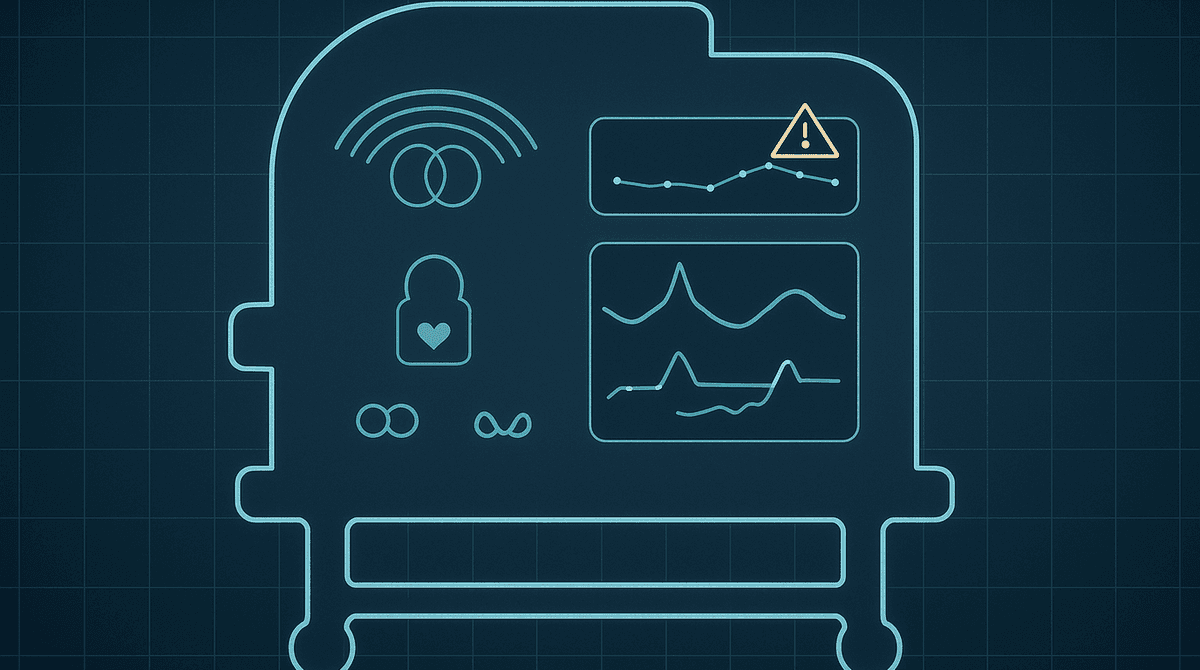
PPG in NICU monitoring can do more than estimate oxygen saturation. In neonatal care, the same optical signal can help clinicians track peripheral perfusion, judge waveform reliability, observe breathing related variation, and follow physiologic trends over time rather than reacting only to isolated alarm values.
Pulse photoplethysmography, or PPG, is already familiar in the NICU because it sits inside routine pulse oximetry. That familiarity can make it easy to think of the signal as a single-purpose stream used to produce SpO2 and pulse rate. In practice, the waveform itself contains more information than the headline number on the monitor.
For neonatal teams, that matters because babies in intensive care often change quickly and sometimes subtly. A saturation value may stay within target while perfusion worsens, respiratory effort shifts, motion artifact increases, or the signal becomes unreliable before the numeric display fully reflects the change. Looking beyond routine SpO2 can make PPG a richer bedside monitoring tool, especially when it is interpreted as a continuous physiologic waveform instead of a simple output.
If you want a foundation on how neonatal PPG works, see our overview of neonatal PPG monitoring. For a clinical framing of oxygen targets and routine monitoring, this neonatal oxygen monitoring guide is a useful companion. For a related non contact angle, our article on rPPG in neonatal and infant monitoring explores where camera based methods may fit.
Why NICU monitoring needs more than a single SpO2 number
Standard pulse oximetry is essential, but it is also a processed estimate. The displayed SpO2 value is built from a pulsatile optical signal, signal quality checks, and device specific algorithms. In the NICU, several factors can interfere with that chain: low perfusion, motion, vasoconstriction, sensor fit, ambient light, skin fragility, and changes in respiratory support. Preterm infants add another layer because their physiology can be labile even when the monitor display looks momentarily stable.
That is why waveform aware monitoring is attractive. Instead of asking only, "What is the oxygen saturation right now?" clinicians can also ask, "How strong is the pulsatile signal? Has pulse amplitude changed over the last hour? Is the waveform clean enough to trust? Is breathing modulating the signal in a way that matches the clinical picture?"
This broader view aligns with how NICU care actually works. Bedside decisions are rarely based on one value in isolation. Teams synthesize vital signs, appearance, perfusion, ventilatory status, trends, and context. PPG becomes more useful when it supports that pattern recognition.
Perfusion assessment from the PPG waveform
One of the most promising uses of NICU PPG beyond routine SpO2 is perfusion tracking. The amplitude and shape of the pulsatile waveform can reflect how much arterial blood volume change is reaching the sensor site. While this is not a direct measure of systemic blood flow, it can serve as a practical bedside signal for peripheral perfusion.
In neonates, peripheral perfusion can change with temperature instability, patent ductus related hemodynamics, sepsis, vasoactive medication use, or simply a shift in clinical status. A baby may have acceptable saturation while the pulse waveform becomes weak, inconsistent, or harder to detect. That combination can prompt a more careful look at circulation, sensor position, skin temperature, and overall status.
Perfusion index, when available from the monitoring platform, is one way vendors try to summarize this concept numerically. Even without a formal perfusion index display, waveform strength itself can still be informative. Repeated dampening of the pulsatile component, especially when paired with a believable heart rate trace and consistent sensor contact, may suggest worsening peripheral flow or local vasoconstriction.
The important point is not to overstate what PPG can diagnose on its own. A weak waveform does not automatically identify the cause, and sensor related issues are common. Still, as a continuous, low burden physiologic signal, PPG can provide an early bedside cue that the infant deserves reassessment before more overt instability appears.
Waveform quality is not a side issue, it is part of the monitoring value
Waveform quality often gets treated as a technical nuisance. In the NICU, it is better viewed as a monitoring layer in its own right. If the waveform is noisy, clipped, irregular because of motion, or intermittently absent, then the derived SpO2 value may deserve less confidence. That matters because treatment changes based on a poor quality signal can create unnecessary oxygen adjustments, alarm fatigue, and staff workload.
A clean neonatal PPG waveform is not always easy to obtain. Tiny digits, fragile skin, incubator handling, caregiving tasks, and infant movement all affect the signal. Some babies also have intrinsically lower pulse amplitude at the sensor site, making the monitor more vulnerable to artifact. When teams look at waveform quality directly, they can distinguish between a physiologic change and a measurement problem more quickly.
This is where trend aware systems may help. Rather than treating every low saturation alarm as equally meaningful, advanced processing can weigh signal quality, pulse regularity, and recent waveform behavior before escalating concern. Even simple bedside habits help: confirming pulse waveform presence, checking whether displayed heart rate matches the broader clinical picture, and watching whether artifacts appear during handling or repositioning.
For NICU monitoring, waveform quality is not just about better engineering. It supports better clinical trust. A monitor that helps users understand when the signal is reliable can improve response quality and reduce unnecessary intervention.
Respiratory coupling and PPG derived breathing insight
PPG is also shaped by breathing. As the infant inspires and expires, intrathoracic pressure changes and cardiorespiratory interactions can modulate the waveform. This can alter amplitude, baseline, and beat to beat variation. In some settings, signal processing can extract a respiratory related signal from the PPG stream, sometimes described as PPG derived respiration.
Why is this interesting in the NICU? Because respiratory instability is common, and clinicians already care about how breathing effort, apnea, support level, and thoracoabdominal mechanics change over time. A PPG signal that carries respiratory information could add redundancy or context, especially when conventional respiratory channels are imperfect.
This does not mean PPG replaces dedicated respiratory monitoring. It does mean that the optical waveform may contribute more than pulse rate and saturation alone. For example, changes in respiratory modulation may accompany shifts in work of breathing, airway obstruction, support transitions, or motion related false alarms. When combined with other signals, respiratory coupling in PPG can help build a more coherent picture of what the baby is doing.
In practice, this is most useful as a trend feature, not a standalone diagnostic label. If the respiratory pattern inferred from PPG starts to drift from the rest of the bedside picture, that discrepancy itself can be clinically useful. It may reflect signal degradation, sensor disturbance, or a real physiologic change that deserves closer review.
Continuous trend monitoring is where PPG may add the most value
The strongest case for expanded PPG use in NICU monitoring may be continuity. NICU teams do not just need instantaneous values. They need to know whether a baby is getting better, staying stable, or slowly drifting in the wrong direction over minutes and hours.
PPG is well suited for this because it is continuous, noninvasive, and already part of routine care. Trend analysis can track more than saturation. It can follow pulse amplitude stability, waveform morphology consistency, variability, perfusion related changes, and respiratory modulation over time. A single low quality epoch may not matter much. A gradual decline in waveform robustness across a shift might.
This trend perspective is especially helpful in newborns whose deterioration can be subtle early on. An infant may show small but persistent changes in perfusion or waveform stability before obvious clinical decompensation. Trend aware analytics can support earlier review, better handoff communication, and more thoughtful responses than alarm driven care alone.
Continuous PPG trend monitoring also fits well with data rich NICU environments. Modern units already generate streams of heart rate, saturation, respiratory data, temperature, and support parameters. PPG waveform features can add another layer for integrated monitoring, quality improvement, and possibly predictive modeling, provided validation stays strong and clinical interpretation remains conservative.
Beyond contact sensors, where rPPG may fit
Although contact PPG remains the present standard, there is growing interest in remote photoplethysmography, or rPPG, for infants. Camera based sensing is appealing in neonatal settings because it may reduce skin contact burden and enable observation during periods when adhesive or clip based monitoring is difficult.
That said, rPPG in the NICU is still an emerging method, not a replacement for established bedside devices. Motion sensitivity, lighting conditions, line of sight, incubator reflections, and validation challenges remain important limits. The more realistic near term view is that rPPG may complement traditional monitoring in selected workflows rather than replace it.
Even so, the conceptual link is important. Whether the PPG comes from a standard sensor or a camera derived signal, the lesson is the same: optical pulsatility carries more information than a single oxygen number. That broader signal interpretation is likely to shape future neonatal monitoring design.
Practical limits clinicians and product teams should keep in mind
There is real promise here, but restraint matters. PPG derived perfusion signals can be influenced by local factors at the sensor site. Waveform morphology varies across devices. Motion artifact remains a major confounder. Respiratory extraction methods are sensitive to preprocessing choices. And neonatal physiology differs enough from adult monitoring that methods cannot simply be copied downward and assumed to work.
For clinicians, the safest position is to treat expanded PPG features as adjunctive signals. They can strengthen bedside judgment, improve confidence in trend interpretation, and point toward earlier reassessment. They should not be used in isolation to make high stakes decisions without clinical correlation.
For device makers and digital health teams, the bar is clear. New PPG based NICU features need transparent signal quality handling, neonatal specific validation, sensible visualization, and careful alarm strategy. The goal is not more numbers. The goal is better situational awareness at the bedside.
FAQ
What does PPG measure in NICU monitoring?
PPG measures changes in light absorption caused by pulsatile blood volume changes in tissue. In NICU settings it is most often used to derive pulse rate and oxygen saturation, but the waveform can also support perfusion assessment, signal quality review, and respiratory related analysis.
Is PPG the same thing as pulse oximetry?
Not exactly. Pulse oximetry uses PPG signals, usually at red and infrared wavelengths, to estimate SpO2. PPG is the underlying optical waveform, while pulse oximetry is one application built from that signal.
Can NICU PPG help assess perfusion?
It can help, but it should be interpreted carefully. Waveform amplitude and related indices may reflect peripheral perfusion trends, yet they are also affected by sensor placement, motion, temperature, and local vasoconstriction.
Can PPG detect breathing problems in newborns?
PPG can carry respiratory related modulation, and some systems can derive a breathing signal from it. This is best used as supportive trend information rather than a replacement for dedicated respiratory monitoring.
Why does waveform quality matter so much in the NICU?
Because a poor quality waveform can make SpO2 and pulse displays less trustworthy. Reviewing waveform quality helps clinicians separate true physiologic change from motion artifact or sensor problems.
Could rPPG replace contact sensors in neonatal care?
Not today in routine NICU use. rPPG is promising for low contact observation and future innovation, but current neonatal care still depends on validated contact based monitoring for dependable bedside decision support.
References
Frequently Asked Questions
- What does PPG measure in NICU monitoring?
- PPG measures changes in light absorption caused by pulsatile blood volume changes in tissue. In NICU settings it is most often used to derive pulse rate and oxygen saturation, but the waveform can also support perfusion assessment, signal quality review, and respiratory related analysis.
- Is PPG the same thing as pulse oximetry?
- Not exactly. Pulse oximetry uses PPG signals, usually at red and infrared wavelengths, to estimate SpO2. PPG is the underlying optical waveform, while pulse oximetry is one application built from that signal.
- Can NICU PPG help assess perfusion?
- It can help, but it should be interpreted carefully. Waveform amplitude and related indices may reflect peripheral perfusion trends, yet they are also affected by sensor placement, motion, temperature, and local vasoconstriction.
- Can PPG detect breathing problems in newborns?
- PPG can carry respiratory related modulation, and some systems can derive a breathing signal from it. This is best used as supportive trend information rather than a replacement for dedicated respiratory monitoring.
- Why does waveform quality matter so much in the NICU?
- Because a poor quality waveform can make SpO2 and pulse displays less trustworthy. Reviewing waveform quality helps clinicians separate true physiologic change from motion artifact or sensor problems.
- Could rPPG replace contact sensors in neonatal care?
- Not today in routine NICU use. rPPG is promising for low contact observation and future innovation, but current neonatal care still depends on validated contact based monitoring for dependable bedside decision support.